
Building a Web of Trust: A Social Network Approach to Semantic Intelligence
A Social Network-Based Trust Model for the Semantic Web
This paper introduces a social-network-based trust model for the Semantic Web that calculates trust values using an edge-weighted graph. It uniquely decouples trust into two dimensions—Trust Rating and Reliable Factor—and employs statistical similarity analysis to provide personalized recommendations.
TL;DR
Navigating the Semantic Web requires more than just machine-readable data; it requires a mechanism to decide which agents to trust. This paper presents a decentralized trust model that simulates human social structures. By separating Trust Rating (how good a service is) from Reliable Factor (how honest a recommender is), and using parallel graph algorithms, the authors create a scalable framework for agent-to-agent interaction.
Context & Motivation: Why Centralization Fails
In the vision of the Semantic Web, intelligent agents act on behalf of humans to perform tasks like e-banking or information retrieval. Traditional trust models (like eBay's) rely on a central authority to manage scores. However, the Semantic Web is too vast and diverse for a single referee.
The authors argue that trust is inherently a sociological issue. Borrowing from the "Small World" phenomenon (the idea that any two people are connected by six degrees of separation), the paper proposes that agents should leverage their direct acquaintances and "friends" to infer the trustworthiness of strangers.
Methodology: The Two-Dimensional Trust Framework
1. Decoupling Trust
The core innovation lies in the two-dimensional interpretation of trust:
- Trust Rating (): Evaluation of a provider’s ability to perform a task.
- Reliable Factor (): Evaluation of an acquaintance’s honesty when they give you a recommendation.
This distinction is crucial: you might trust a friend’s character (high ) but know they have terrible taste in movies (low ).
2. The Model Architecture
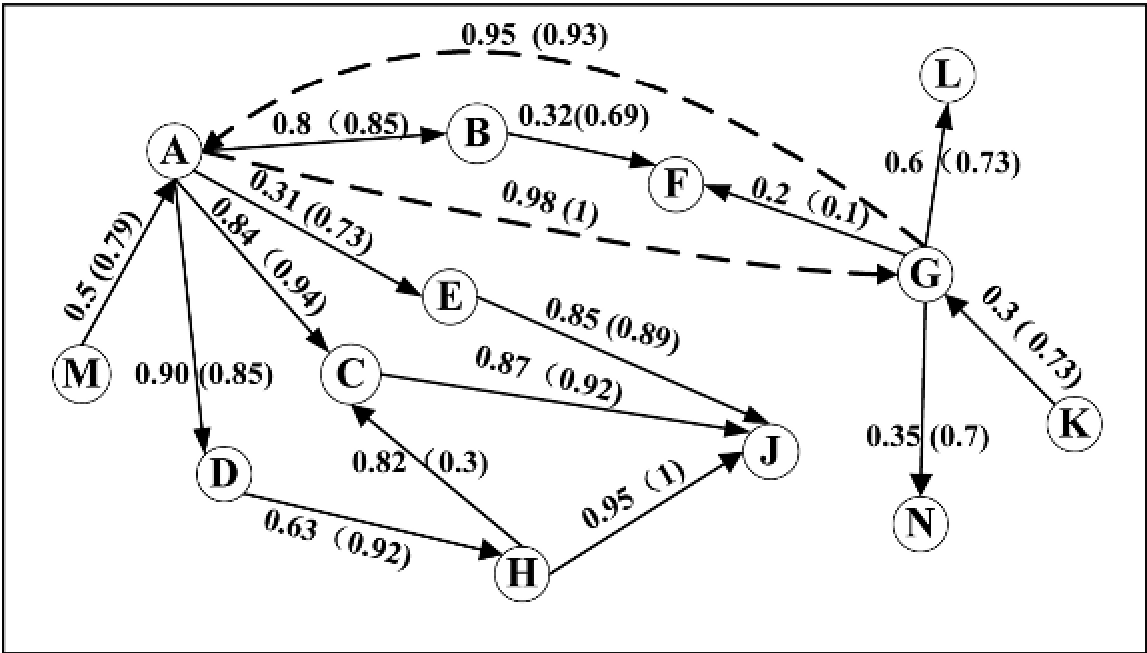
The system treats the Semantic Web as a directed graph . To ensure performance doesn't degrade as the network grows, the authors implemented:
- Honor Rolls & Blacklists: Shortcuts to skip calculations for known good/bad actors.
- Push/Pull Reporting: Efficient data synchronization mechanisms.
3. Parallel Trust Calculation
When Agent wants to evaluate Agent , it doesn't just look at one path. It aggregates all possible paths using a weighted formula:
The Intuition: Trust decays with distance () and is gated by the reliability of the intermediaries. Because the algorithm uses a breadth-first search (BFS), multiple paths are calculated in parallel, making it highly efficient for real-time agent networks.
Analyzing Similarity: "Birds of a Feather"
To further refine trust, the model uses probability and statistics to calculate the Similarity of Preferences. If Agent A and Agent B consistently rate the same providers similarly, their "Reliable Factor" for each other increases.
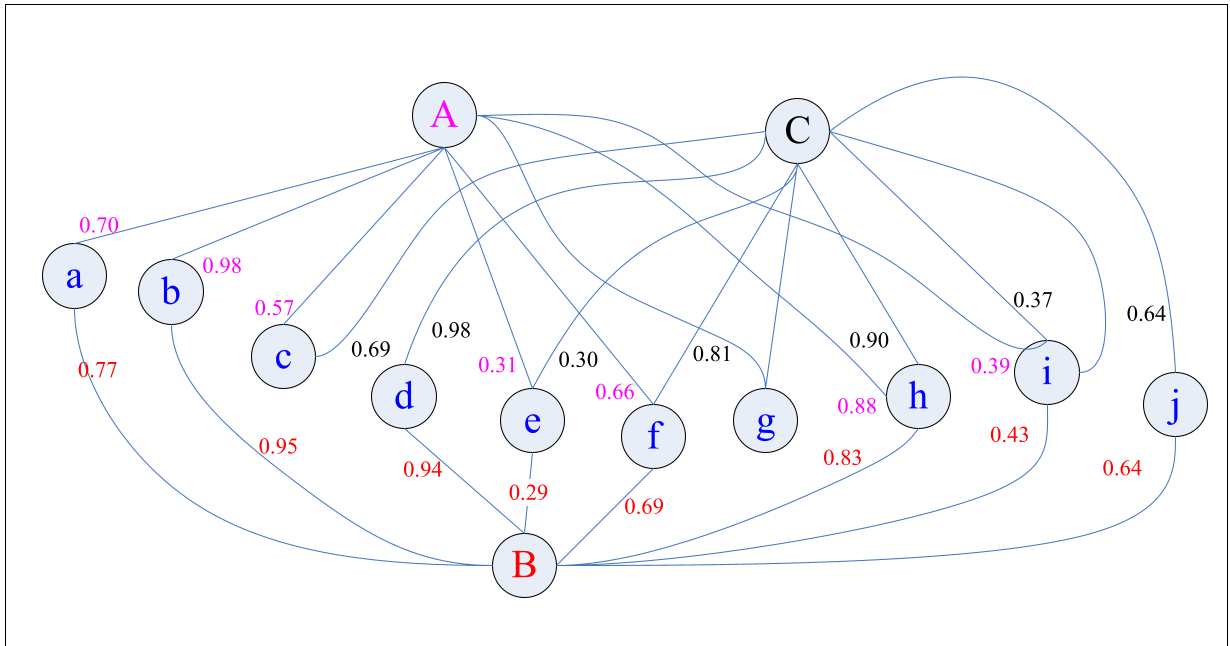
The authors use Mathematical Expectation () and Standard Deviation () of the difference in ratings to determine similarity. A low standard deviation indicates that two agents have stable, aligned viewpoints, making their recommendations highly valuable to each other.
Experimental Insights
The paper demonstrates that by using these statistical thresholds ( and ), agents can identify "friends" who act as shortcuts in the network. This drastically reduces the need to query the entire web, focusing instead on a trusted sub-network with similar preferences.

Critical Analysis & Conclusion
This work provides a robust foundation for automated trust in RDF-based systems. Its strength lies in its parallel nature and the statistical grounding of similarity.
Limitations: Directly addressed by the authors, the model currently lacks a defense against coordinated "Sybil attacks" or strategic liars who might build a high factor only to betray the system later.
Future Outlook: As we move toward decentralized AI agents, the integration of reasoning and learning abilities into this social trust model will be the next frontier. This paper remains a seminal example of how to bridge the gap between human social intuition and machine-calculable logic.