
Beyond Similarity: Leveraging Social Connections to Supercharge Collaborative Filtering
Use of social network information to enhance collaborative filtering performance
This study proposes a hybrid Collaborative Filtering (CF) approach that integrates explicit social network information (friendships) to improve recommendation accuracy. By evaluating diverse neighbor selection strategies on the Cyworld platform, the authors demonstrated that a "Combined" method, which merges traditional nearest neighbors with a user's real-life friends, achieves State-of-the-Art (SOTA) performance in preference prediction.
TL;DR
While most recommender systems treat you as an island of data points, this paper argues that your social graph is the secret sauce for better accuracy. By hybridizing traditional Collaborative Filtering (CF) with explicit friendship data from Cyworld, the researchers reduced prediction error (MAE) by over 10%, proving that "who you know" is often as important as "what you like."
Background: The "Stranger" Problem in CF
Collaborative Filtering is the backbone of modern commerce, from Amazon to Netflix. Its logic is simple: find people who rated items similarly to you and recommend what they liked. However, there is a fundamental psychological blind spot: CF cannot distinguish between a stranger who happens to like the same indie band and your best friend.
Research shows we trust friends more than algorithms. The authors set out to bridge this gap by using explicit social network information to refine the "neighborhood" used in prediction math.
Methodology: Four Ways to Build a Neighborhood
The researchers conducted four distinct experiments to find the optimal balance between mathematical similarity and social trust:
- Traditional CF: The baseline using the Top N neighbors based on Pearson Correlation.
- Pure Social: Using only friends as neighbors (testing the limits of small-circle trust).
- The Combined Hybrid: Merging a user's friends with the top nearest neighbors to ensure a robust yet socially-relevant group.
- The Amplified Hybrid: Keeping traditional neighbors but boosting the "influence weight" of friends based on how many messages they sent to the user.

The Interaction Factor
The authors hypothesized that not all friends are equal. They introduced a "level of interaction" formula: This formula scales the Pearson correlation () based on the ratio of messages friend sent to user compared to the total messages received.
Experimental Results: Why Hybrid Wins
Using data from Cyworld (one of South Korea's pioneer social networks), the study focused on "skin" items (profile decorations).
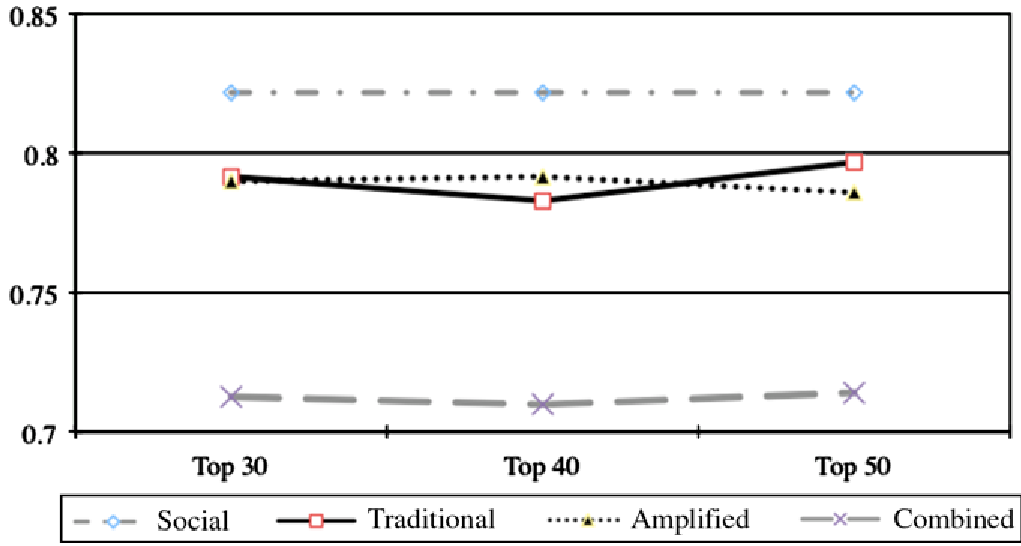
The results revealed a clear hierarchy of performance:
- The Hybrid Goldmine: Experiment 3 (Combined) was the clear winner. By injecting friends into the nearest neighbor set, the MAE dropped significantly across all neighborhood sizes (30, 40, and 50).
- The Sparsity Trap: Interestingly, Experiment 2 (Social Only) performed the worst. Why? Most users only had about 12 friends in the dataset. This "small circle" doesn't provide enough data points to cover all items, highlighting why we still need the "wisdom of strangers."
- The Interaction Surprise: Simply amplifying weights based on message frequency (Experiment 4) didn't help much, suggesting that the existence of a friendship is a stronger signal than the frequency of digital pings.
Critical Insight & Academic Positioning
This paper serves as a bridge between Social Choice Theory and Machine Learning. At its core, it challenges the purely mathematical "Nearest Neighbor" approach by introducing Inductive Bias from social science.
The true value of this work is the realization that social information acts as a high-quality filter for neighbors. While a stranger might have a high correlation with you by chance (coincidental similarity), a friend's similarity is rooted in shared context, making their ratings more reliable for future predictions.
Conclusion & Future Directions
The takeaway for developers is clear: If you have access to a social graph, use it to anchor your CF neighborhoods.
However, the study has limits. It only looked at "Level 1" friends. The next frontier, which modern Graph Neural Networks (GNNs) are now tackling, involves "friends of friends" (Level 2) and the latent community structures that define our tastes before we even click "like."
Key contribution summary:
- Social + Similarity > Either alone.
- Data Sparsity is the enemy of pure social filtering.
- Explicit relationships are the most reliable weights in personalization.