
Socially-Aware Recommendation: Beyond the User-Item Matrix
The Social Network Role in Improving Recommendation Performance of Collaborative Filtering
This paper provides a comprehensive review of integrating Social Network (SN) information into Traditional Collaborative Filtering (TCF). It categorizes social-enhanced recommendation methods into trust-based and friendship-based approaches, demonstrating how auxiliary social data mitigates traditional user-item sparsity issues.
TL;DR
This research explores the evolution of recommender systems from TCF (Traditional Collaborative Filtering) to social-enhanced models. By integrating Trust and Friendship relations from social networks, the authors demonstrate a significant leap in recommendation accuracy and the ability to solve the notorious data sparsity problem.
Context: The Limitations of 2D Recommendation
For years, Collaborative Filtering (CF) has been the gold standard, powering giants like Amazon and Netflix. However, TCF lives in a vacuum—a 2D matrix of User-Item interactions. In the real world, our preferences are rarely isolated; we are influenced by our social circles. TCF fails because it treats a "stranger" with similar taste and a "trusted friend" identical if their rating history overlaps, ignoring the inherent reliability of social ties.
The Social Signal: Trust and Friendship
The paper categorizes the integration of social data into two main pillars:
1. Trust-Based Approaches
Trust is a directed relationship. If User A trusts User B, User B’s ratings should carry more weight in predicting User A’s preferences.
The authors highlight a "Merge" methodology where ratings of an active user's directly trusted neighbors are combined via a weighted average:
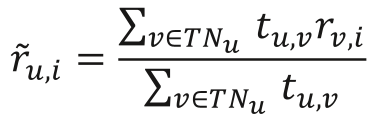
Why it works: Trust functions as a filter for noise. Even if a stranger has a high Pearson Correlation with you, a friend's recommendation is empirically more "recoverable" and trustworthy in sparse scenarios.
2. Friendship and Community-Based Approaches
Friendship is typically viewed as an undirected or mutual interaction. The paper discusses "Community-based CF," which uses social link structures to extract user communities.
Key steps include:
- Community Discovery: Using algorithms like SAC1 or SAC2 to group users based on their friendship graph.
- Intra-group Prediction: Preferring ratings from within the same community, which inherently captures shared cultural or social contexts.
Experimental Evidence
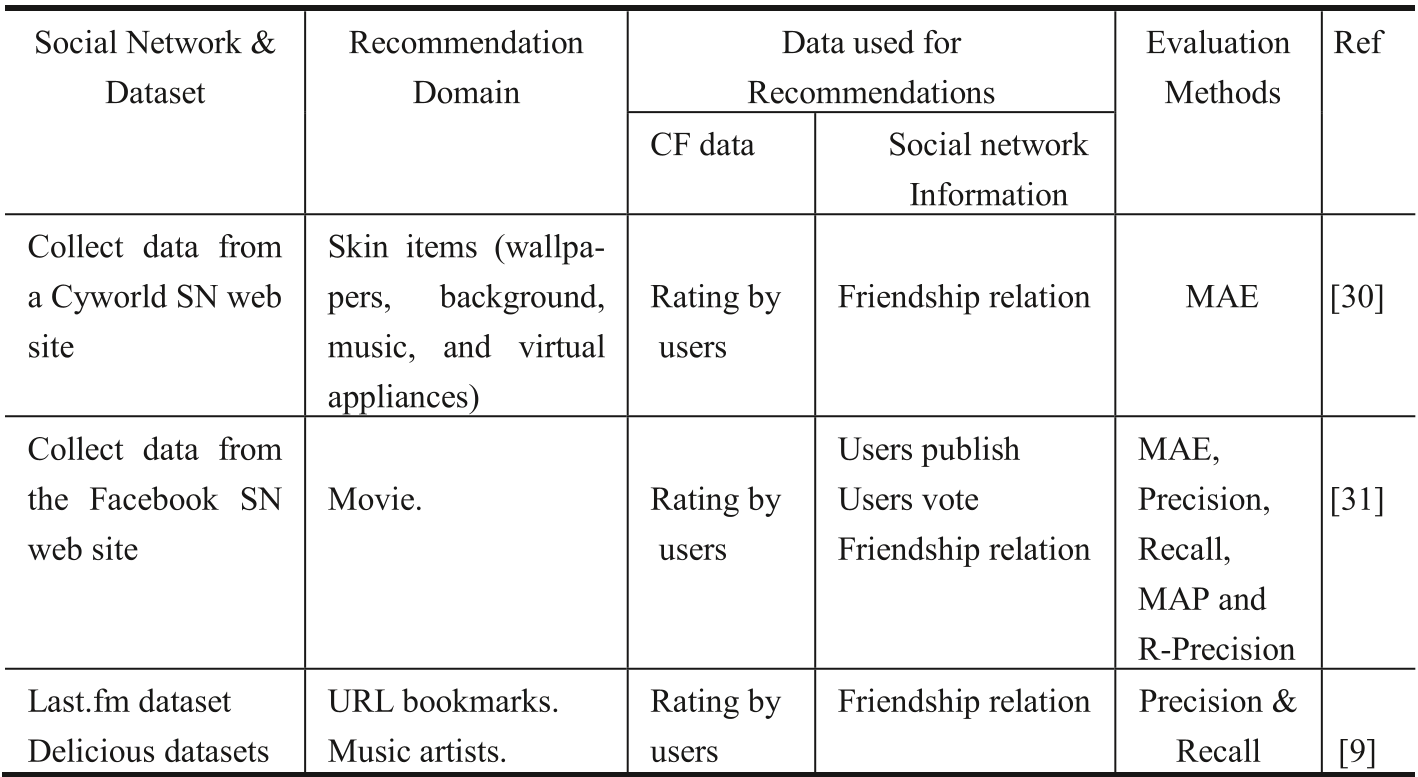
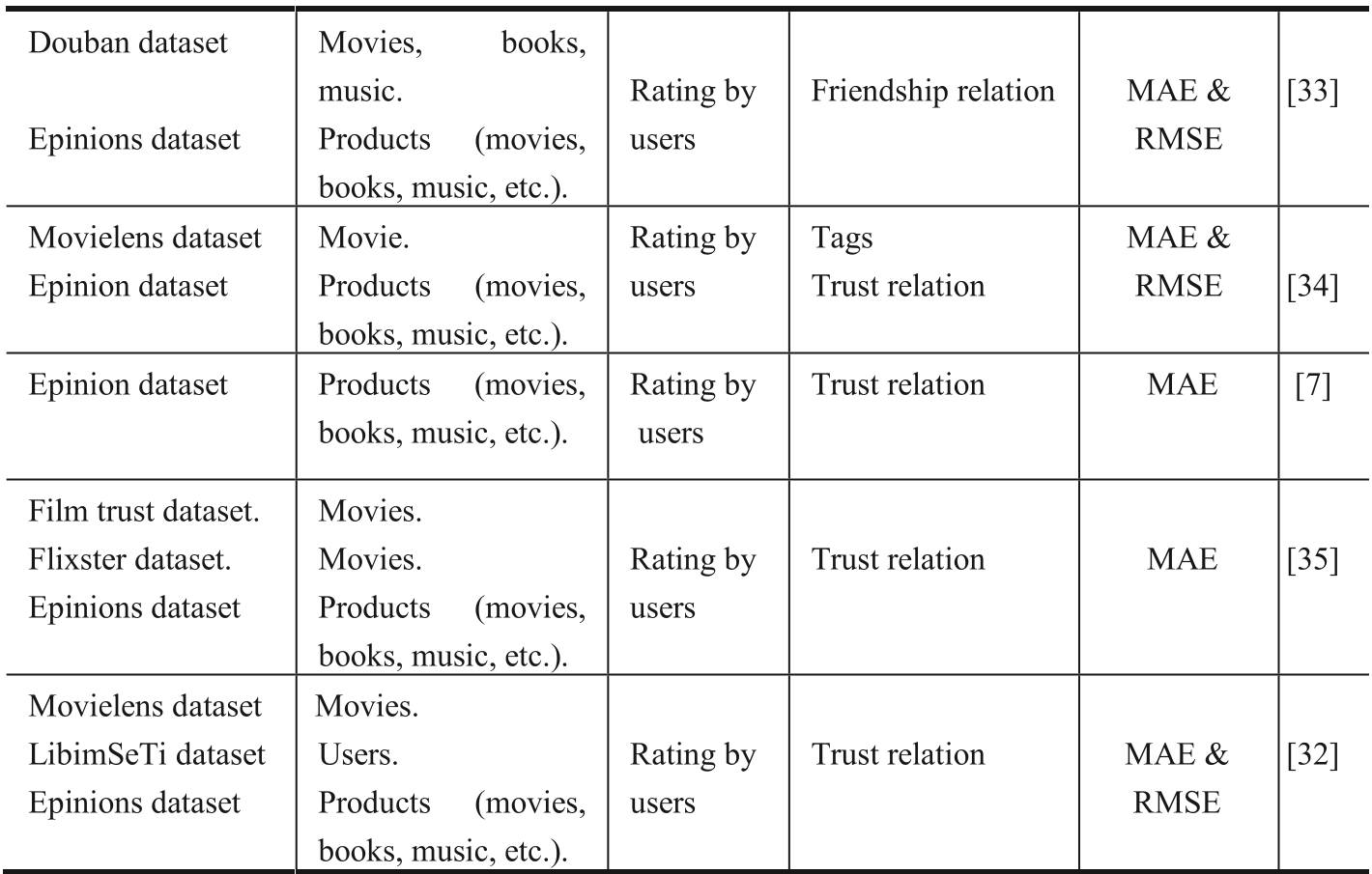
The review synthesizes results across various datasets including Epinions, Douban, and Facebook.
- SOTA Comparison: Models like SNSCF and Social Regularization (SR1, SR2) consistently outperform traditional Matrix Factorization.
- Cold Start Mitigation: Notably, when explicit rating data is unavailable (the cold-start problem), social profile data from platforms like Facebook can serve as a highly effective surrogate, maintaining recommendation performance.
Critical Insight: The "Social" Inductive Bias
The fundamental contribution of this work is the validation of social metadata as a vital Inductive Bias. In machine learning, the right bias helps a model generalize from sparse data. By assuming that "Users connected in a social graph are likely to share latent preferences," the algorithm effectively constrains the search space, leading to faster convergence and higher relevance.
Conclusion & Future Outlook
While this paper provides a robust overview of trust and friendship, the next frontier—which we are already seeing—involves Graph Neural Networks (GNNs). Future systems will likely not just "weight" social ties but "embed" the entire social topology into a latent space, allowing for even more nuanced influence propagation.
Takeaway: In the age of information overload, the social graph is the ultimate filter. If your recommender system isn't "socially aware," it's leaving significant accuracy on the table.