
Collective Intelligence in Web Service Composition: Bridging Human Intuition and SOC
An Approach Based on Social Network and Collective Intelligence for Interactive Composition of Web Services
The paper introduces a novel framework for Interactive Web Service Composition (IWSC) that integrates Collective Intelligence (CI) and Social Network analysis. By leveraging a dynamically constructed ontology from web instructions and social interactions, the system helps users select and compose Web Services through real-time collaboration and recommendation.
TL;DR
This research addresses the "decision fatigue" in Service-Oriented Computing (SOC). By integrating Collective Intelligence (CI) and Social Networks into the composition process, the authors propose a system that doesn't just search for services but understands human goals through a dynamically generated ontology. This allows users to rely on collective wisdom (e.g., friend recommendations and community instructions) to build more effective composite services.
Problem & Motivation: The Complexity of Choice
In the world of Web Services, composition is the art of stitching multiple APIs/services together to satisfy a complex requirement. However, existing automated tools often fail because they don't account for the subjective preferences of the user.
The authors identify two major gaps in prior work:
- Semantic Staticity: Traditional ontologies are often too rigid to handle daily dynamic activities.
- Isolation: Current systems ignore the "social" aspect of intelligence—the experiences of other users who have solved similar problems.
Methodology: Harnessing the "Group Mind"
The core of the proposed approach is to transform Web Service selection from a cold database query into a collaborative experience.
1. The Situation Ontology
Instead of manually defining rules, the system mines resources like eHow and wikiHow (and social feeds) to understand Action Sequences. For example, if the goal is "Visit Paris," the system learns the necessary steps (Book Flight -> Find Hotel -> Get Transport).
2. Matching and Social Interaction
The system uses a mathematical matchmaking algorithm based on Euclidean Distance Scoring to find the closest match between user attributes and service provider capabilities.
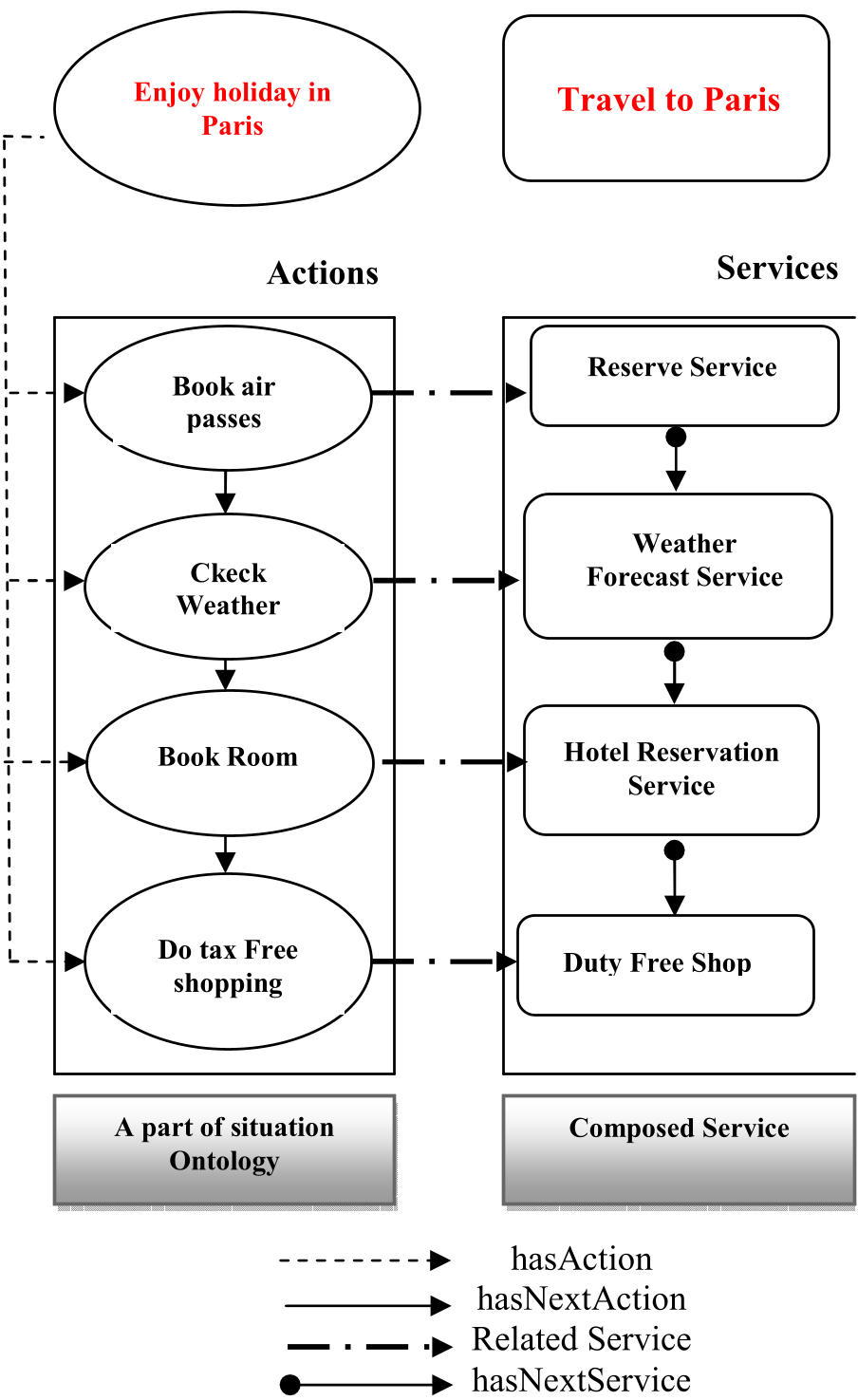 Fig 1: The Interactive Model for Web Service Composition illustrating the interplay between the service repository, the CI-driven ontology, and user interactions.
3. Social Feedback Loop
Unique to this approach is the "AskToFriends" or "GetOpinion" feature. While the system suggests services technically, it allows the user to trigger social verification, pulling real-time advice from social media platforms to confirm a choice.
Experiments: The London-to-Paris Scenario
The paper illustrates the method through a medical professional, Dr. Mickel, traveling to a conference. When faced with multiple identical flight options, the system doesn't just list them; it uses social networking data to rank them based on real-world reliability and friend experiences.
Quantitative Matchmaking
The compatibility is measured using the following formula: This ensures that the "distance" between what the user wants and what the provider offers is minimized across five key attributes like efficiency and availability.
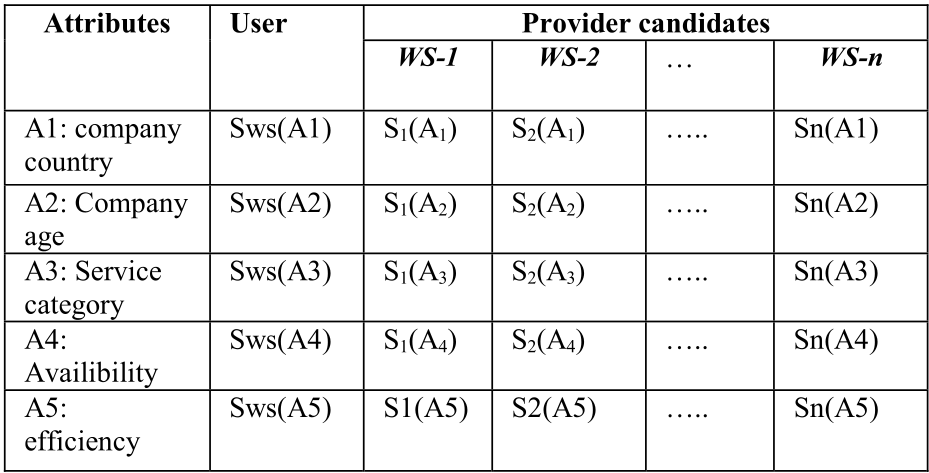 Table 1: Attribute mapping for matchmaking between user requirements and provider candidates.
Critical Analysis & Conclusion
The merit of this work lies in its recognition that Service-Oriented Computing is fundamentally a human activity. By utilizing Collective Intelligence, the authors move closer to "Social-Aware" computing.
Takeaway: The integration of social networks into technical workflows is no longer just for "socializing"—it is a critical data source for resolving ambiguity in complex system designs.
Limitations:
- The paper relies heavily on the quality of social data, which can often be noisy or biased.
- The computational overhead of real-time ontology mining from social feeds is not fully discussed.
Future Work: The authors intend to further prove the efficiency of these CI techniques through more extensive experimental deployments, potentially paving the way for autonomous agents that "discuss" service quality before making a purchase.