
CBDA: Unmasking Social Identities via Overlapping Community Fingerprints
Social Network De-anonymization with Overlapping Communities: Analysis, Algorithm and Experiments
This paper introduces a seedless social network de-anonymization framework targeting overlapping community structures. It proposes a Minimum Mean Square Error (MMSE) based cost function and a Convex-concave Based De-anonymization Algorithm (CBDA) to re-identify users across correlated networks without prior ground-truth seeds.
TL;DR
Researchers have developed a new framework for "seedless" social network de-anonymization that exploits a common reality: people belong to multiple social circles (overlapping communities). By shifting from Maximum A Posterior (MAP) to Minimum Mean Square Error (MMSE) estimation and using a specialized convex-concave optimization algorithm (CBDA), the method reaches 90% accuracy in matching users across different platforms—even when no initial "matches" are known to the attacker.
The "Overlapping" Reality: Beyond Simple Clusters
In the world of privacy research, de-anonymization is the art of linking an "anonymized" dataset (the Published Network) with an "identified" dataset (the Auxiliary Network). Most prior work assumed communities were distinct silos. However, your life isn't a silo; you are simultaneously part of a "work" group, a "family" group, and a "hobby" group.
This paper argues that these overlaps aren't just details—they are unique structural fingerprints. Most current tools fail because they are either:
- Seed-dependent: They need "initial matches" which aren't always available.
- Statistically Thin: They ignore the richness of multi-group membership.
- Heuristic-heavy: Algorithms like Genetic Algorithms (GA) are unstable and prone to getting stuck in local optima.
Methodology: From NP-Hard to Convex-Concave Relaxation
The authors frame the problem as finding a permutation matrix that minimizes the mapping error. Since calculating all possible mappings is impossible (NP-hard), they introduce two major technical shifts.
1. The MMSE Cost Function
Unlike MAP, which looks for the single "most likely" mapping, the Minimum Mean Square Error (MMSE) approach minimizes the expected number of mismatched users. This provides a more robust estimate that doesn't deviate wildly if the single "best" guess is slightly off. They transform this into a Weighted-Edge Matching Problem (WEMP), where the "weights" () are theoretically derived from the community density.
2. The CBDA Algorithm
To find the optimal mapping without a brute-force search, the authors use a Convex-Concave Based De-anonymization Algorithm (CBDA).
- The Intuition: Optimization over "permutations" is hard because it's a discrete space. CBDA starts in a continuous, convex space (where the problem is easy) and gradually shifts the objective function toward a concave one (where the solution is forced to stay at the discrete boundaries).
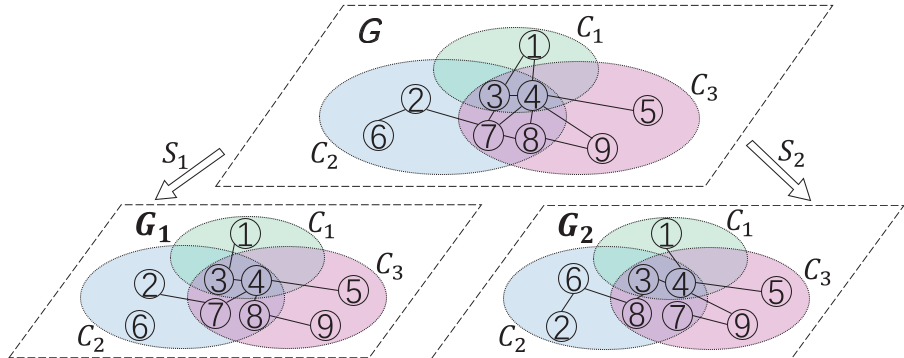 Figure 1: Illustration of the de-anonymization framework showing how two social networks are sampled from a common underlying structure.
Experiments: Real-World Impacts
The researchers tested CBDA on synthetic data, LiveJournal samples, and a high-stakes real-world dataset: Microsoft Academic Graph (MAG).
Key Findings:
- Co-author Networks: In real computer science co-author networks (cross-domain), CBDA achieved 90% accuracy.
- The Overlap Bonus: As the density of overlapping communities () increases, de-anonymization actually becomes easier for the algorithm. This is a counter-intuitive blow to privacy: the more social groups you join, the easier you are to re-identify.
- Stability: Unlike Genetic Algorithms, which showed massive performance swings, CBDA proved stable across different network sizes.
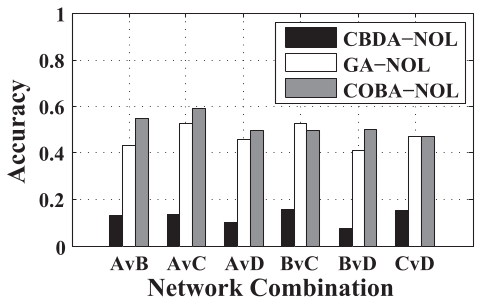 Figure 2: Experimental results comparing CBDA against Genetic Algorithms and COBA across multiple datasets.
Critical Analysis & Takeaways
The paper effectively proves that overlapping communities provide a "signal" that is more resilient than simple edge relationships. However, the computational complexity of per iteration remains a hurdle for extreme-scale networks (billions of nodes).
Future Outlook: This work signals that "anonymizing" data by simply removing names is insufficient if the underlying social structure remains intact. For the security community, it suggests that adding "noise" to user group memberships might be just as important as hiding the connections themselves.
Final Takeaway: In the era of big data, your unique constellation of social circles is a serial number that is nearly impossible to hide.