
Decoding Social Ties: Inferring Networks from Multi-Source Behavior Logs
Social Network Discovery from Multiple Log Data through a Behavior Model
This paper introduces a novel framework for discovering social networks of smartphone users by analyzing multi-source log data from web browsing and mobile applications. The method builds a user behavior model that integrates homophily, cross-user influence, and item-adoption history, achieving significant improvements in social tie prediction accuracy over baseline methods.
TL;DR
Researchers have developed a new framework that "reads between the lines" of our digital logs—browsing history and app usage—to reconstruct our real-world social circles. By modeling Homophily, User Influence, and Item Semantics, and fusing data from multiple devices, they significantly improved the accuracy of social network discovery, doubling the precision of standard baseline methods.
Background & Motivation: The "Why" of Behavior
In the era of big data, our smartphone logs are digital fingerprints. However, just because two people use the same app doesn't mean they are friends. It could be a coincidence, a shared interest (Homophily), or one person influencing the other (Contagion).
The core challenge addressed here is: How can we mathematically separate these semantic factors to accurately map a social network? Existing tools like NetInf or ConNie often treat logs as simple cascades, ignoring the nuanced reasons why a user adopts a specific web page or application at a specific time.
Methodology: The Behavior Model
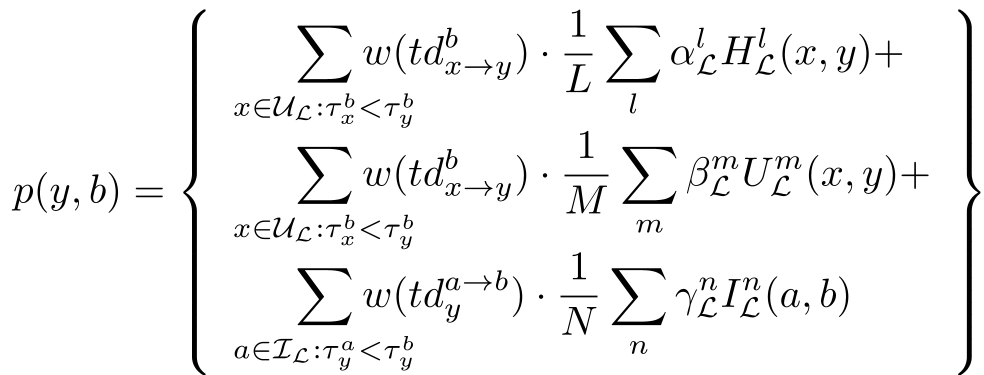
The authors propose a behavior model where the probability of a user adopting an item is influenced by a weighted sum of three distinct effects:
- Homophily (H): Connecting with similar users (e.g., same gender or department).
- User Effect (U): Direct social influence from others who adopted the item earlier.
- Item Effect (I): Personal preference based on the user's own past behavior.
Crucially, these effects are moderated by a Time Difference (td) function—the longer the gap between actions, the weaker the influence.
Handling Multiple Logs
The true power of the framework lies in its ability to handle multiple datasets (Mobile apps, Mobile web, PC web). The authors propose three fusion methods:
- (Merging): Averaging the results of separate models.
- (Penalty): Regularizing the models so that user associations across different logs don't diverge too much.
- (Synthesized): Sharing parameters across all logs to create a unified influence model.
Experimental Battleground
The study utilized real-world data from 130 students, comparing the inferred networks against "ground truth" questionnaire data (Talk, Email, and Phone Call ties).
Key Results
- The Power of Synthesis: The Synthesized method () was the clear winner. By sharing parameters across logs, the model became more robust against noise in individual datasets.
- The Importance of Homophily: Models that ignored homophily (marked "w.o." in the tables) performed substantially worse. Knowing that two people are in the same department acts as a powerful "prior" for social tie prediction.
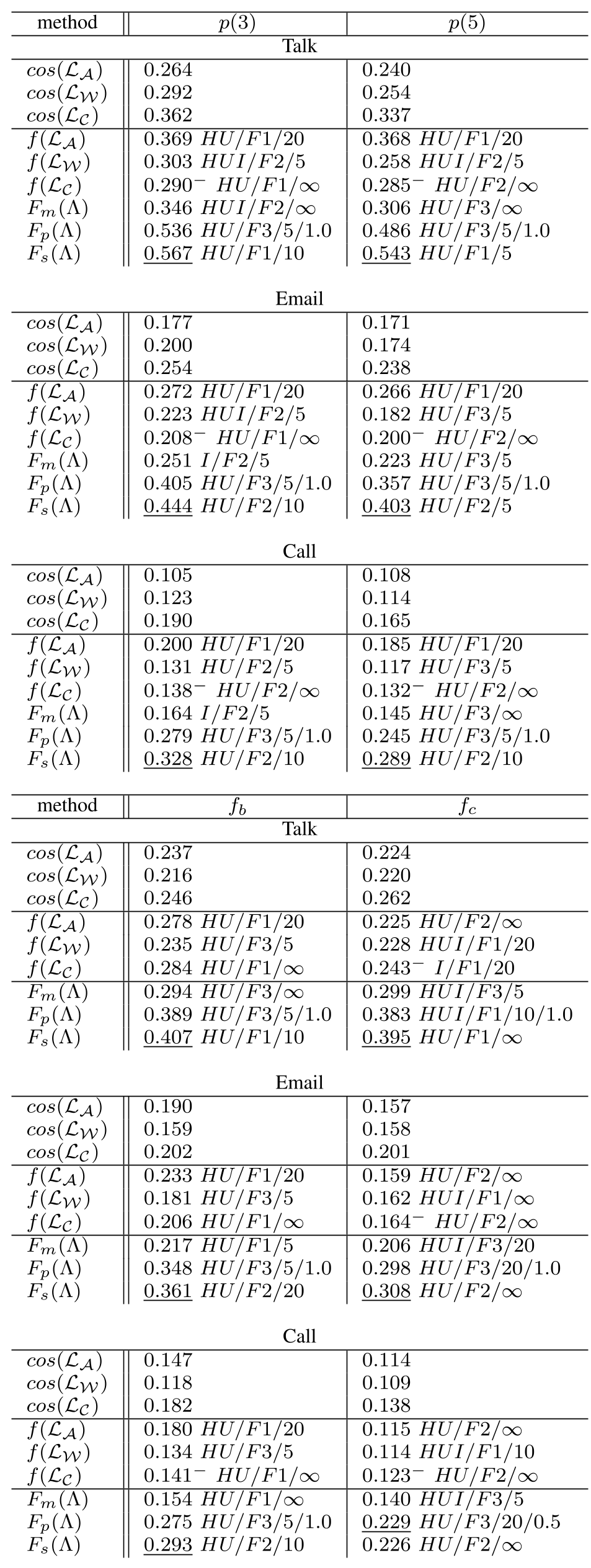
As shown in the table above, the precision (p(3)) for the method reaches 0.567, nearly doubling the performance of baseline cosine similarity measures.
Deep Insights & Future Outlook
The study reveals an interesting nuance: Temporal sensitivity () varies by platform. For mobile app logs, a short decay (5-10 days) works best, reflecting the fast-paced nature of mobile trends. For PC-based browsing, time differences mattered much less (), suggesting that PC usage might reflect more stable, long-term interests.
Limitations
- Parameter Sensitivity: The model requires careful tuning of weights () and the decay factor ().
- Scalability: While effective for 130 users, the optimization complexity for multi-source logs might grow significantly with larger populations.
Conclusion
This research moves beyond simple data mining into the realm of behavioral semantics. It proves that by understanding why users act (is it my friend's influence or my own habit?), we can much more accurately map the hidden social structures that govern our digital interactions. For industries like viral marketing and recommendation engines, this framework provides a sophisticated roadmap for identifying "true" social influencers.