
Beyond the Visible: Discovering Hidden Social Structures via Sensitivity Analysis
Social Network Discovery Based on Sensitivity Analysis
This paper introduces a novel methodology for discovering hidden social relationships using sensitivity analysis of Markov centrality. By calculating the partial derivatives of node importance with respect to connectivity changes, the authors identify "implicit links" that indicate significant indirect influence between seemingly disconnected entities.
TL;DR
Visualizing social networks often results in a "hairball" of connections that obscures true influence. This paper proposes a mathematical lens—Importance Sensitivity—to look past explicit edges. By calculating how much the "importance" of one person would change if another person’s connectivity shifted, the authors can reveal "implicit links": hidden relationships between people who don't talk directly but occupy the same structural niche.
Perspective: From Static Ranking to Dynamic Impact
Most network analysis asks: Who is the most important person? (Centrality). This paper asks a much deeper question: How much does Person A's importance depend on Person B?
In the academic coordinate system, this work moves social network analysis (SNA) from descriptive statistics (what the graph looks like) to differential analysis (how the graph behaves under perturbation).
The Core Challenge: The "Clutter" of Reality
Raw social data is messy. In the VAST Challenge dataset (Figure 1a) and the MIT Reality dataset (Figure 1c), the sheer density of calls or proximity pings makes the network illegible.
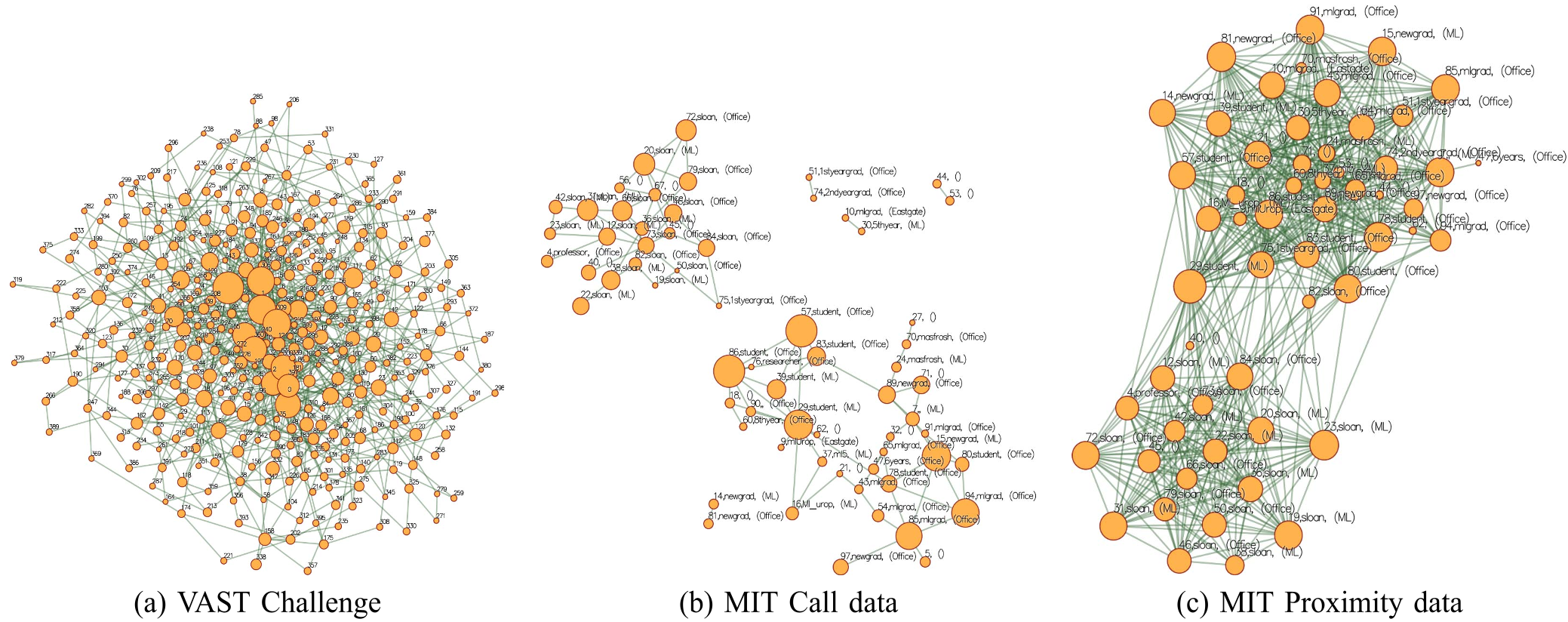
The authors argue that a link in a database node-link diagram isn't the same as a link in the "real world." Two people might never call each other, yet they might be the only two bridging two massive corporate departments. Standard metrics miss this; sensitivity analysis catches it.
Methodology: The Math of Influence
The authors use Markov Centrality, which treats a social network as a Markov chain where "messages" wander via random walks. The importance of a node is the inverse of the average time it takes for a message to reach it.
The "Secret Sauce" is Equation 4:
Where is the importance of node and is the degree of node .
By deriving the derivative of the Fundamental Matrix (Z), the authors can compute a matrix of sensitivity coefficients.
- High Sensitivity + No Edge = Implicit Link: A hidden, indirect relationship.
- High Sensitivity + Existing Edge = Critical Link: A backbone connection.

Case Study: Cracking the VAST Challenge
In a synthetic terrorist-tracking task, the goal was to find a hidden organization. Using Markov Importance alone (Figure 2a) only showed clusters. However, adding Sensitivity Analysis (the dashed lines in Figure 2a) revealed specific pairings like 1-309 and 5-306.
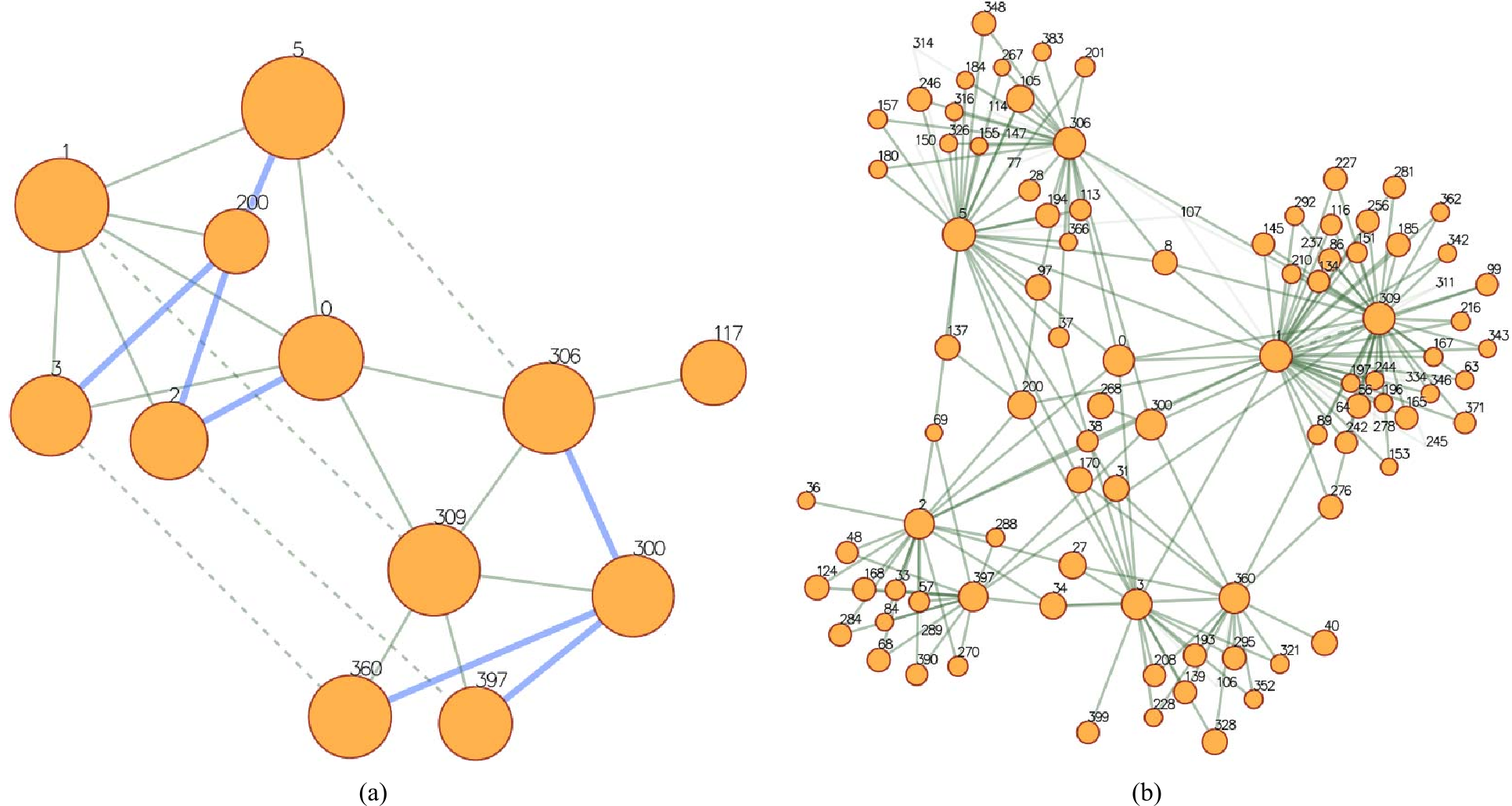
The Insight: These pairs were actually the same people using two different cell phones. Because their sub-networks were identical, their sensitivity to each other was massive, even though the phones never called one another.
Deep Insight: Limits and Future Work
While powerful, the method suffers from complexity due to matrix inversion, making it difficult to run on a Facebook-scale graph with millions of nodes without using local approximation or clustering.
However, the signed nature of sensitivity is a brilliant takeaway. A negative sensitivity coefficient means that as Node B becomes more important, Node A's relative standing decreases. This could be used to model competitive environments or "power struggles" within organizations—a dimension of social data rarely captured by standard link-prediction algorithms.
Conclusion
This paper isn't just about making prettier graphs; it's about introducing Inductive Bias into visualization. By guiding the eye toward nodes with the highest mutual impact, we move from simply "viewing data" to "interacting with the underlying social physics."