
SNDocRank: Leveraging Global Social Graphs for Personalized Document Search
Social network document ranking
The paper introduces SNDocRank, a personalized ranking framework for social network documents that combines traditional TF-IDF content relevance with a novel Multi-level Actor Similarity (MAS) algorithm. By leveraging structural similarity between searchers and document owners, it achieves significantly better retrieval performance in social media contexts like YouTube.
TL;DR
SNDocRank is a personalized ranking framework that moves beyond basic search history to use the global structure of a user's social network. By introducing the Multi-level Actor Similarity (MAS) algorithm, the researchers managed to incorporate complex vertex similarity metrics into large-scale search engines, achieving up to a 20% boost in ranking relevance (NDCG) for social video search.
Problem & Motivation: The Limits of User-Neutral Search
In traditional Information Retrieval (IR), the "relevance" of a document is typically determined by its content (TF-IDF) or its link structure (PageRank). However, if an animal lover and a software engineer both search for "Snow Leopard," a neutral engine cannot distinguish between the endangered species and the Apple operating system.
Prior attempts at personalization used "local" clues like click-logs or direct friends. The authors argue that these are too narrow. True personalization requires understanding the global social context—who is connected to whom across the entire network. The primary barrier to this was computational: existing algorithms for calculating "structural similarity" (like LHN) involve expensive matrix multiplications that don't scale to millions of users.
Methodology: High-Speed Global Similarity through MAS
The core innovation is the Multi-level Actor Similarity (MAS) algorithm. Its goal is to allow global similarity calculations without the cubic complexity.
1. Hierarchical Clustering
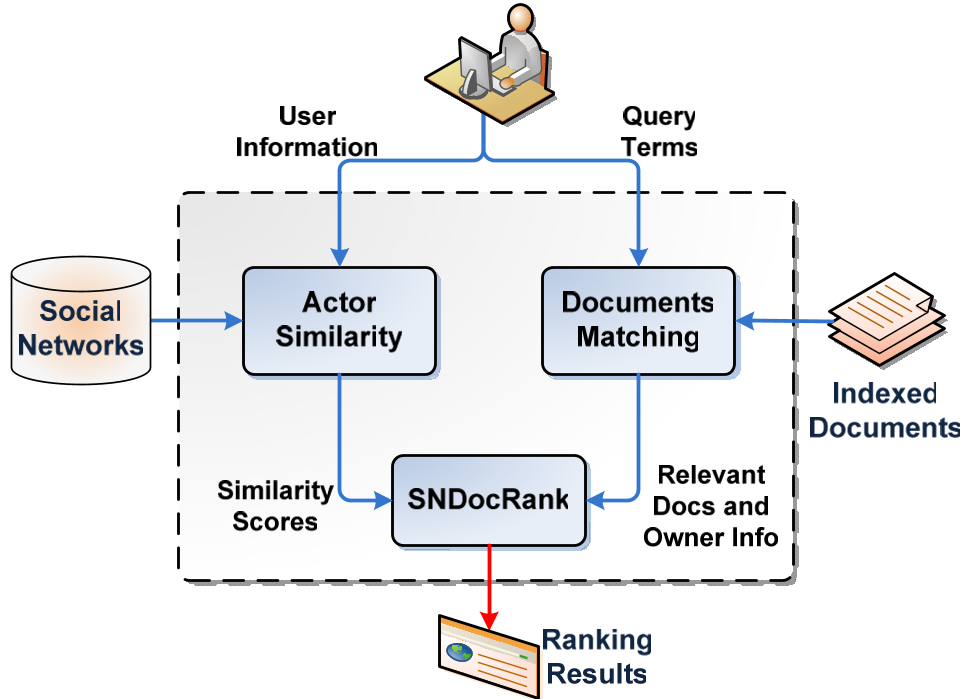
Instead of treating the network as one giant flat graph, MAS uses a modularity-oriented approach to cluster users into a hierarchy of "communities." This creates a "backbone" network where groups of users are treated as single aggregate nodes.
2. Weighted LHN Similarity
The system applies a weighted version of the Leicht-Holme-Newman (LHN) vertex similarity. LHN's recursive logic states that "two nodes are similar if their neighbors are similar." By running this on the aggregated backbone first, the system captures global context efficiently.
3. Composite Ranking
The final SNDocRank score is a function of:
- Content Score: Traditional TF-IDF matching the query to video metadata.
- Social Score: The structural similarity between the searcher and the video uploader.
Experiments & Results
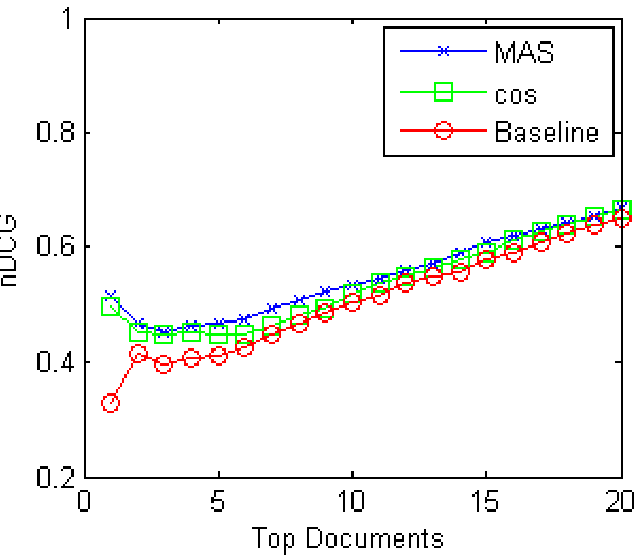
The authors crawled YouTube to build two networks (A: ~16k users, B: ~2k users) and indexed nearly 40,000 videos. Performance was measured using NDCG (Normalized Discounted Cumulative Gain), which rewards models for putting the most relevant results at the top.
Key Findings:
- Superiority of MAS: MAS-based ranking outperformed both the baseline and direct cosine similarity (which only looks at shared friends).
- Network Size Matters: Personalization became significantly more effective as the network size increased, suggesting a "network effect" in search accuracy.
- The High-Degree Advantage: Users with more connections (higher degrees) saw a 25% improvement in results compared to 10% for average users, as the system had more "clues" to work with.
Critical Analysis & Conclusion
Takeaway
SNDocRank proves that the "birds of a feather" (homophily) principle in social science translates directly into IR performance. If you are structurally similar to an uploader, you are statistically more likely to find their content relevant.
Limitations & Ethics
The authors honestly acknowledge a potential "social bias." Because the algorithm favors high-degree users and large communities, it might create echo chambers or filter bubbles, where unpopular or niche content becomes even harder to find.
Future Outlook
This work pre-dates the current "Graph Neural Network" (GNN) era but provides the fundamental logic for why graph structures are essential for personalization. Future iterations could replace the MAS grouping with Graph Embeddings (like Node2Vec) to capture even deeper semantic relationships within the social fabric.