
Social Networks as a Double-Edged Sword: Quantifying the Frictions of Exchange
Social Network as Double-Edged Sword to Exchange: Frictions and the Emerging of Intellectual Intermediary Service
The paper introduces a quantitative framework to measure "Direct" and "Indirect" frictions in bipartite exchange networks derived from social structures. It evaluates how exogenous and endogenous intermediary services, such as government or brokers, optimize social networks by adding strategic links to reduce these transactional barriers.
TL;DR
While we often view social networks as "lubricants" for trade and communication, they inherently harbor structural frictions that can block value realization. This paper introduces a formal mathematical framework to measure these frictions and explores how Intellectual Intermediary Services (both external like governments and internal like brokers) attempt to optimize these networks. The key findings reveal a trade-off: adding links to help one agent may inadvertently increase competition for others.
Problem & Motivation: The "Marriage" Paradox
In a social exchange network (like a labor market or a marriage market), a node only realizes value if it finds a complementary partner. However, structure complicates this:
- Isolation (Direct Friction): If you are a "demander" who only knows other "demanders," you are structurally blocked from exchange.
- Competition (Indirect Friction): If you find a "supplier," but that supplier is connected to many other "demanders" (your rivals), your probability of a successful exchange drops.
Previous economic theories (like Coase's theory of the firm) discuss intermediaries as a response to transaction costs, but they rarely model how the network topology itself generates these costs.
Methodology: Formalizing Friction
The authors define two core metrics to quantify the "resistance" in an exchange network :
- Direct Friction (): Represents the lack of suitable partners. If a node has zero neighbors of the opposite type, its friction is 1 (maximum).
- Indirect Friction (): Represents the degree of competition. It is calculated based on how many rivals share your neighbors, adjusted by the neighbors' total connections.
Optimization Strategies
The paper compares two types of "Intermediary Services":
- Exogenous (DRA/IRA Algorithms): External entities with global knowledge of the network who add links specifically to minimize average direct/indirect friction.
- Endogenous: Nodes within the network who act as brokers. They use local information to link their own neighbors, often seeking "intermediary income."
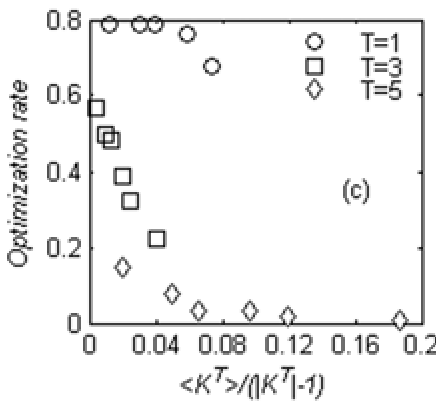 Figure: The charts illustrate how Average Direct Friction (AD_F) and Average Indirect Friction (AI_F) decrease as an exogenous intermediary adds links (t).
Experimental Insights: Why Global Knowledge Wins
The authors conducted agent-based simulations on 500 networks with varying connectivity (average degree ) and supplier ratios ().
- The "Sweet Spot" of Friction: Frictions are most volatile at medium connectivity. At very low connectivity, everyone is isolated (high ); at very high connectivity, the network saturates, reducing the relative benefit of intermediaries.
- The Intermediary’s Dilemma: Endogenous intermediaries are "selfish" optimizers. While they reduce direct friction by connecting their neighbors, they often increase Indirect Friction (competition) because they create new links without considering the holistic impact on the market's competitive balance.
- Efficiency Decay: As the network becomes more connected naturally, the marginal utility of an intermediary service decreases.
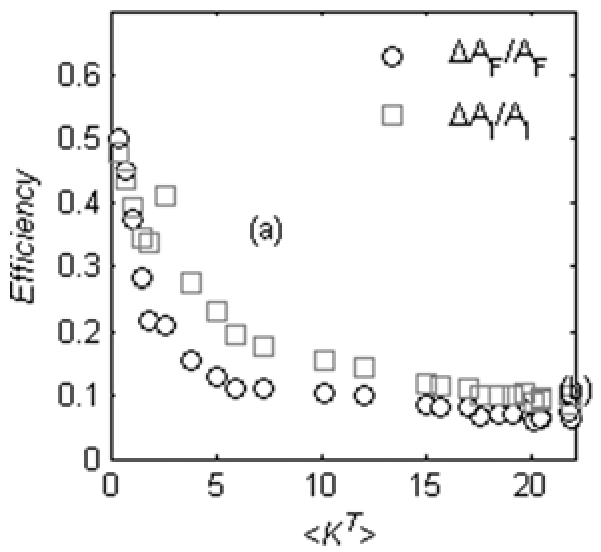 Figure: The efficiency () of adding links drops significantly as the original network's connectivity increases.
Critical Analysis & Conclusion
This work provides a bridge between Social Network Analysis (SNA) and Microeconomics. By defining friction mathematically, it explains why "market-clearing" is rarely perfect: the social structure we are embedded in acts as a "double-edged sword."
Takeaways for Modern Tech
- For Platforms: E-commerce sites (as exogenous intermediaries) must balance helping buyers find sellers (reducing direct friction) with the risk of creating hyper-competitive "bidding wars" that discourage participants (increasing indirect friction).
- Limitations: The model assumes homogeneous services. In real-world scenarios, the "quality" of nodes varies, which would introduce a third dimension of friction.
In conclusion, the paper suggests that the "Invisible Hand" of the market is often restrained by the "Visible Friction" of our social ties. Intermediaries are necessary, but they are not a panacea—their success depends entirely on the pre-existing topology of the network.