
The Tug-of-War: Balancing Social Synergy and Network Congestion in Wireless Pricing
When Social Network Effect Meets Congestion Effect in Wireless Networks: Data Usage Equilibrium and Optimal Pricing
This paper explores the interaction between social network effects (positive externalities) and physical congestion effects (negative externalities) in wireless data usage. It proposes a Stackelberg game involving a wireless provider and mobile users to determine User Demand Equilibrium (UDE) and optimal pricing strategies.
TL;DR
When you see a viral video on WeChat or WhatsApp, you use more data—that's the Social Network Effect. But if everyone does it at once, the network slows down—that's the Congestion Effect. This paper provides the first mathematical framework to balance these two opposing forces through a Stackelberg game, offering a blueprint for wireless providers to maximize revenue by pricing "socially."
The Hidden Conflict in Your Data Plan
Wireless service providers (WSPs) have traditionally viewed data usage through a simple lens: users want data, and the WSP charges for it. However, the modern mobile landscape is driven by social apps where one user's activity triggers others (positive externalities). Conversely, the physical reality of radio spectrum is a zero-sum game: more usage leads to interference and delays (negative externalities).
The authors argue that ignoring this interplay leads to suboptimal revenue and poor user experience. The challenge lies in the complexity of the "User Demand Equilibrium" (UDE)—unlike simpler models, the interaction here is not always predictable; for example, increasing the price can sometimes increase a specific user's usage if it significantly clears congestion from others.
Methodology: The Two-Stage Strategy
The authors model this as a Stackelberg Game, a strategic "leader-follower" framework:
Stage I: The Provider’s Move (Pricing)
The WSP sets a price to maximize total revenue . Because the response of users is piecewise linear, the revenue function becomes piecewise quadratic.
Stage II: The Users' Response (Usage)
Users decide their usage based on the following payoff function: The "Social Gain" is modeled by the product of users’ data usage (), while "Congestion" is a quadratic penalty on the total network usage.
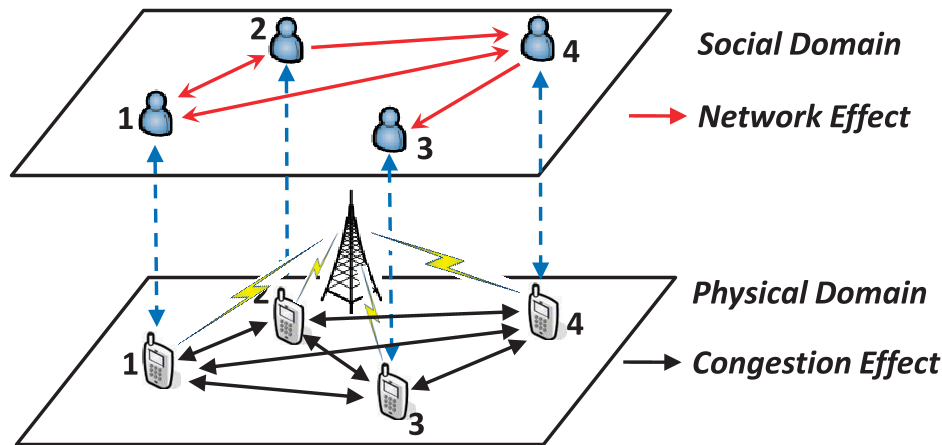 Fig 1: Conceptual framework showing the dual influence of social domains and physical wireless domains on user behavior.
Engineering Insights: When to Raise or Lower Prices
The research yields several counter-intuitive insights that diverge from standard economic theory:
- The Price Paradox: In networks with diverse users, a price hike might reduce the usage of social "followers" (who are price-sensitive), thereby reducing congestion so much that social "influencers" actually increase their usage.
- Asymmetric Ties Matter: If User A influences User B, but not vice versa, increasing User A's affinity for the service might actually decrease total network usage because the congestion User A creates overwhelms the social benefit to User B.
- Optimal Pricing Logic:
- Social Dominance: If social ties are strong (e.g., a tight-knit community on a social app), the provider should actually lower the price. The "network effect" acts as a force multiplier, where the surge in volume far outweighs the lower per-unit price.
- Congestion Dominance: In crowded urban environments with weak social links, higher prices are preferred to act as a regulator, preventing the network from collapsing under its own weight.
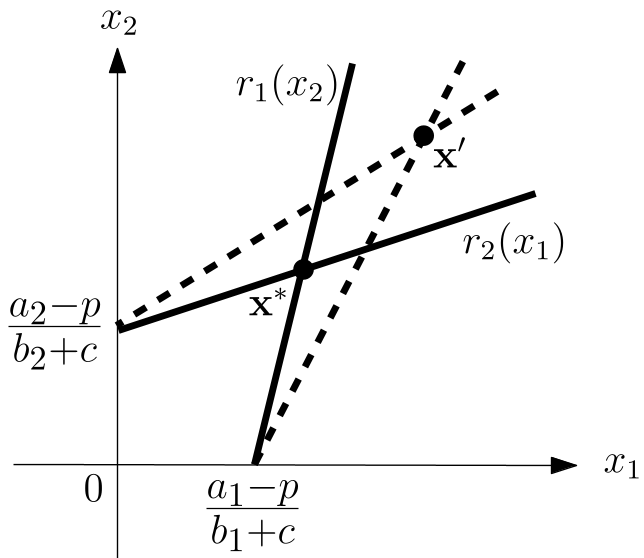 Fig 2: Visualization of how the UDE shifts as social tie strength increases, illustrating the boost in total usage.
Performance & Complexity
Using real-world data from the Brightkite social network, the authors validated their Optimal Pricing Algorithm (Algorithm 3). They demonstrated that the computational complexity scales linearly——with the number of users, making it feasible for real-time deployment in large-scale wireless cells.
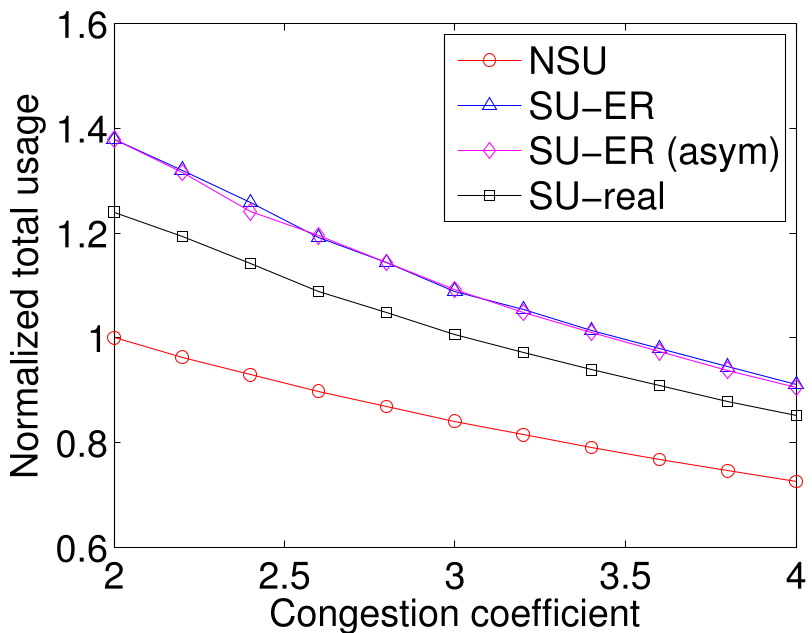 Fig 3: Total usage vs. Number of users. When social effects (SU-ER) dominate, the marginal gain of adding users increases, unlike the diminishing returns seen in standard non-social models (NSU).
Conclusion & Future Directions
This work sets a new standard for wireless economics by proving that social relationships are just as critical as physical constraints. Future extensions could move toward differential pricing, where influencers are charged less to stimulate the network, or incorporate Machine Learning to dynamically estimate social tie strengths from live traffic data.
Key Takeaway: Don't just price for the bits—price for the relationships between the people using those bits.