
When Social Cues Meet Signal Clogs: The New Math of Wireless Pricing
When Social Network Effect Meets Congestion Effect in Wireless Networks: Data Usage Equilibrium and Optimal Pricing
This paper proposes a Stackelberg game framework to model mobile data usage by balancing the positive social network effect (peer influence) against the negative physical congestion effect. It provides a rigorous analysis of User Demand Equilibrium (UDE) and an optimal pricing algorithm for wireless providers to maximize revenue in socially-aware environments.
TL;DR
Social media doesn't just eat data; it creates a "network effect" where your friends' usage pushes you to use more. However, this hits a wall called the "congestion effect." This paper presents a Stackelberg game model that helps wireless providers find the "sweet spot" price that maximizes revenue by considering how social ties and physical bandwidth constraints fight each other.
The Hidden Tug-of-War: Social vs. Physical
Why do we use data? Historically, it was a solo activity. Today, data usage is a social contagion. If your circle is active on WeChat or WhatsApp, your demand spikes. But as everyone jumps on the same cell tower, the network slows down.
The authors identify a critical gap: Prior work either looks at social benefits or network congestion, but rarely both. Without a unified model, providers set prices that either leave money on the table (by ignoring social stimulation) or crash the network (by ignoring congestion).
Methodology: The Two-Stage Game
The paper structures the interaction as a Stackelberg Game, a strategic model where a "Leader" (the provider) moves first, and "Followers" (users) react.
Stage II: The User Demand Equilibrium (UDE)
Each user tries to maximize a payoff function that looks like this:
The genius here is the Net Effect:
- If your friend's influence () is greater than the congestion cost (), they have a positive net effect on you.
- If the network is too crowded, the net effect becomes negative.
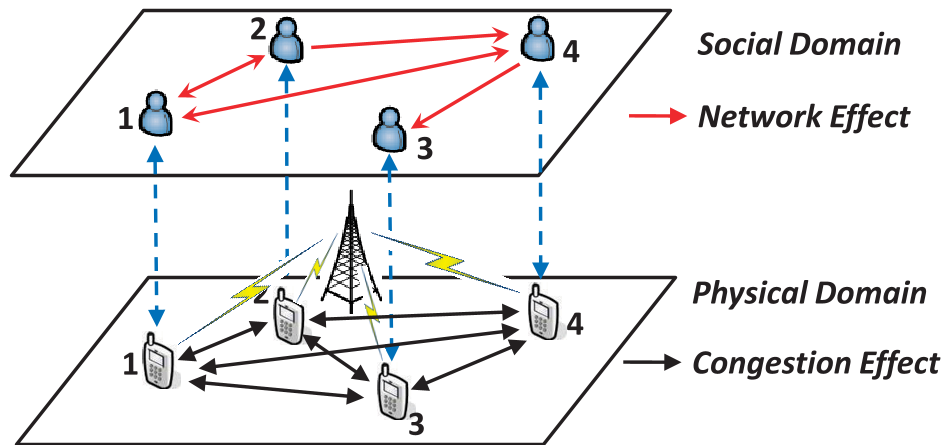
Stage I: Optimal Pricing
The provider observes how users reach equilibrium and then solves for the price that maximizes . The authors prove that the total usage is a piece-wise linear function of price, which simplifies a seemingly impossible optimization problem into a manageable algorithm.
Counter-Intuitive Insights
The analytical results challenge standard economic assumptions:
- Price Hikes can Increase Usage? In some cases, increasing the price for users with weak social ties actually decreases overall congestion so much that total usage for the "socially heavy" users goes up.
- The "Domination" Pivot:
- Social Dominant: Marginal revenue increases with users. (Growth is exponential).
- Congestion Dominant: Marginal revenue decreases. (Growth saturates).
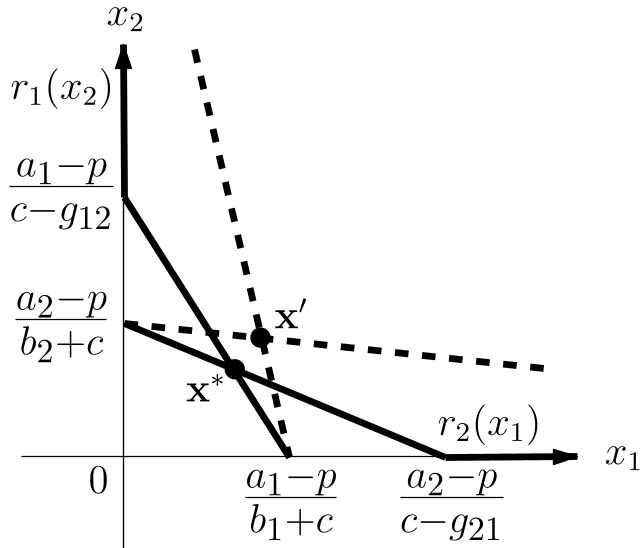 Fig: As social ties () increase, the equilibrium usage shifts favorably, even if prices remain steady.
Real-World Performance
Using the Brightkite social dataset, the authors validated their model. They found that their "Socially-Aware" (SU) strategy consistently outperformed standard "Non-Socially-Aware" (NSU) strategies.
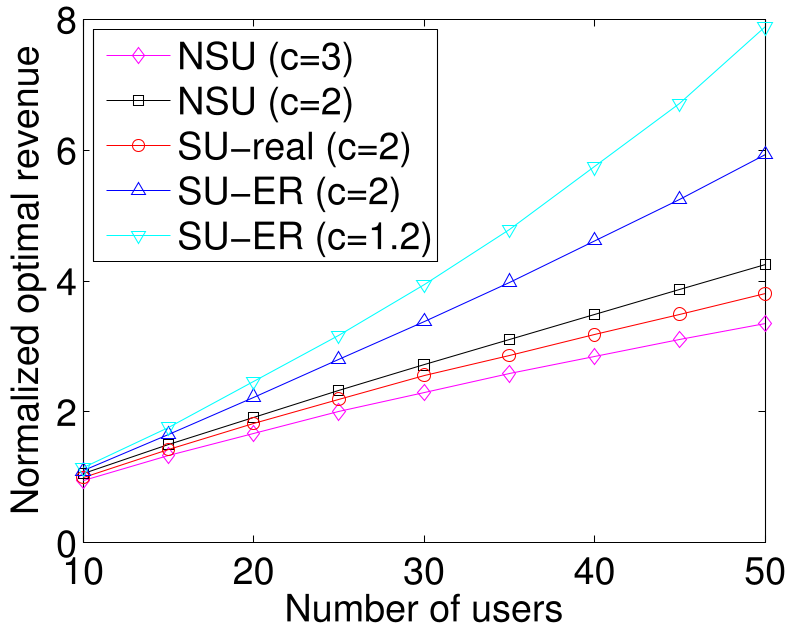 Fig: Note how SU-Real (Socially Aware) provides a significant usage lead over standard models (NSU).
Critical Analysis & Engineering Takeaways
The paper's contribution is a vital roadmap for 5G/6G operators:
- Strategic Discounting: If a social group is highly connected, a lower "group price" can actually increase total revenue by triggering a massive usage cascade.
- Infrastructure Priority: Reducing the congestion coefficient () isn't just about "better service"—it's a revenue multiplier that amplifies the existing social network effect.
Limitations: The model assumes users are rational and have perfect information about others' usage, which rarely happens in real-time. Future iterations using Machine Learning to estimate these hidden social parameters in real-time will be the next frontier in wireless economics.
Conclusion
This work elegantly bridges the gap between social graph theory and physical layer constraints. For wireless providers, the message is clear: stop pricing data like a commodity and start pricing it like a social experience.