
Beyond Keywords: Optimizing Research Grant Selection with Social Network Analytics
A social network-empowered research analytics framework for project selection
The paper introduces a Social Network-Empowered Research Analytics Framework (RAF) designed to automate and optimize the assignment of reviewers to research grant proposals. Deployed at the National Natural Science Foundation of China (NSFC), the framework integrates data from the Scholarmate professional social network to build comprehensive researcher profiles across three dimensions: relevance, productivity, and connectivity.
TL;DR
Government funding agencies are overwhelmed by the exponential growth of research proposals. This paper presents a Research Analytics Framework (RAF) that leverages professional social networks (Scholarmate) to profile researchers based on Relevance, Productivity, and Connectivity. By transforming the reviewer assignment task into a constrained optimization problem, the authors reduced a two-week manual process to 6 hours for the NSFC.
The "Blind Spot" in Traditional Peer Review
The integrity of scientific funding hinges on the quality of peer review. However, traditional assignment methods suffer from two major flaws:
- Semantic Sparsity: Relying on 5-10 keywords provided by authors is insufficient to capture the nuance of modern interdisciplinary research.
- Social Opacity: Manual assignments often fail to identify hidden conflicts of interest (co-authorship, institutional colleagues) or fail to tap into the "community" of emerging experts who haven't yet achieved "senior" status but possess the specific technical expertise required.
The authors' insight is that a researcher’s value and suitability aren't just in what they write, but where they sit in the scientific social fabric.
Methodology: The Three Dimensions of a Researcher
The RAF framework constructs a "Visual Research CV" by aggregating data from bibliographic databases (ISI, Scopus, EI) and the Scholarmate social network. It evaluates potential reviewers through three lenses:
1. Relevance: The "What"
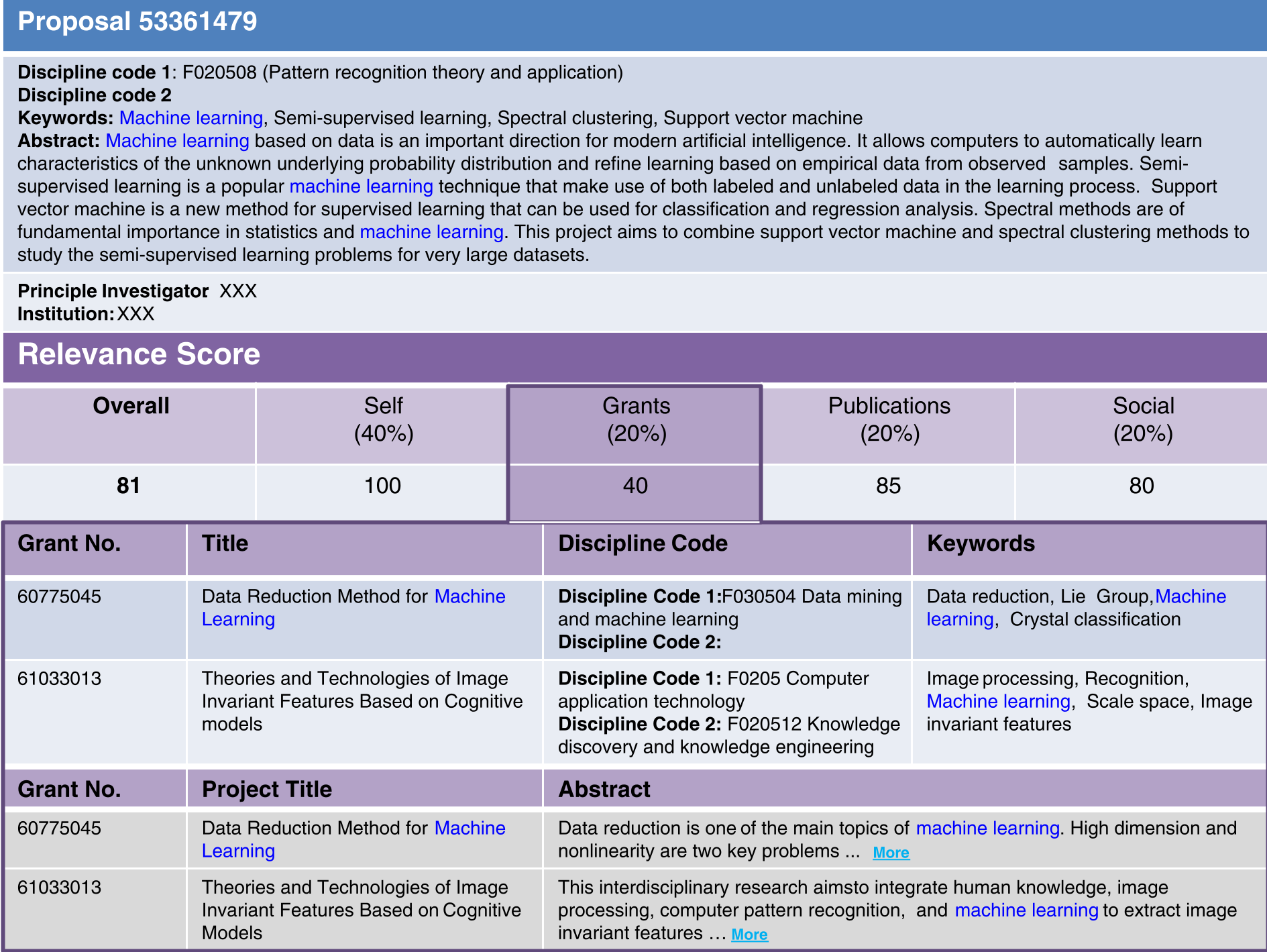
The system doesn't just look at keywords. It uses a Rough Threshold Model (RTM) and phrase analysis to mine the full text of titles and abstracts. This resolves semantic ambiguity (e.g., "SVM" in different contexts) and uses Jaccard Similarity and Cosine Similarity to match proposals with reviewer expertise.
2. Connectivity: The "Who"
By modeling the research world as a graph, the authors use Newman's Fast Algorithm for community detection.
- Community Structure: Reviewers are prioritized if they belong to the same research "cluster" as the proposal's PI, indicating shared methodologies.
- Conflict Avoidance: If a direct link (co-authorship in the last 5 years) is detected, the connectivity index drops to zero, automatically disqualifying the candidate.
3. Productivity: The "How Well"
Reviewer quality is quantified using a weighted scheme of journal rankings (Level A, B, C), H-index, and professional titles. This ensures that the review panel isn't just relevant, but also possesses the academic rigor to judge high-stakes proposals.
Optimization: The Reviewer Assignment Problem
The framework culminates in an Integer Programming model. The goal is to maximize total relevance while satisfying real-world constraints:
- Load Balancing: No reviewer gets more than proposals (e.g., 20).
- Review Density: Every proposal must have at least reviewers (e.g., 3).
- Expertise Balancing: A crucial constraint ensures that the average experience level of the assigned group meets a target threshold, preventing a proposal from being reviewed solely by junior scholars.
Impact and Results
The framework was tested on the massive datasets of the National Natural Science Foundation of China (NSFC).
- Efficiency: Scaling to 34,000 proposals and 30,000 reviewers took under 6 hours via parallel computing.
- Economic Benefit: Significant reduction in administrative overhead and a measurable improvement in the "fairness" of matches as perceived by division managers.
Critical Insight & Future Outlook
While the 2013 paper was a pioneer in using social data for research analytics, its methodology provides the foundational logic for today's AI-driven systems. The shift from "searching for a person" to "optimizing a network" is the key takeaway.
Limitations: The model assumes that journal rank is a perfect proxy for quality—a controversial stance in today's bibliometric circles. Future work could integrate "Social Votes" or real-time altmetrics to capture the impact of research that resides outside of traditional high-impact journals.
Final Takeaway
The Research Analytics Framework (RAF) transforms the "black box" of peer review into a transparent, data-driven optimization task. For research managers, it provides a roadmap for leveraging social capital to ensure scientific excellence.