
Beyond the "More is Better" Myth: How Social Networks Can Actually Hinder Entrepreneurship
Does social network always promote entrepreneurial intentions? An empirical study in China
This empirical study explores the relationship between social network characteristics and entrepreneurial intentions among Chinese "College-graduate Village Officials." Using a Structural Equation Model (SEM) on 157 samples, it identifies that while network heterogeneity promotes entrepreneurial intent, network size and the prestige of the "top node" (high-status connections) unexpectedly exert negative influences.
TL;DR
A common academic assumption is that a larger social network equals more entrepreneurial success. This study of 157 Chinese Village Officials flips the script: while diverse connections (heterogeneity) help, having a large network or high-status connections actually decreases the intention to start a business. In risk-averse cultures, high social capital often translates to high opportunity costs, keeping individuals in "safe" roles.
Contextual Positioning
This paper serves as a critical "reality check" in the field of entrepreneurial psychology. While most SOTA (State of the Art) research in Western contexts praises social capital, this study applies a "Social Embedding Perspective" to the specific socio-political landscape of China, revealing a non-linear relationship between resources and risk-taking.
The Paradox of Social Capital
The core intuition of the authors is rooted in Risk Aversion. In many Chinese communities, someone with a "Top Node" (connections to government officials or scientists) has more to lose. Why start a risky business in a village when your network can land you a stable, prestigious job in the city?
Conversely, "self-made" entrepreneurs often lack these high-status safety nets. For them, the opportunity cost is low, making the leap into entrepreneurship a more feasible path to wealth.
Methodology: Measuring "Guanxi"
To quantify these invisible ties, the authors used a uniquely Chinese metric: the "New-Year Greeters’ Network." By analyzing who the participants contacted during the Spring Festival, they derived three key variables:
- Network Size: Total number of contacts.
- Network Heterogeneity: The diversity of occupations within the network.
- Properties of Top Node: The highest level of occupational prestige in the network.
The Research Model
The authors hypothesized that these network traits influence Entrepreneurial Intentions through two psychological mediators: Desirability (do I want to do it?) and Feasibility (can I do it?).
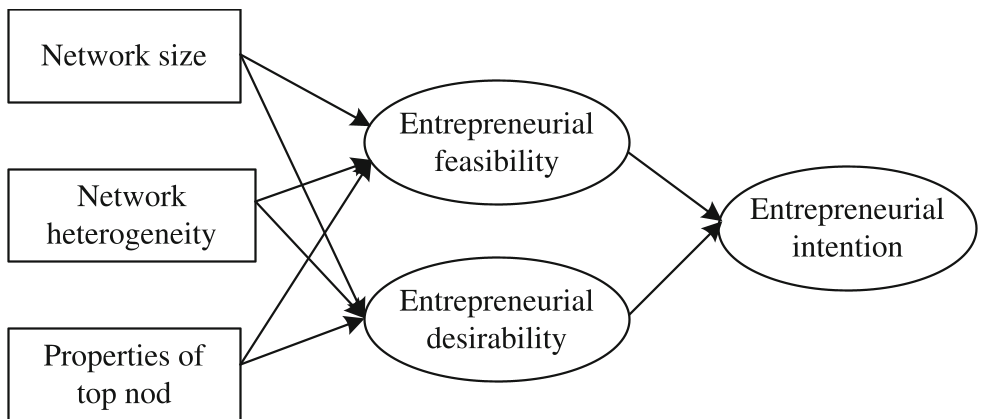 Figure 1: The theoretical framework linking social networks to intentions via desirability and feasibility.
Empirical Results: Surprising Findings
The results from the Structural Equation Model (SEM) were counter-intuitive to traditional theory:
- Heterogeneity (Positive): Interacting with people from different industries provides "Structural Holes"—new information that others don't have. This significantly boosts both the desire and the perceived feasibility of starting a business.
- Network Size (Negative): Large networks often contain "redundant" information. If you know 100 people but they are all in the same field, your network lacks the "Structural Holes" needed for innovation.
- Top Node Prestige (Negative): This was the most striking finding. Higher-status connections were negatively associated with entrepreneurial intent.
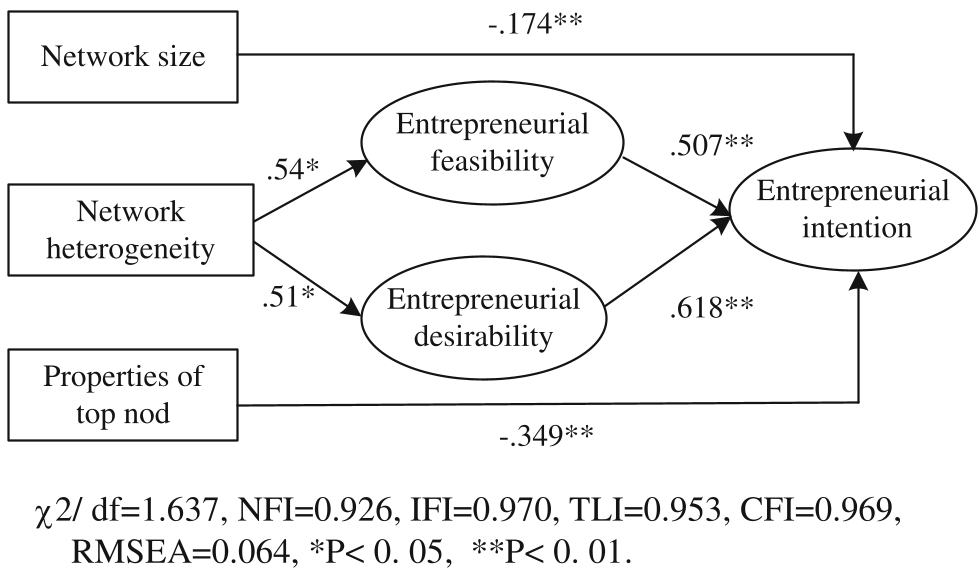 Figure 2: The modified SEM showing the direct negative paths from network size and top node to intent.
Deep Insight: The "Safety Trap"
The study highlights a crucial Inductive Bias in entrepreneurship research: we assume everyone wants to be an entrepreneur if they have the tools.
The reality is that Social Resources = Conservative Approaches. If your network gives you access to a "Government Official" (Prestige Score: 80) or a "Scientific Researcher" (Prestige Score: 95), you are likely to use those resources to secure a stable career rather than venturing into the "New Countryside Construction" business.
Critical Analysis & Conclusion
Takeaway
For policymakers, the message is clear: simply providing "connections" isn't enough. To foster entrepreneurship, one must encourage Heterogeneity—connecting people across industry silos—rather than just building larger, homogeneous groups.
Limitations
- Sample Specificity: The "College-graduate Village Official" is a very specific group. Their motivations might differ from urban tech entrepreneurs.
- Temporal Measurement: Using Spring Festival contacts is a clever cultural proxy but might not capture professional/weak ties formed throughout the rest of the year.
Future Outlook
Future research should explore if this "Negative Top Node" effect persists in the age of digital platforms, where the cost of maintaining high-status "weak ties" is lower, potentially lowering the opportunity cost of risk-taking.