
SIC Model: Why Emotions are the "Fuel" of Social Media Virality
Social Network Influence Propagation Model Based on Emotion Analysis
The paper proposes the Sentiment Independent Cascade (SIC) Model, which integrates fine-grained emotion analysis into the traditional Independent Cascade (IC) framework. By redefining activation probability through emotional coefficients and user interaction history, the model achieves better accuracy in simulating information spread on social platforms like Sina Weibo.
TL;DR
Information doesn't spread in a vacuum; it spreads through human feeling. This paper introduces the Sentiment Independent Cascade (SIC) Model, an upgrade to the classic IC model that incorporates 7-way fine-grained emotion analysis. By replacing random activation probabilities with emotion-aware coefficients, the researchers significantly reduced prediction errors on real-world Sina Weibo data.
Background: The Limits of Randomness
In the study of social networks, the Independent Cascade (IC) Model is the industry standard. It treats a network like a series of falling dominoes: if I am "activated" (e.g., I post a tweet), I have a certain probability of activating my neighbors.
However, the classic IC model has a glaring flaw: it often treats as a random variable. In reality, a "Happy" post about a product launch and an "Angry" post about a public scandal do not have the same . The authors argue that emotion is the latent variable that determines whether a node stays dormant or ignites a cascade.
Methodology: Mapping Feelings to Math
The authors break down their methodology into two core phases:
1. Fine-Grained Sentiment Analysis
Instead of simple "Positive/Negative" labels, the paper uses seven categories: Objective, Happy, Angry, Sadness, Fear, Disgusting, and Surprised. They use a dictionary-based approach combined with PMI (Pointwise Mutual Information) to calculate the intensity of these emotions within Micro-blog texts.
2. The SIC Model Formula
The breakthrough lies in the new activation probability :
- Interaction History: The first two terms represent the strength of the relationship between user and based on past forwarding behavior.
- Emotional Coefficient (): This is the "booster." If the emotion of the message aligns with the user's typical sentiment or carries high polarity, increases the chance of activation.
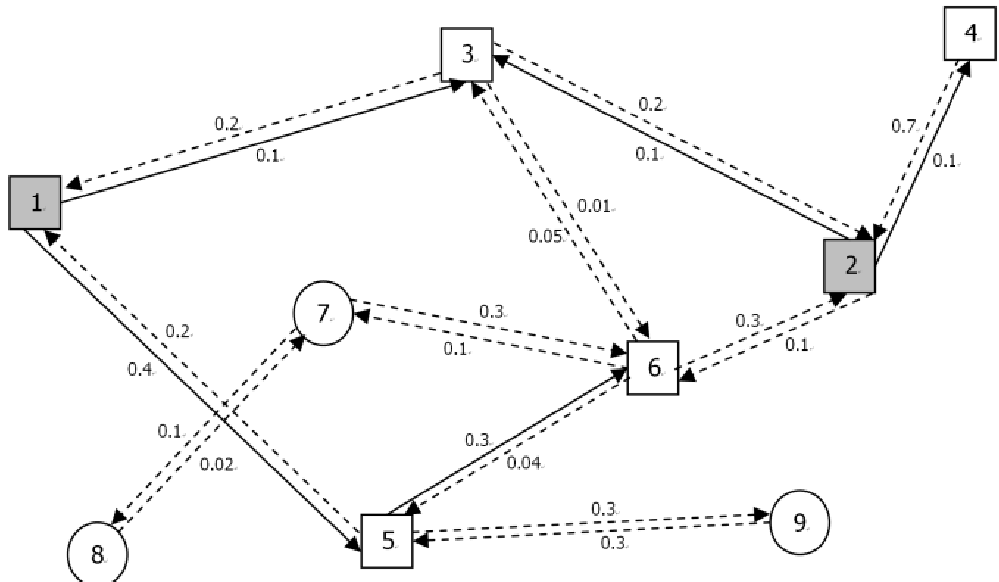 Fig 1. The fundamental IC process where seeds (squares) attempt to activate neighbors.
Experiments: Real-World Validation
The researchers crawled 10,000 Sina Weibo posts and tracked their propagation over three distinct time slices.
The "Happy" Dominance Effect
The data revealed a fascinating trend: at the start of a cascade (Time Slice 1), sentiments are diverse (Surprised, Objective). However, as the influence spreads and stabilizes, the "Happy" sentiment often becomes the dominant driver of the cascade reaching a massive 78.53% ratio in the final stages.
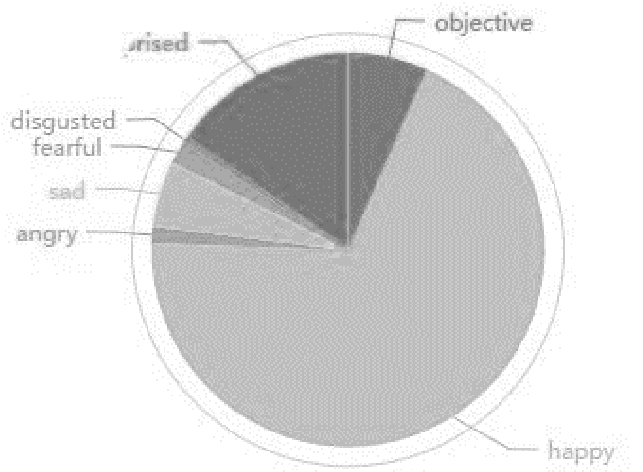 Fig 2. Visualization of emotional shifts across different stages of propagation.
Performance Metrics
The researchers used Mean Absolute Error (MAE) to compare the SIC model against the baseline IC model.
| Model | Time Slice 1 | Time Slice 2 | Time Slice 3 |
|---|---|---|---|
| Classic IC | 2.19 | 2.07 | 2.01 |
| SIC (Ours) | 2.21 | 1.96 | 1.78 |
While the model struggled slightly in the initial stage (due to lack of data/noise), it clearly outperformed the baseline as the event matured, proving that sentiment is a reliable predictor for long-term influence.
Critical Insight & Conclusion
The SIC Model moves us away from "Black Box" social modeling toward Interpretable AI. By acknowledging that (activation probability) is a function of emotion, we can better predict stock market fluctuations, movie box office success, and public opinion shifts.
Limitations: The reliance on a static dictionary for sentiment analysis might miss nuances like sarcasm or evolving internet slang. Future iterations integrating LLMs (Large Language Models) for the "Sentiment Engine" could further push the boundaries of SIC accuracy.
Takeaway: In the digital age, your influence isn't just about who you know, but how you make them feel.