
VISIT: Leveraging Social Topology to Uncover Truth in Crowdsourced Networks
Using Social Network Information in Community-Based Bayesian Truth Discovery
This paper introduces VISIT and S-VISIT, a Bayesian truth discovery framework that leverages social network information to aggregate opinions from unreliable agents. By integrating a mixed membership stochastic blockmodel with Laplace and stochastic variational inference, the method achieves SOTA performance in identifying event truths and agent reliabilities, especially in sparse data scenarios.
TL;DR
Determining the "ground truth" from conflicting crowdsourced reports is challenging when agents are biased or unreliable. This paper presents VISIT, a framework that uses social network connections to group agents into communities with shared biases. By utilizing Laplace and Stochastic Variational Inference, it outperforms traditional methods like Majority Voting and BCC, particularly when observations are sparse or when agents change their perspectives across different events.
Background & Motivation: Beyond Independent Agents
In the world of social sensing—from movie ratings to rumor detection—we usually treat agents as independent data points. However, humans are social animals. Our backgrounds, biases, and reliabilities are often correlated with our social circles.
The core insight of this paper is that social network information is a goldmine for truth discovery. If two agents are connected socially, they likely belong to the same community and share similar "Confusion Matrices" (the probability of reporting state when the true state is ).
The Limitations of Prior Work
- Majority Voting: Assumes every agent is equally reliable (often false).
- BCC (Bayesian Classifier Combination): Estimates individual reliability but struggles when an agent provides only a few reports (data sparsity).
- CBCC (Community BCC): Groups agents but assumes they stay in the same community forever and doesn't use the actual social graph structure.
Methodology: The Hierarchical Bayesian Approach
The authors model the problem using a Directed Acyclic Graph (DAG) that connects event truths, agent observations, and social ties.
1. The Generative Model
The model assumes that for every event, an agent "subscribes" to a community belief. This community defines a shared confusion matrix. Crucially, the model incorporates the Mixed Membership Stochastic Blockmodel (MMSB) to explain the social graph: if two agents are in the same community, the probability of a social link increases.
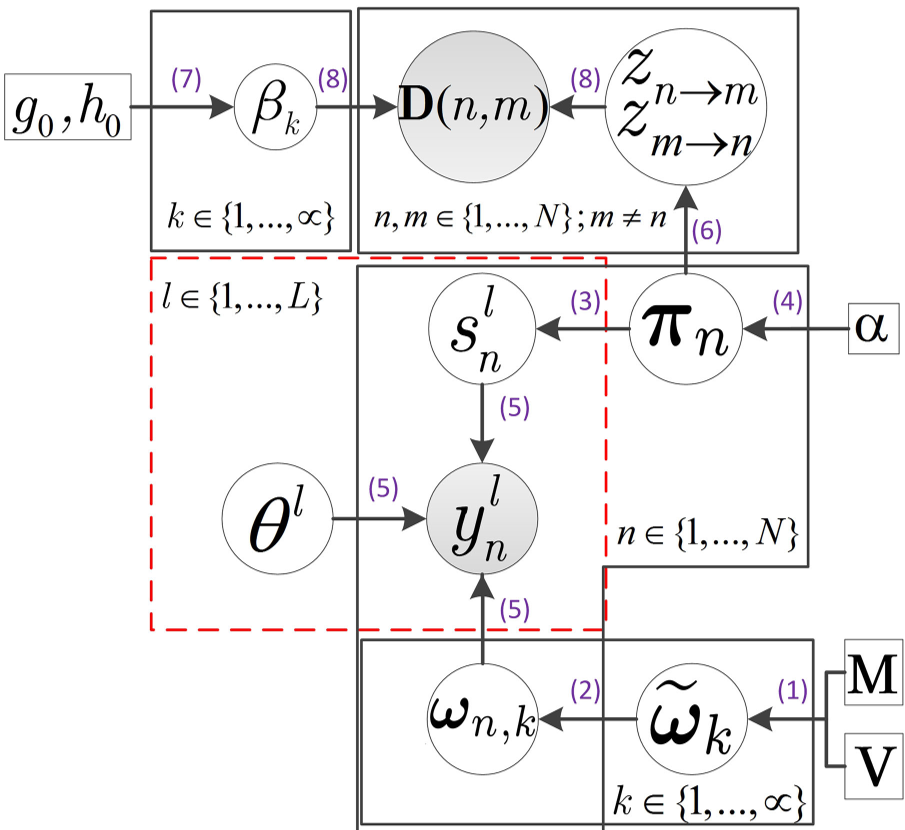 Figure 1: The proposed Bayesian Network model integrating social connections (D) and agent observations (y).
2. Inference: VISIT & S-VISIT
Because the model is non-conjugate (the Log-Normal community priors don't play nice with Dirichlet agent priors), the authors use Laplace Variational Inference.
To handle massive datasets, they introduce S-VISIT. It uses a three-level stochastic update:
- Agent Pair Level: Update social influence.
- Agent Level: Update individual weights and matrices.
- Global Level: Update community and event states.
Experimental Validation
The authors tested their method against 17 algorithms. Two scenarios were highlight:
- Static Communities: Agents have fixed biases.
- Switching Communities: Agents can adopt different community beliefs depending on the event (a more realistic, dynamic model).
Performance Highlights
In synthetic tests with high sparsity (90% missing data), VISIT maintained high accuracy while baselines like BCC degraded significantly.
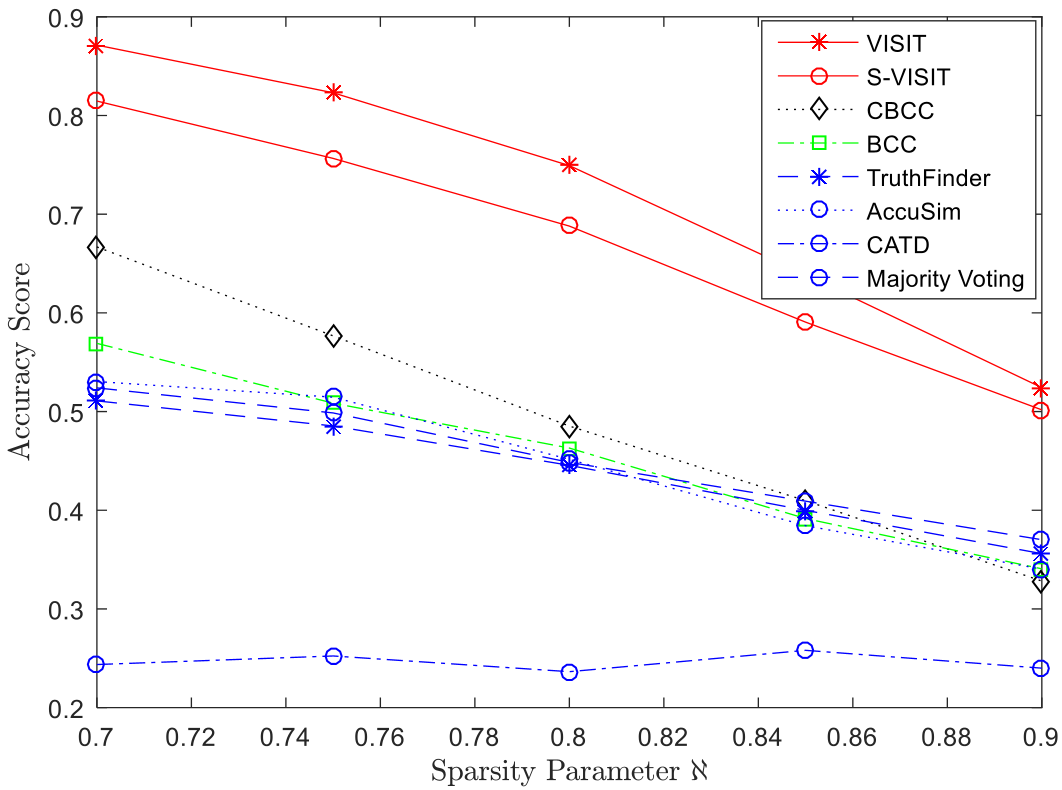 Figure 2: Accuracy scores in scenarios where agents remain in the same community. VISIT and S-VISIT significantly outperform classic BCC.
On real-world data like IMDB Movie Rankings, VISIT reached an accuracy of 0.75 for binary classification, whereas Majority Voting and TruthFinder hovered around 0.71.
Critical Analysis & Conclusion
The true value of this work lies in its robustness to sparsity. By using the social graph to cluster agents, the model can infer the reliability of an agent who has only made one or two reports by looking at their "neighbors."
Limitations:
- The model assumes the social network is known and static. In many real-world cases, the network itself might be noisy or evolving.
- The computational cost of Laplace approximations, while mitigated by S-VISIT, still requires careful hyperparameter tuning for the Log-Normal components.
Future Outlook: This framework sets a high bar for "social-aware" AI. Future iterations could integrate Deep Learning (like Graph Convolutional Networks) to replace the manual variational derivations, potentially capturing even more complex social dynamics.
Summary Takeaway
If you want to find the truth in a crowd, don't just listen to what they say—look at who they talk to. Social topology is not just metadata; it is a fundamental component of latent reliability.