
From Text to Tactics: Rapid Social Network Modeling for Crisis De-Escalation
Social Network Modeling and Agent-Based Simulation in Support of Crisis De-Escalation
The paper introduces the "Data-to-Model" (D2M) framework, a rapid pipeline for crisis de-escalation that extracts multi-mode social networks from unstructured text using Automap and assesses intervention strategies via the Construct agent-based simulation. It achieves SOTA-level operational efficiency by providing actionable insights into belief diffusion (e.g., "pro-war" vs. "anti-war") during the 2002 India-Pakistan crisis scenario.
TL;DR
Decision-makers in conflict zones often operate on intuition because robust simulations take too long to build. This paper presents a Data-to-Model (D2M) process that transforms massive text corpora into dynamic agent-based simulations in days, not months. Applied to the 2002 India-Pakistan crisis, it reveals why early diplomatic intervention is critical to stopping the "pro-war" feedback loop.
Background: The Latency of Deterrence
In the world of high-stakes deterrence, speed is life. Traditional modeling and simulation (M&S) often miss the window of opportunity. By the time researchers have hand-coded the relationships between actors, the missiles are already in the air. The authors identify a critical gap: the need for a rapid, repeatable, and semi-automated way to turn unstructured data (news, websites, reports) into a computable metanetwork.
Methodology: The D2M Pipeline & Construct
The core innovation is a two-stage engine:
- Automap (The Parser): It ingests thousands of text files (LexisNexis, official government sites) and performs ontological classification. It doesn't just find people; it identifies the relationships between agents, knowledge, and tasks—creating a rich metanetwork.
- Construct (The Simulator): Unlike simple models where everyone eventually agrees, Construct accounts for homophily (talking to people like yourself) and transactive memory (your flawed perception of what others know).
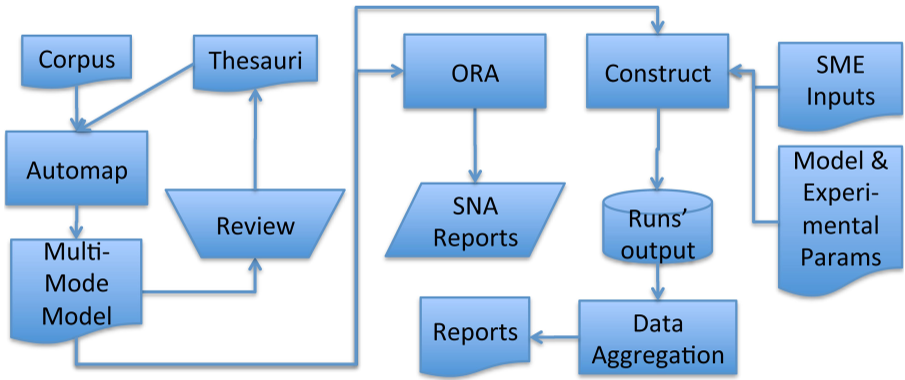 Fig 1: The Data-to-Model (D2M) workflow integrating text mining with dynamic simulation.
The Mathematics of Influence
The paper extends Friedkin's social influence theory. An agent's belief update is not just a simple average but a sum of their prior beliefs, their vulnerability to influence (BI), and the valence weights (V) of specific facts they hold. This explains why some actors remain "stubbornly" pro-war despite peaceful counter-messaging—the facts they hold are anchored to their identity.
Scenario: The 2002 India-Pakistan Standoff
The authors validated the method using a scenario involving 27,000 files and 79 strategic actors. By dividing the crisis into vignettes, they used the Organizational Risk Analyzer (ORA) to see how power shifted from diplomats to military commanders in real-time.
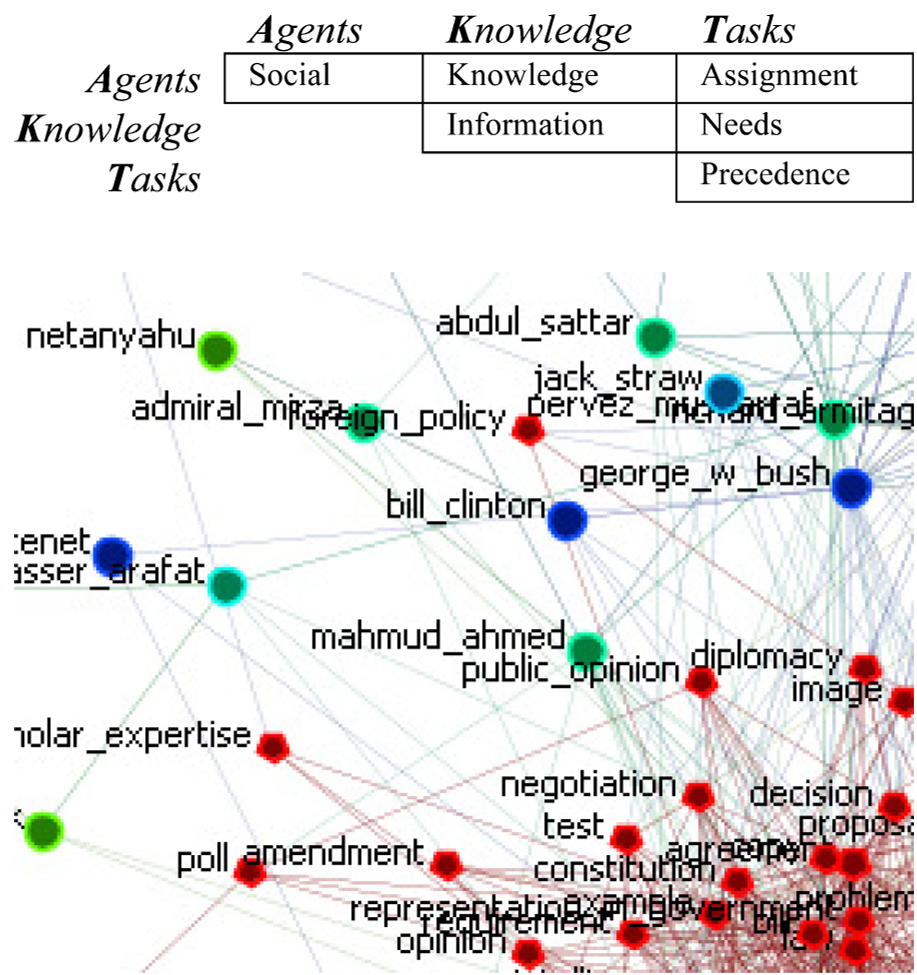 Fig 2: A metanetwork visualization where circles are agents and hexagons represent knowledge bits.
Key Results: The "Echo Chamber" Effect
The simulation results were stark:
- Baseline (No Intervention): Over 60% of leadership reached a pro-war consensus within a month.
- The Timing is Everything: "Early" interventions were significantly more effective than "Late" ones. Once the "pro-war" knowledge pool reaches a critical mass, the Echo Chamber Effect takes over. Agents reinforce their beliefs by interacting with similar agents, making later diplomatic efforts essentially invisible to them.
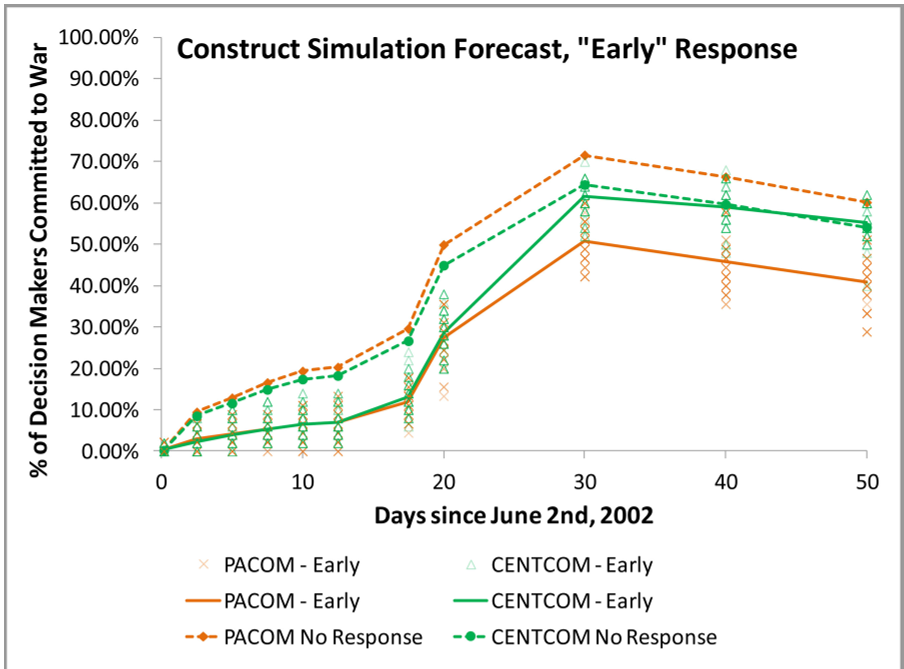 Fig 3: Comparison of intervention timing. Early action (bottom line) keeps pro-war beliefs at a manageable levels compared to late action.
Critical Insight & Future Outlook
This work's true value lies in its Triangulation. The authors compared the Construct results with other tools like Pythia (Bayesian nets) and CAESAR III (Petri nets). All three pointed to the same conclusion: the window for de-escalation is narrow.
Limitations: The model relies on the quality of the input text. If the text corpus doesn't capture the "internal" beliefs of a secret regime, the simulation might mirror public posturing rather than private intent.
Future Work: Integrating this pipeline with Generative AI could theoretically allow for real-time monitoring of global "belief climates," offering a dashboard for peace in an increasingly volatile world.
Conclusion
The D2M approach proves that social science isn't just for retrospective analysis. In crisis environments, being "roughly right" and "very fast" is often more valuable than being "perfectly right" and "too late."