
Decoding Classroom Dynamics: Using Fuzzy Concept Lattices to Map Social Networks
Social Network and One-sided Fuzzy Concept Lattices
The paper presents a socio-technical experiment applying One-sided Fuzzy Concept Lattices and a modified Rice-Siff hierarchical clustering algorithm to analyze a social network of 34 secondary school students. The core achievement is the transformation of complex, multi-valued relationship data into a manageable hierarchy of social clusters that effectively mirror real-world dynamics.
TL;DR
Researchers have successfully applied a specialized form of Formal Concept Analysis (FCA)—One-sided Fuzzy Concept Lattices—to map the social intricacies of a 34-student classroom. By utilizing a modified Rice-Siff algorithm, they reduced a massive mathematical search space of 25,000 possibilities into 33 actionable social clusters, accurately predicting real-world friendships and seating arrangements.
Background: The Complexity of "Friendship"
In social network analysis, we often simplify relationships to a binary: either you are friends, or you aren't. However, human interaction exists on a spectrum. The authors of this paper utilized a 7-point Likert scale (from -3 "Dislike" to +3 "Very good friend") to capture the grain of 12-year-old social life.
The challenge? When you apply Formal Concept Analysis (FCA)—a mathematical method that groups objects sharing common attributes—to such multi-valued data, you face a "combinatorial explosion." In this study, the raw data generated over 25,000 mathematical "concepts," a number far too large for any teacher or researcher to interpret.
Methodology: From Fuzzy Logic to Social Clusters
To bridge the gap between abstract math and social reality, the study employed two key technical innovations:
1. One-sided Fuzzy Concept Lattices
Instead of forcing the data into a binary format, the authors used a fuzzy approach.
- Objects (Students): Remain as distinct, "crisp" individuals.
- Attributes (Relationships): Treated as fuzzy sets. A "concept" in this framework is a group of students who are viewed by others in a similarly graded way. The relationship degree is mapped to the interval, allowing the math to respect the intensity of the students' feelings.
2. The Modified Rice-Siff Algorithm
To solve the "Concept Explosion," the authors didn't just filter the results; they used a metric-driven hierarchical clustering approach. They replaced the classical Rice-Siff distance (which measures intersection over union for sets) with a fuzzy metric:
This formula calculates the distance between social clusters based on the overlap of their "fuzzy intents." It allows the algorithm to "glue" the nearest clusters together step-by-step until a readable hierarchy is formed.
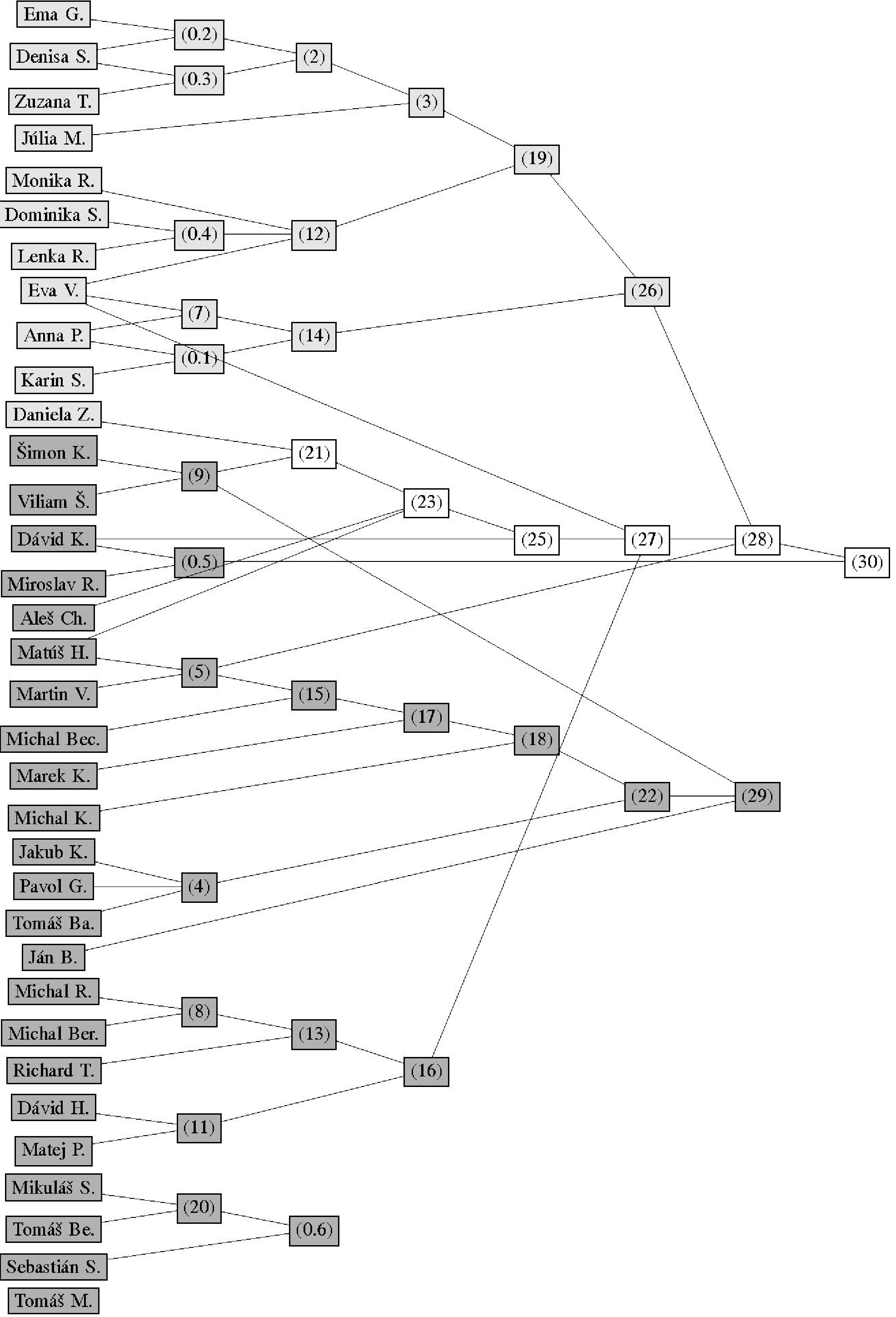 Figure 1: The resulting dendrogram showing the hierarchical merging of student groups, with distinct gender-based clusters (Boys in dark gray, Girls in light gray).
Experimental Insights: Does the Math Match Reality?
The results were remarkably consistent with the class teacher's observations:
- Gender Segregation: The algorithm clearly separated the class into boy-dominated and girl-dominated clusters, reflecting the natural developmental stage of 12-year-olds.
- Predicting Pairs: In Slovakia, students sit in pairs. The model successfully identified 10 of the students' self-chosen seating pairs as early-stage clusters.
- Social Outliers: The model identified a specific cluster (0.6) composed of three boys who were marginalized due to shared negative socio-economic perceptions—an insight that could allow for targeted pedagogical intervention.
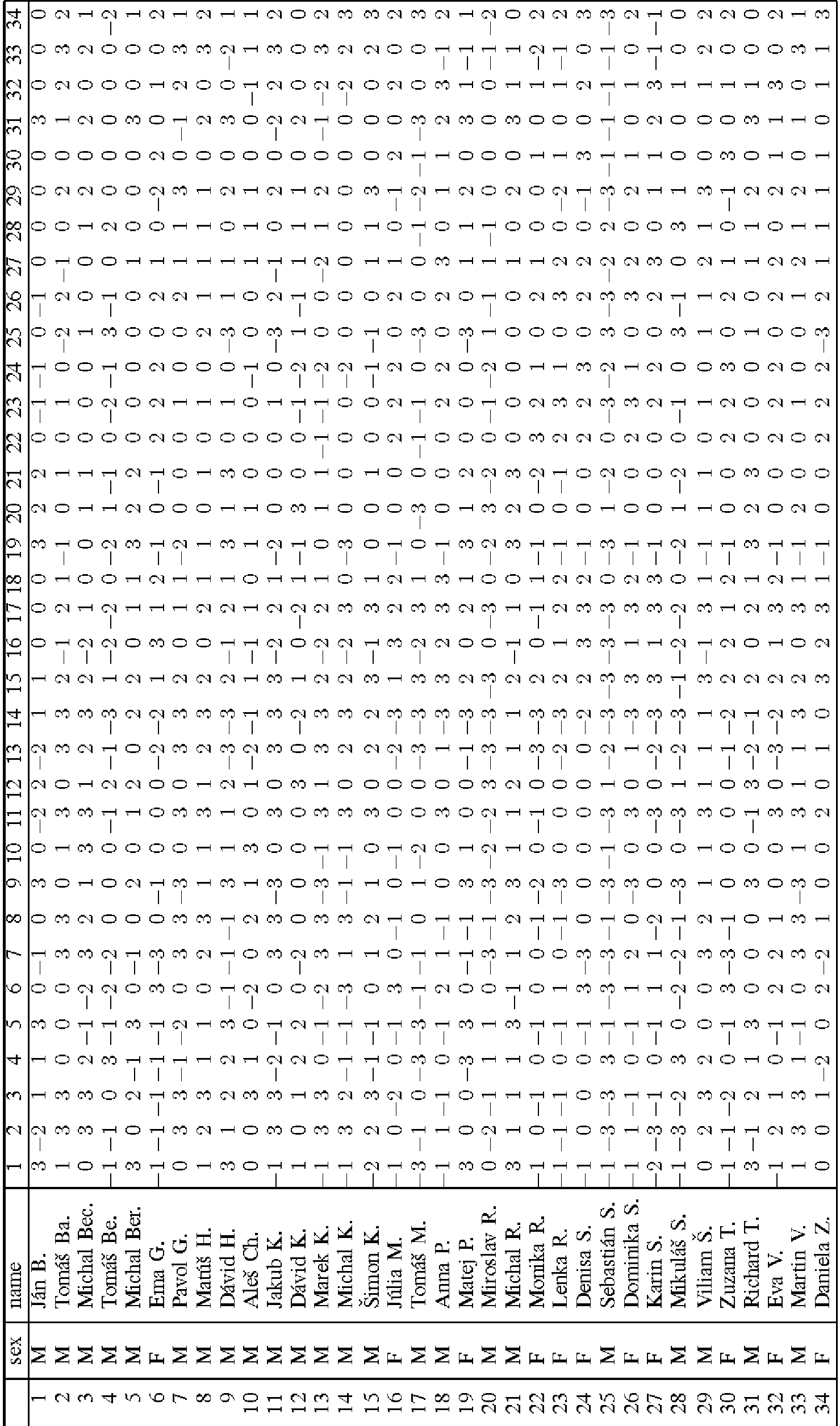 Figure 2: The raw evaluation matrix () used as the fuzzy relation .
Critical Analysis & Conclusion
This paper demonstrates that FCA isn't just a theoretical tool for computer scientists; when combined with metric-based pruning, it becomes a powerful instrument for Social Signal Processing.
Limitations
- Scalability: While the Rice-Siff reduction works for 34 students, the underlying context construction is still computationally heavy for massive networks (e.g., thousands of nodes).
- Dynamic Nature: Social networks are temporal, and this study provides a static snapshot.
Future Outlook
The "One-sided" approach is particularly clever because it keeps the groups (extents) easy to understand for humans while letting the "feelings" (intents) be complex and fuzzy. This framework could be applied to HR talent management or Recommendation Systems where users (objects) are grouped by their fuzzy preferences for products (attributes).
Ultimately, the study proves that even in the messy world of middle-school social life, there is a distinct, discoverable mathematical order.