
SNO-Driven Design: Tripling Vehicle Energy Harvesting Efficiency
Optimized linear generator for vehicle energy harvesting by social network optimization algorithm
This paper introduces a novel metaheuristic algorithm, Social Network Optimization (SNO), to optimize the design of a Tubular Permanent Magnet Linear Generator (TPMLG) for vehicle energy harvesting. The method achieves a significant power output increase—over 3x compared to reference designs—while balancing vehicle comfort and road-holding performance.
TL;DR
Researchers from Politecnico di Milano have successfully applied a new evolutionary algorithm, Social Network Optimization (SNO), to the design of linear generators for vehicles. By simulating social interactions to find optimal geometric parameters, they developed a generator that harvests 3x more energy from road bumps without making the ride any bumpier for the passengers.
The Challenge: Power vs. Comfort
In the quest for greener transport, capturing the wasted kinetic energy from vehicle suspensions is a "holy grail." However, the design space is a nightmare:
- Complexity: Dozens of variables (stator thickness, magnet height, winding turns) interact non-linearly.
- Trade-offs: A generator that captures too much energy might act like a rigid pillar, destroying passenger comfort and tire grip.
- Simulation Cost: Evaluating a single design requires heavy Finite Element Method (FEM) calculations and multi-body vehicle dynamics simulations.
Methodology: Optimization Through Socializing
The authors move away from traditional Genetic Algorithms (GA), which can be slow to converge, and introduce Social Network Optimization (SNO).
How SNO Works
SNO treats every candidate solution as a "person" with a character (search behavior) and a situation (the current design parameters).
- Interaction: Solutions are grouped into "Friends" (similar designs) and "Peers" (similar behaviors).
- Influencers: High-performing designs become "Influencers," dragging the rest of the population toward the optimal region of the design space.
- Explorers: Some individuals are designated as "Explorers" to ignore influencers and search distant areas, preventing the algorithm from getting stuck in local optima.
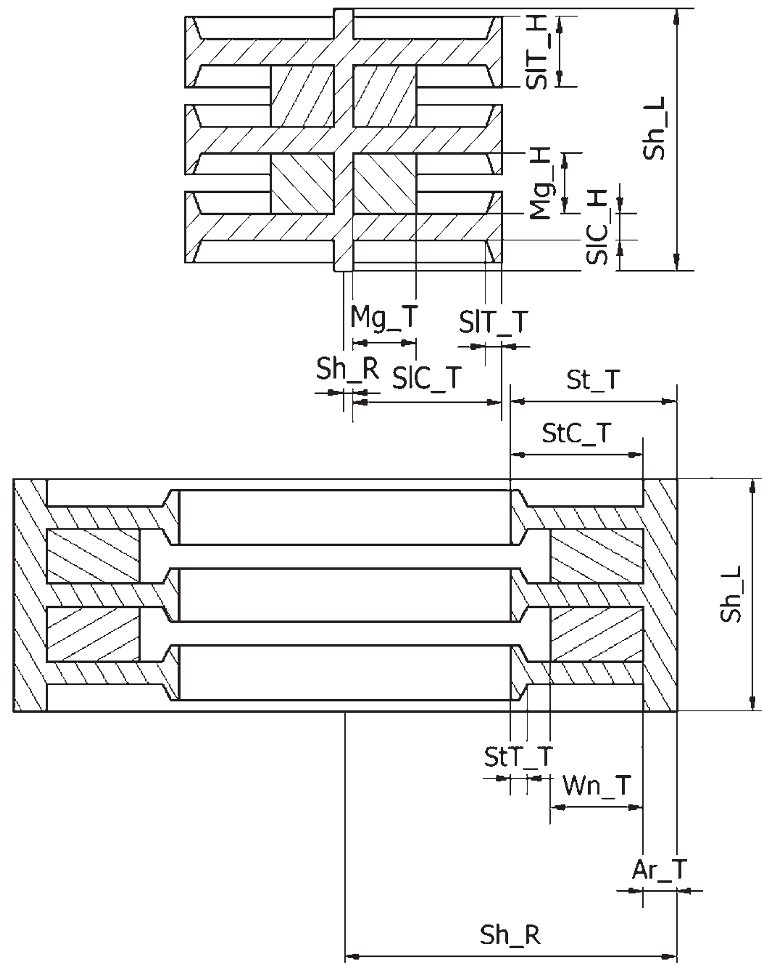 Figure 1: The architecture of the Tubular Permanent Magnet Linear Generator (TPMLG) showing the stator and slider modules.
The Multi-Physics Bridge
To accurately test the SNO output, the authors built a comprehensive 7-Degree of Freedom (7-DOF) vehicle model. This model accounts for:
- Vehicle Dynamics: Pitch, roll, and vertical translation of the car body.
- Road Irregularity: Simulated using the ISO8608 standard to represent "real-world" urban road conditions.
- Electromagnetic Feedback: The generator's force is calculated in real-time, ensuring the energy harvesting doesn't negatively impact the suspension's damping.
Experimental Results
The results were stark. By using a scalarized objective function that penalized poor comfort and maximized power, the SNO found a geometry that significantly outperformed baseline designs.
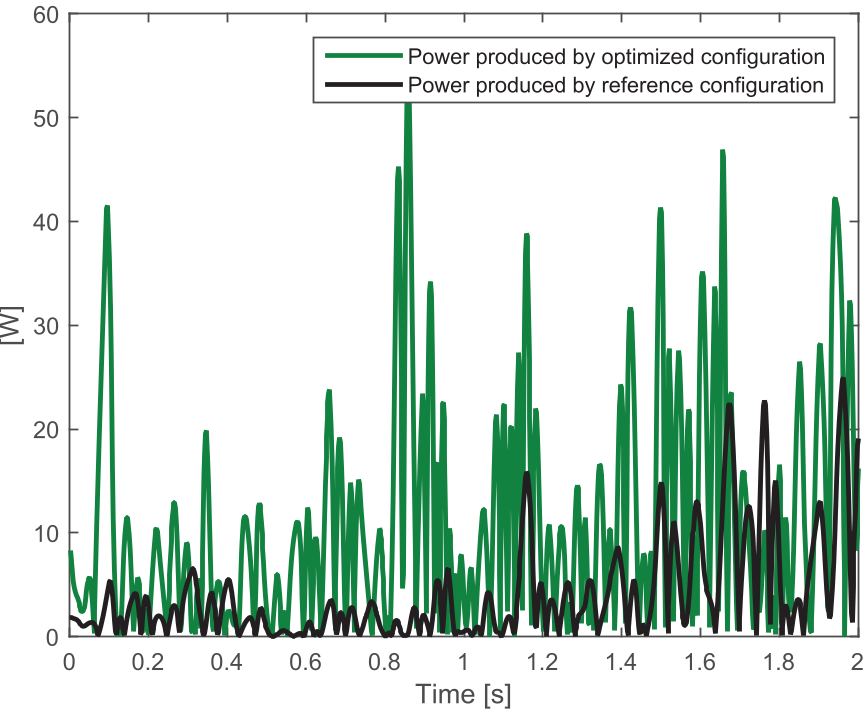 Figure 2: Instantaneous power and energy comparison. Note the 3x increase in energy harvested on a standard urban road profile.
- Power Boost: More than 300% increase in harvested energy.
- Ride Quality: The Comfort Index (RMS of body acceleration) remained virtually unchanged, proving that energy harvesting can be "invisible" to the driver.
Deep Insight & Conclusion
The core value of this work isn't just the 3x power gain; it's the demonstration that Social Network Optimization handles the "noise" and complexity of multi-domain simulations (Magnetics + Mechanics) better than older heuristics.
Limitations: While the simulation is robust, the study assumes a constant vehicle speed. Real-world stop-and-go traffic might alter the frequency of vibrations, potentially requiring adaptive generator tuning.
Future Outlook: SNO could be a powerful tool for designing other complex electromechanical systems, such as active robotic joints or regenerative braking systems for micro-mobility.