
OSN-P2P Hybrid: Leveraging Social Capital for Resilient Video Streaming
Taking Advantage of Social Network Relationships in P2P Streaming Overlays
The paper proposes a novel P2P streaming architecture that integrates Online Social Network (OSN) relationships to optimize video distribution. By implementing a preemptive priority mechanism, the system creates a "privileged" class of users (OSN friends) who receive guaranteed service quality even during critical bandwidth scarcity (overloaded conditions).
TL;DR
This paper bridges the gap between Online Social Networks (OSNs) and Peer-to-Peer (P2P) Streaming. By introducing social-aware preemptive priority, the authors demonstrate that "friendship" in the digital realm can be converted into "bandwidth" in the physical realm. When a network is under heavy load, your social connections ensure you don't lose your stream, even if it means bumping an anonymous user off the line.
Background: The Social-Technical Gap
Most P2P protocols operate on a "selfish-but-fair" basis—peers share resources to receive them, but every peer is treated as an anonymous node. However, human society doesn't work this way. We are more likely to share resources with friends or acquaintances. The authors argue that by embedding social graphs (like Flickr’s) into P2P overlays, we can create a more robust delivery mechanism that prioritizes "trusted" nodes during congestion.
Methodology: Socially-Aware Preemption
The core innovation is the Preemptive Priority Mechanism. The authors define a Resource Index ():
When , the total upload capacity is less than the required download rate, and the system is "overloaded." In this state, the system switches from fair treatment to social prioritization:
- Direct Friends: A new OSN peer can ask direct friends to drop a non-OSN "child" and serve them instead.
- Two-Hop Friends (Friends-of-Friends): The search radius expands. If a direct friend can't help, their friends are contacted.
- OSN Community: Any OSN member prioritizes any other OSN member over "outsiders."
Modeling the Social Graph
To make the study realistic, the authors didn't just use a random graph. They modeled the evolution of Flickr, amending the standard Leskovec model to account for the "Initial Spike" of users and the "Short-lived" nodes (users who join but never engage).
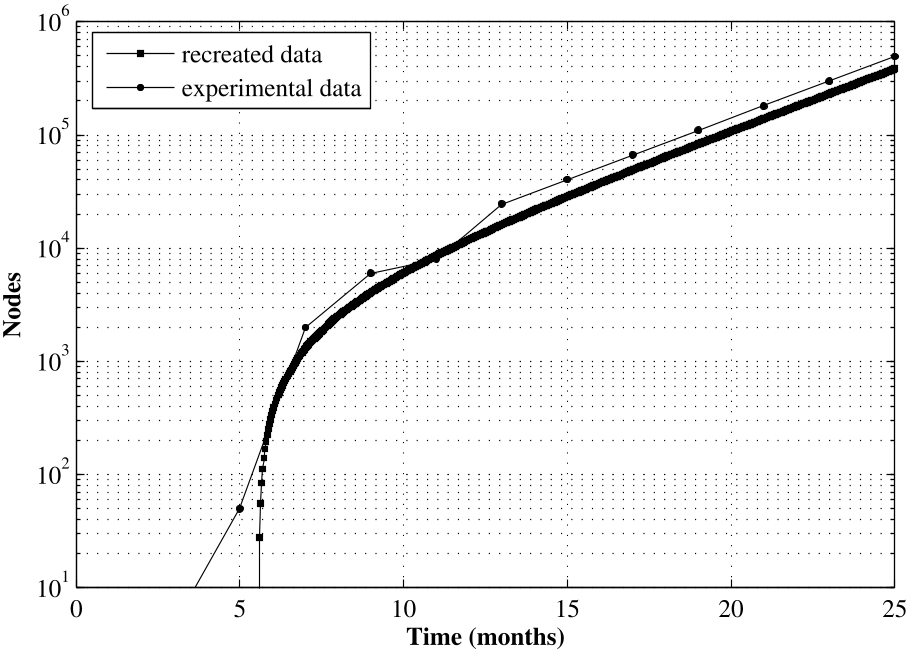 Figure 1: Comparison of the original evolution model vs. the authors' amended model to fit real Flickr data.
Experimental Performance
Using the PeerSim simulator with 100,000 nodes, the study tested these strategies in a heterogeneous environment (mixture of residential users, institutional users, and free riders).
High Stakes: Receiving the Entire Video
In an overloaded scenario (), the results are striking. As shown in the graphs below, the "Two-Hops" and "All OSN" strategies create a massive performance gap between "in-network" (inSN) and "out-network" (outSN) users.
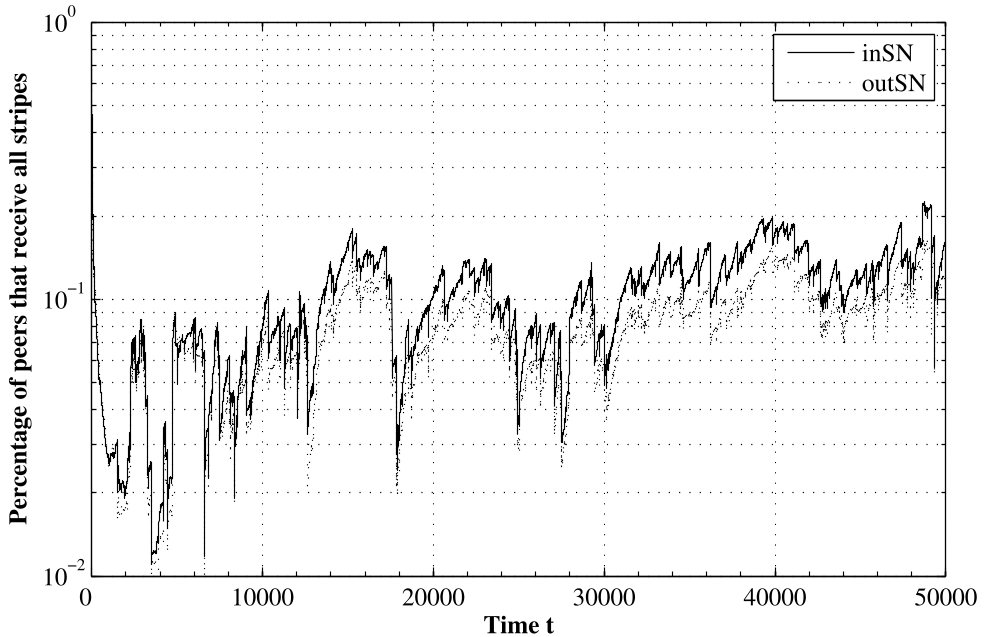 Figure 2: Probability of receiving the full video for (a) Direct Friends, (b) Two-Hop Friends, and (c) All OSN members.
The CDF of Video Quality
When looking at the Cumulative Distribution Function (CDF) of received substreams (stripes), the social strategy acts as a quality stabilizer. While ordinary peers might only get 4-5 stripes (basic quality), OSN members consistently hit 7-8 stripes (high quality) by "borrowing" the slots of non-members.
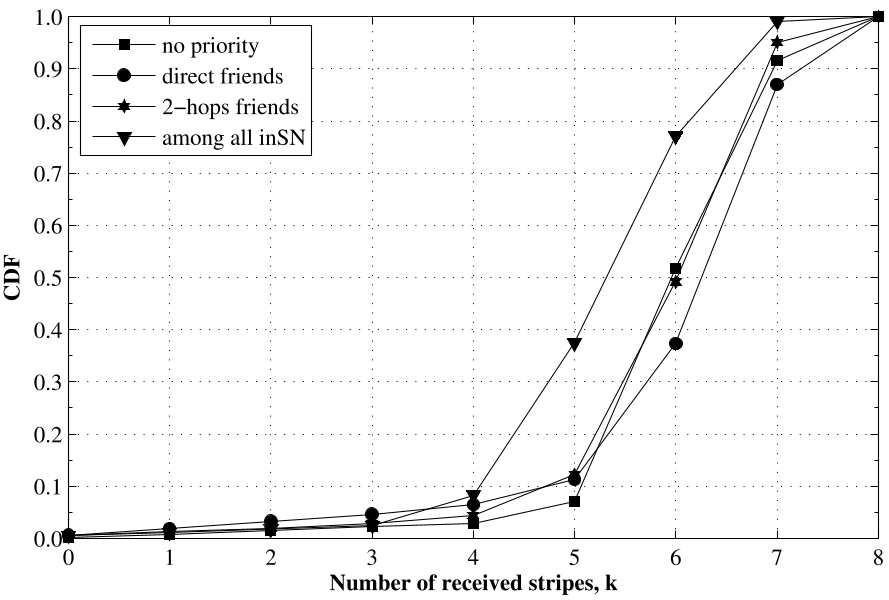 Figure 3: OSN members (inSN) see their stripe count shift heavily toward the maximum (8) as social help expands.
Deep Insights & Limitations
- The Price of Privilege: This setup creates a "digital divide." While OSN members thrive, non-OSN members suffer significantly higher churn and lower quality. This acts as a strong social incentive to join the OSN.
- Scalability of Trust: The "Two-Hop" strategy strikes the best balance. Direct friends are often too few to provide meaningful bandwidth, while the "Global OSN" strategy risks becoming a centralized-like priority list that ignores the "social" nature of the connection.
- Privacy Concerns: The paper focuses on performance but overlooks the privacy implications of a P2P tracker knowing your entire social graph to facilitate these connections.
Conclusion
This work demonstrates that technical systems shouldn't ignore the social contexts in which they operate. By formalizing "friendship" as a routing priority, P2P networks can maintain high QoS for loyal user bases even under extreme stress.