
Scaling Social Networks: Multi-Agent Synergy in Resource Scheduling
Data Scheduling Method of Social Network Resources Based on Multi-Agent Technology
This paper introduces a social network resource data scheduling method leveraging Multi-Agent technology and a two-level Content Delivery Network (CDN) framework. By integrating reasoning tools for SLA assessment and a two-stage placement algorithm, the approach maintains a stable processing time of ~10s even as data volume scales significantly.
Executive Summary
TL;DR: This research tackles the bottleneck of social network data processing by replacing rigid, centralized scheduling with a flexible Multi-Agent Technology framework. By utilizing a two-level structure and SLA-based reasoning, the method caps data processing latency at 10 seconds, regardless of increasing task loads.
Context: This work positions itself as a structural optimization in the field of Distributed Computing. It shifts from traditional "empirical scheduling" to an intelligent, proactive architecture that views resources not as static entities, but as a dynamic virtual pool.
The Problem: The Latency Trap in Social Resources
As social networks grow, the diversity of data (video, text, interactions) and the heterogeneity of hardware (different CPU powers, memory sizes) create a scheduling nightmare.
- Heterogeneity Blindness: Traditional methods often treat all nodes the same, leading to "SLA breaches" when a weak node is overloaded.
- The Instantaneous Peak Problem: Short bursts of activity trigger unnecessary VM migrations, wasting energy and bandwidth.
- Resource Fragmentation: Imbalanced use of resources (e.g., high CPU but low Memory) prevents new tasks from being assigned, leaving hardware idle but "full."
Methodology: Hierarchical Intelligence
The authors propose a framework that uses SLA (Service Level Agreement) comprehensive levels to quantify actual node performance rather than just raw utilization.
1. The Multi-Agent Architecture
The system uses a hierarchical approach: "Upper-level Agents" manage global strategy, while "Second-level Agents" control specific management domains across three CDN layers. This hides the complexity of underlying hardware from the end-user.
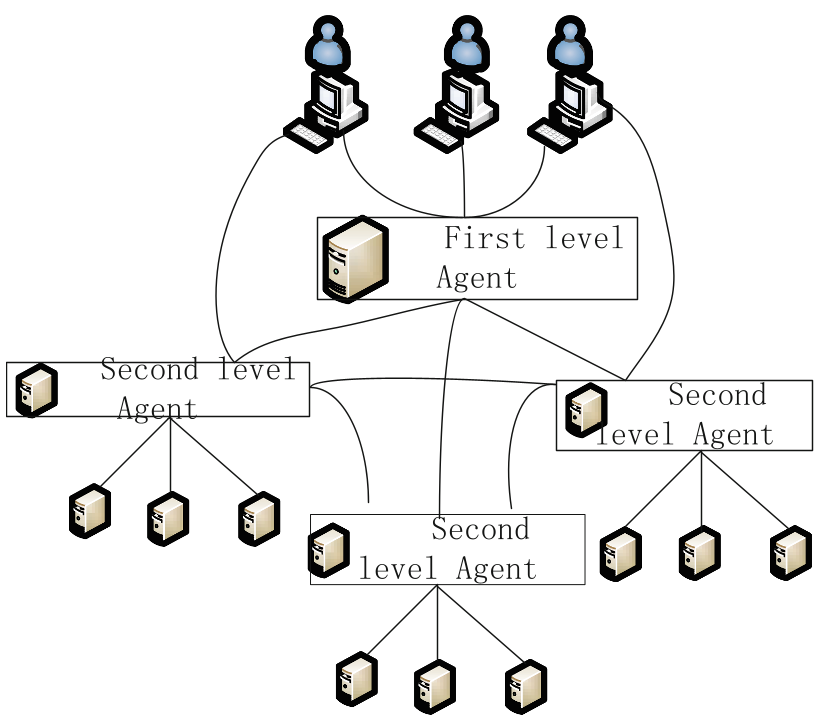 Fig 1. The Hierarchical Agent Framework connecting virtual resource pools.
2. Solving Fragmentation through Skewness
To ensure physical machines don't become "fragmented," the authors introduce a Skewness formula. By calculating the standard deviation of utilization across different resource dimensions (CPU, RAM, Net), the system picks nodes where the resources are being used in a balanced way.
The goal is simple: The smaller the skewness, the better the balance.
Experiments and Results
Testing was conducted via CloudSim 3.1, simulating a variety of virtual machine types (Single to Quad-core) and task lengths.
Performance Scalability
The most striking result is the relationship between task volume and processing time.
- Traditional Methods: Time increases linearly. As the task volume hits 120, these systems struggle to keep pace.
- Proposed Multi-Agent Method: After an initial ramp-up, the processing time plateaus at approximately 10 seconds.
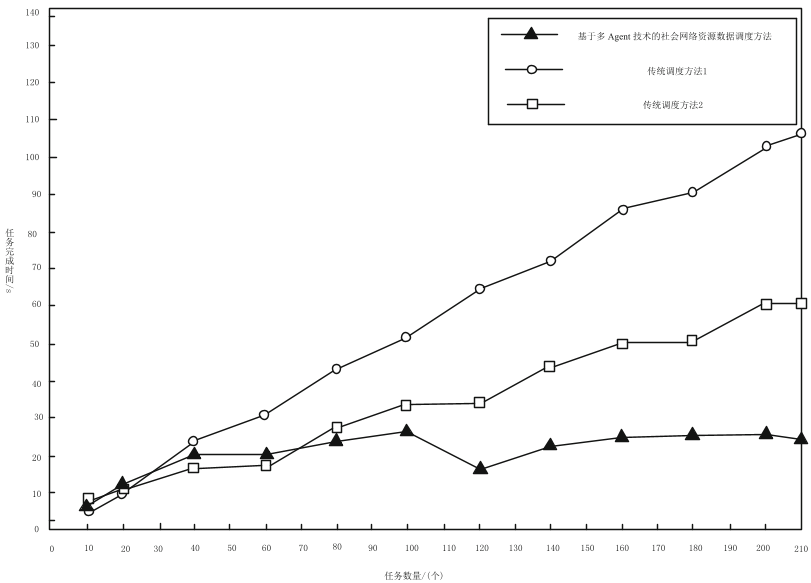 Fig 2. Processing time stability of the Multi-Agent approach vs. traditional benchmarks.
Critical Insight & Conclusion
Takeaway
The core achievement of this paper is the transition from Reactive to Proactive management. By using reasoning tools to predict "Upper Limit Trigger Conditions," the system avoids the trap of reacting to "instantaneous peaks" that don't reflect actual load needs.
Limitations
While the 10-second stability is impressive, the paper primarily focuses on static resource pools. In a real-world "Social Network" scenario, the topological connections between agents (who is talking to whom) could further optimize data locality, a factor not deeply explored here.
Future Outlook
This Multi-Agent approach lays the groundwork for Crowdsourced Task Management. By treating every network node as an autonomous agent, we move closer to a truly self-healing, self-optimizing "Global Computer" for social media.