
Understanding Rumor Dynamics: A Cellular Automata Approach to Social Networks
Social Network Rumors Spread Model Based on Cellular Automata
This paper proposes a novel rumor-spreading model for Online Social Networks (OSNs) based on Cellular Automata (CA). It introduces a 7-state classification of user behavior and demonstrates through simulation how immunization strategies and transmission rates affect the global equilibrium of information dissemination.
TL;DR
To counteract the viral spread of misinformation, researchers have moved beyond simple biological "infection" models. This paper introduces a 7-state Cellular Automata (CA) model that simulates how rumors evolve through individual skepticism, peer influence, and debunking efforts. The study mathematically proves that increasing "common sense" (immunization) and spreading positive truths are the most effective ways to dissolve a rumor cycle.
Background & Motivation: Moving Beyond SIR
Most early research viewed rumors as a biological virus, using the classic SIR (Susceptible-Infectious-Recovered) model. However, human behavior on platforms like Twitter or Facebook is more nuanced. A user doesn't just "catch" a rumor; they might question it, ignore it, or actively fight it.
The authors argue that traditional models lack the mechanistic depth to explain why some rumors die instantly while others cause global panic. Their insight? Use Cellular Automata—a bottom-up simulation tool—to observe how simple local interactions between "friends" create complex global social phenomena.
Methodology: The 7-State Evolution
The core of this research is the subdivision of a social network user into seven distinct states ():
- Uncontacted (0): Oblivious to the rumor.
- Contacted (1): Aware, but hasn't formed an opinion.
- Believing (2): Accepts the rumor as truth.
- Disbelieving (3): Rejects the rumor but stays silent.
- Transferring (4): Actively spreading the rumor.
- Questioning (5): Doubtful, seeking more info.
- Refuting (6): Actively debunking the rumor.
Model Architecture
The model operates on a grid where each cell interacts with its Moore Neighborhood (the 8 surrounding cells). The transitions are governed by probabilities like (Immunization success) and (Transmission rate).
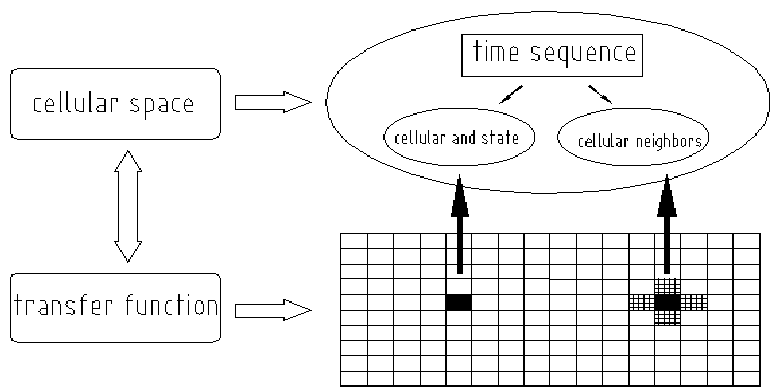 Fig 1: The CA framework, showing how local rules determine global behavior.
Experiments: The Threshold of Virality
Through heavy simulation, the authors discovered a phase transition. By tweaking (the spread rate), they found a threshold at 0.07.
- If : The rumor essentially stays localized and eventually dies out.
- If : The rumor spreads to the entire population in a constant number of steps.
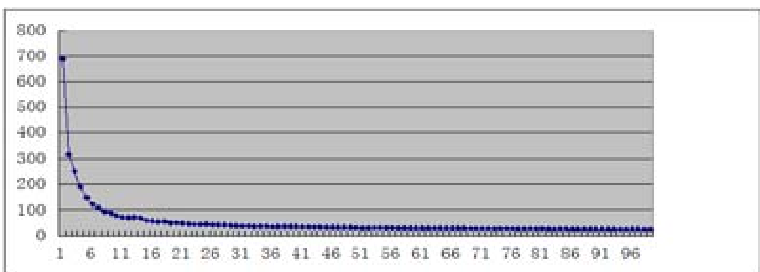 Fig 3: Time steps to total saturation vs. transmission rate (). Note the sharp curve at the threshold.
The Power of Immunization
One of the most striking findings is how immunization changes the "curve" of a rumor. When is high (0.5), the rumor never gains significant traction and exhibits a symmetrical rise and fall, rather than a steep, uncontrollable spike.
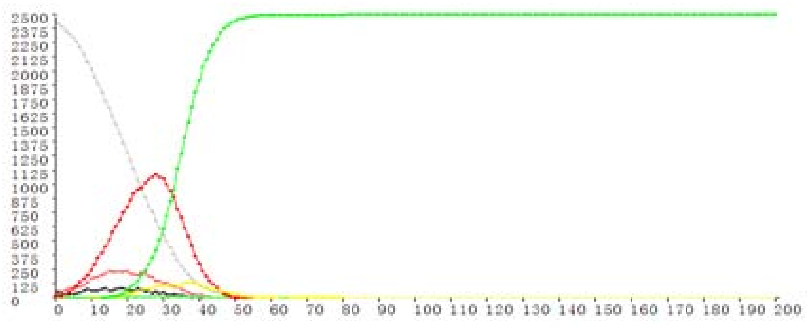 Fig 6: Rumor suppression at high immunization levels ().
Verification & Real-World Implications
The authors validated their CA model using a real-world social network circle of 161 nodes. They found that the spread of information was highly correlated with the "Common Sense" index of the nodes. Messages that contradicted basic facts (high expected immunity) failed to spread, matching their simulation results.
Immunization Strategy: "Rumors Stop at the Wise"
The paper concludes that there is a "local confrontation" between positive and negative information. If a society is "conservative" (unwilling to change views), the confrontation is long-term and turbulent. If the environment is "open" (high acceptance of refutations), the rumor reaches equilibrium and disappears quickly.
Critical Analysis & Conclusion
Takeaways
- Granularity Matters: Breaking "Immunity" into "Questioning" and "Refuting" creates a more realistic simulation of social media friction.
- Thresholds are Key: Content creators and moderators should focus on keeping transmission rates below the critical 0.07 threshold.
Limitations & Future Work
While the grid-based CA is intuitive, real social networks are non-Euclidean (Scale-free or Small-world graphs). Future research should apply these 7-state rules to more complex graph topologies and consider the "weight" of social influence (e.g., an "Influencer" node vs. a regular user).
Ultimately, this work proves that the most effective way to kill a rumor isn't just to delete it, but to empower users with the "positive information" needed to become active refuters.