
MLS Framework: Leveraging Social "Follow the Leader" Dynamics for Semantic Web Service Selection
A social network approach in Semantic Web Services Selection using Follow the Leader behavior
This paper introduces the Market Leadership Selection (MLS) framework, an ontological architecture for Semantic Web Service (SWS) selection that integrates social network analysis with a "Follow the Leader" behavioral model. The system utilizes a recommender engine to identify "Market Leaders" among services, helping users bypass complex manual Quality of Service (QoS) evaluations.
TL;DR
To address the complexity of choosing the "best" web service from thousands of candidates, researchers have developed the Market Leadership Selection (MLS) framework. By combining Semantic Web ontologies with a social network "Follow the Leader" model, the system identifies expert users (Leaders) and allows regular users (Followers) to adopt their successful service choices, significantly reducing the cognitive load of decision-making.
Background & Motivation: The Paradox of Choice
In the era of Semantic Web Services (SWS), discovery is no longer the primary bottleneck—selection is. While a system can find 50 services that "book a flight," how does a user choose which one is the most reliable, cheapest, or fastest?
Current SWS selection relies on non-functional properties (Quality of Service/QoS), but users are notoriously bad at:
- Defining precise preferences.
- Assigning mathematical weights to priorities.
- Dealing with the "Cold Start" problem where no prior data exists for a new service or user.
The authors' insight is simple yet profound: In the real world, people don't calculate utility functions; they ask their friends.
Methodology: Who are the Leaders?
The MLS framework utilizes Goldbaum’s "Follow the Leader" model. Within this social ecosystem, agents are categorized based on their "Confidence Relation":
- Leaders: Users with high self-confidence and explicit preferences. They spend the effort to analyze service features and provide high-quality feedback.
- Followers: Users who lack certain innate preferences and gain utility by imitating the choices of trusted Leaders in their social network.
The Architecture
The system is built on a modular stack that bridges technical service descriptions with social behavior:
- Follower-Leader Ontology: Maps the social hierarchy.
- User Preferences Ontology: Categorizes functional and non-functional (QoS) attributes like response time and trust.
- Social Network Inducer Module (SNIM): Analyzes social graphs (like FOAF) to identify potential "friends" and leaders.
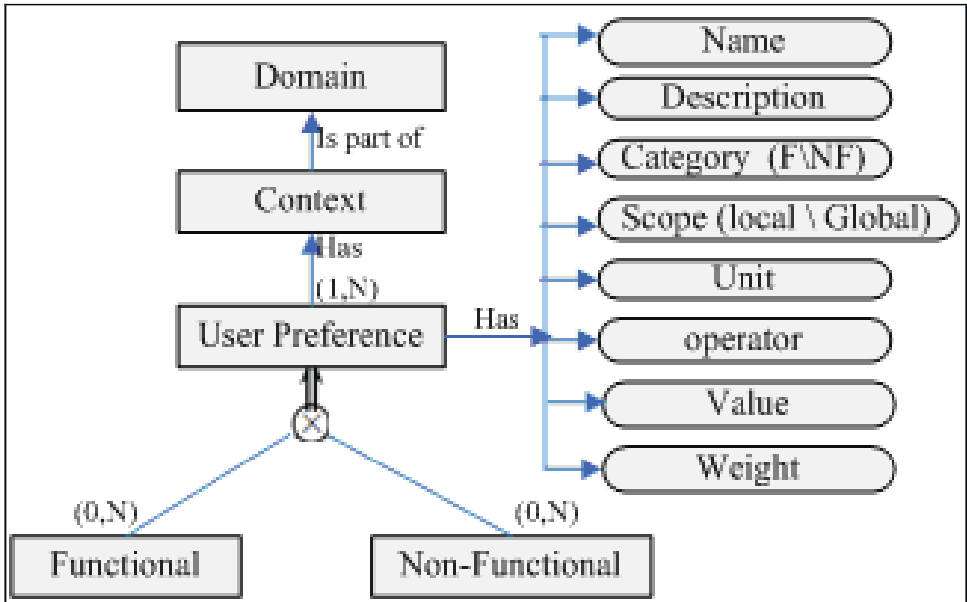 Figure: The Follow the Leader Architecture integrating RM and SNIM modules.
Mathematical Selection Logic
While Followers imitate, the system still needs a way for Leaders to find the best service initially. The authors propose a Utility Function () to rank services:
Where is a normalized score for a QoS attribute. If an attribute needs to be maximized (like reliability), a higher value increases the utility; if it needs to be minimized (like cost), the inverse is applied. This ensures that the "Market Leader" service is mathematically sound before it becomes socially popular.
Simulation & Insights
Using the NetLogo simulation environment, the authors tested 100 customers interacting with 30 atomic services over 500 rounds.
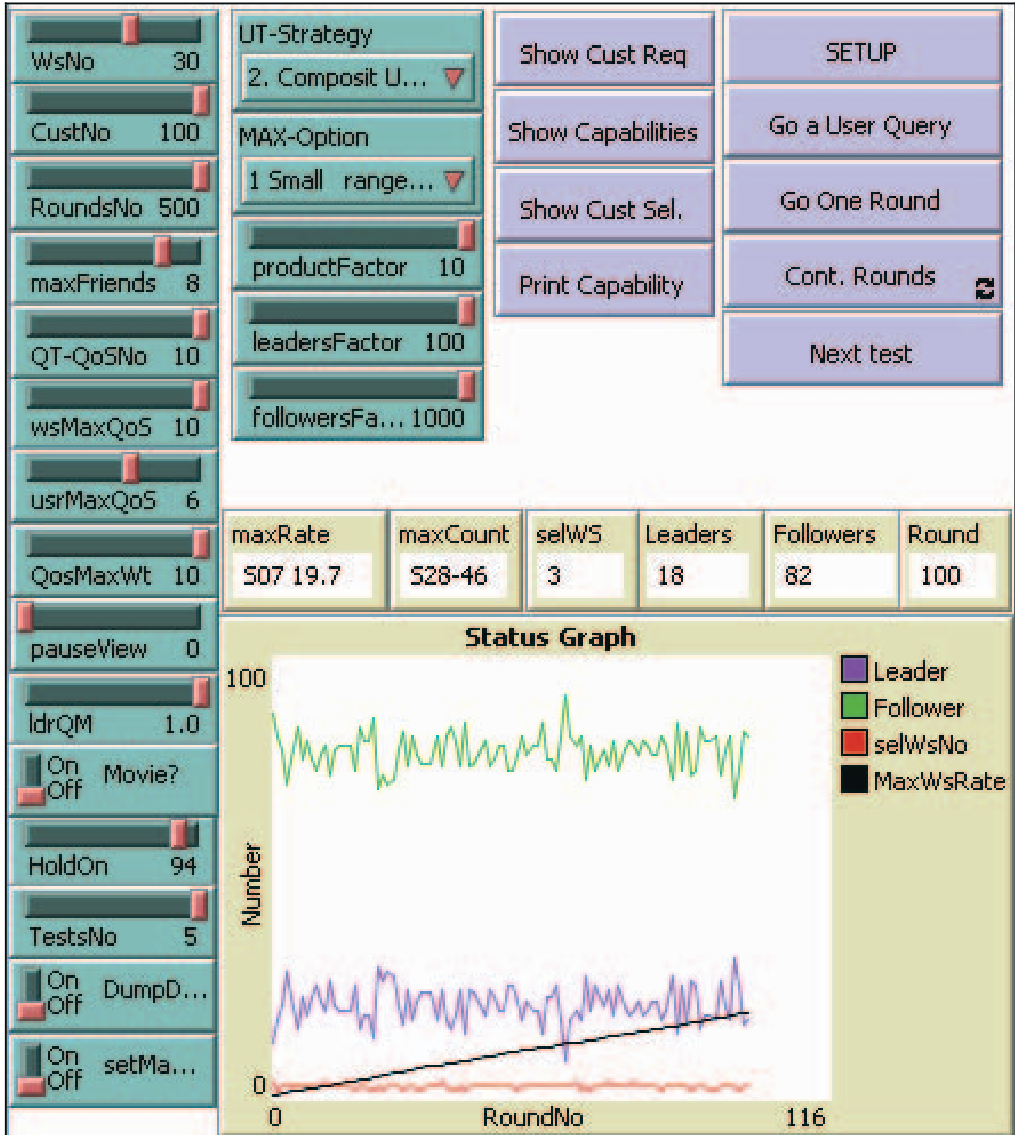 Figure: The Service Selection Simulation Interface.
Key Findings:
- Efficiency: An average of 21% of users acting as Leaders was sufficient to guide the remaining 79% of the population.
- Market Concentration: The "Market Leader" service (defined by high capability) naturally attracted about 40% of all traffic, validating that the "Follow the Leader" behavior successfully converges on high-quality services.
- Cold Start Solution: By using an evolutionary approach to build a preference database from existing QoS ontologies, the system manages to provide recommendations even in the early stages of deployment.
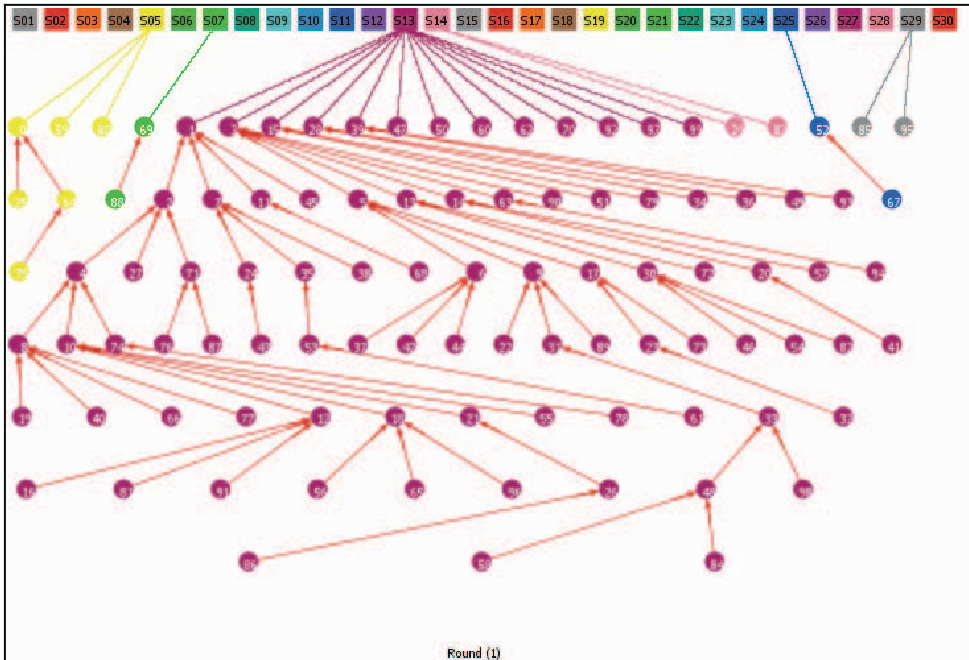 Figure: Accumulative rate of the Market Leader (S07) over time.
Critical Analysis & Conclusion
The MLS framework successfully shifts the paradigm of service selection from "User vs. Machine Optimization" to a "Socially Assisted Selection."
Strengths:
- Reduces user input requirements significantly.
- Captures the nuance of "Context" (e.g., Bob trusts Mary for travel but Adam for insurance).
Limitations:
- The current model assumes friend selection is somewhat random or based on basic confidence; real-world trust is much more volatile.
- The paper lacks a direct benchmark against other SOTA selection algorithms (a gap the authors acknowledge for future work).
Future Outlook: This research paves the way for "Socially-Aware Middleware" in e-business, where our digital social graphs don't just connect us to people, but actively refine the tools and services we use.