
Beyond Mentalism: Reconstructing Agent Communication through Social Network Semantics
Social network semantics for agent communication
The paper introduces a novel semantics for Agent Communication Languages (ACL) based on social networks, specifically using dependence networks to model agent interactions. By shifting from private mental states to public relationship-building, the authors provide a formal graph-based framework for reasoning about social dynamics in Multi-Agent Systems (MAS).
TL;DR
In this seminal 2009 work, Boella et al. challenge the traditional "mental attitude" approach to agent communication (like FIPA). Instead of modeling what an agent thinks, they propose a Social Network Semantics that models how communication builds and changes objective social realities—such as dependencies, authority, and ownership—using a formal graph-based "data structure" view.
Problem & Motivation: The "Black Box" of Mental States
For decades, Multi-Agent Systems (MAS) leaned on the BDI (Belief, Desire, Intention) model. While theoretically rich, it suffered from a major flaw: unverifiability. If an agent says "I believe X," how can a third party or a system monitor verify that internal state?
The authors argue that social relations are often more critical than internal beliefs. In the game of Diplomacy, for instance, a player's power isn't just about what they want; it’s about who they depend on for an alliance. Prior work failed to provide a formal, dynamic bridge between speech acts (the "how" of communication) and social networks (the "what" of social structure).
Methodology: Communication as a State Graph Update
The paper's core innovation is treating a social network as a dynamic data structure. Here:
- A: Agents
- L: Labels (e.g.,
ownership,fear,dependency) - R: Relations
A speech act is no longer just a message; it is a transition function from one network state to another.
Modeling Interactions
The authors visualize transitions using specific performatives. For example, a request isn't just a signal; it adds a dep_int (dependency on intention) label between agents.
 Figure 1: Conceptual visualization of social network agents.
The "Dependence Network" flavor of this semantics focuses on Conditional Dependencies. Agent A depends on Agent B if B can fulfill an intention for A. This allows the system to model complex scenarios like:
- Authority: A command presupposes authority; accepting it reinforces that authority.
- Reciprocity: A request reveals that the speaker believes a coalition is possible, moving the dialogue from "benevolence" to "strategic exchange."
Experiments & Results: The "Diplomacy" Case Study
The authors apply their semantics to the "Diplomacy" game to validate the logic. They define actions like menace (threatening an attack), which adds a fear label to the network, and give, which updates ownership labels.
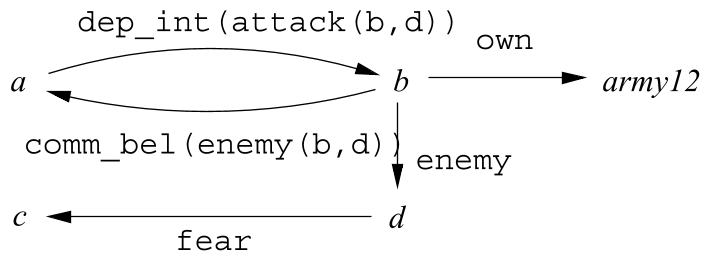 Figure 2: The state of a dependence network after a sequence of speech acts (e.g., ask, answer, request).
The power of this approach lies in indirect effects. If Agent B accepts a request, they become dependent on others to fulfill that new commitment. The social network effectively "computes" the consequences of the dialogue, providing a transparent log of social facts (commitments, debts, and powers) that is accessible to all agents in the environment.
Critical Analysis & Conclusion
Takeaway
The shift from Mental Attitudes to Social Semantics transforms ACL from a psychological modeling problem into a graph-theory problem. This is a massive leap for the Semantic Web, as it allows for "publicly observable" agent interactions.
Limitations & Future Work
- Objective vs. Subjective: The paper acknowledges the tension between public social networks and private views. While the authors argue for public transitions, agents still maintain private beliefs about the network, which adds a layer of "Recursive Modeling" complexity not fully solved here.
- Scalability: While graph theory is efficient, the number of labels () could grow exponentially in complex human-like societies.
Ultimately, this work lays the groundwork for viewing AI communication through the lens of Social Reality Construction, suggesting that for agents to truly collaborate, they don't need to read each other's minds—they just need to navigate the same social map.