
The Privacy Divide: Why Some Users Protect Their Digital Reputation Better Than Others
Understanding social network site users’ privacy tool use
This study investigates the determinants of technological privacy tool use on Social Network Sites (SNS), synthesizing Communication Privacy Management (CPM) theory with digital inequality research. Utilizing a diverse sample of 490 users, the paper identifies critical disparities in how different demographic groups employ features like privacy settings, untagging, and friend list management to protect their digital reputations.
TL;DR
Privacy on social network sites (SNS) is not just about what you post, but how you use the technology to curate your past and present. This study reveals a "second-level digital divide" in privacy management: younger, female, and more experienced users are far more adept at using advanced tools—like untagging and comment deletion—to protect their reputations, leaving older and less frequent users at a systematic disadvantage.
Problem & Motivation: Beyond the "Private/Public" Toggle
For years, academic and public discourse on social media privacy has been obsessed with a binary choice: is your profile public or private? However, author Eden Litt argues that this is an oversimplification.
In reality, privacy management is a dynamic, dialectical process. As our social circles "collapse" online (where your boss, your mom, and your college friends all see the same post), we need more than just general settings. We need "markers"—technological boundaries like pruning friend lists or untagging embarrassing photos. The motivation for this study was to understand why some people take advantage of these tools while others leave their digital footprints exposed to recruiters and insurance companies.
Methodology: The Technological Privacy Tool Index
The researcher used data from the Pew Internet project to track five specific technological strategies:
- Changing general privacy settings.
- Deleting people from friend lists.
- Untagging photos.
- Limiting specific updates to specific audiences.
- Deleting comments made by others.
Theoretical Framework
The study utilizes Communication Privacy Management (CPM) theory. In face-to-face life, we use "markers" like whispering or closing a door. On SNS, these markers are the software features themselves. The author argues that our ability to use these markers is dictated by our Social Network Site Experience, creating a link between technical skill and personal safety.
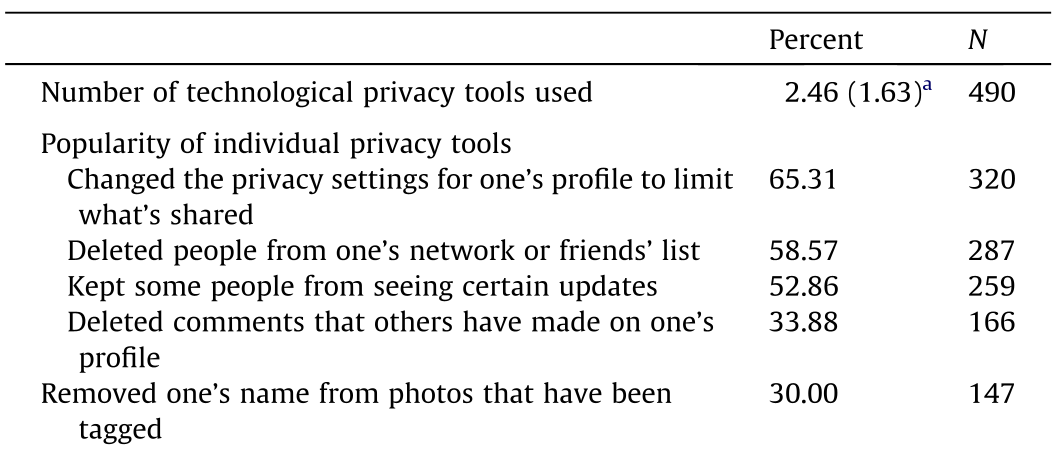 Note: While 65% of users change their settings, only 30% bother to untag themselves from photos, showing a significant gap in active reputation management.
Key Results: The "Privacy Inequality"
The study’s regression models (Model 1-3) yielded several striking insights into the "Academic Coordinates" of digital privacy:
- The Gender Gap: Women are significantly more proactive in using privacy tools. This is likely driven by "gendered privacy models"—women often face higher risks of stalking and harassment, forcing a transition of protective practices from the offline world to the online one.
- The Age Divide: There is a steady linear decline in tool use as age increases. Younger "digital natives" aren't just more comfortable; they are more aware of the reputational stakes involved in their social lives.
- The "Turbulence" Catalyst: The strongest predictor for using more tools was having had a "bad experience" (turbulence). Essentially, users often don't lock the door until after they've been robbed.
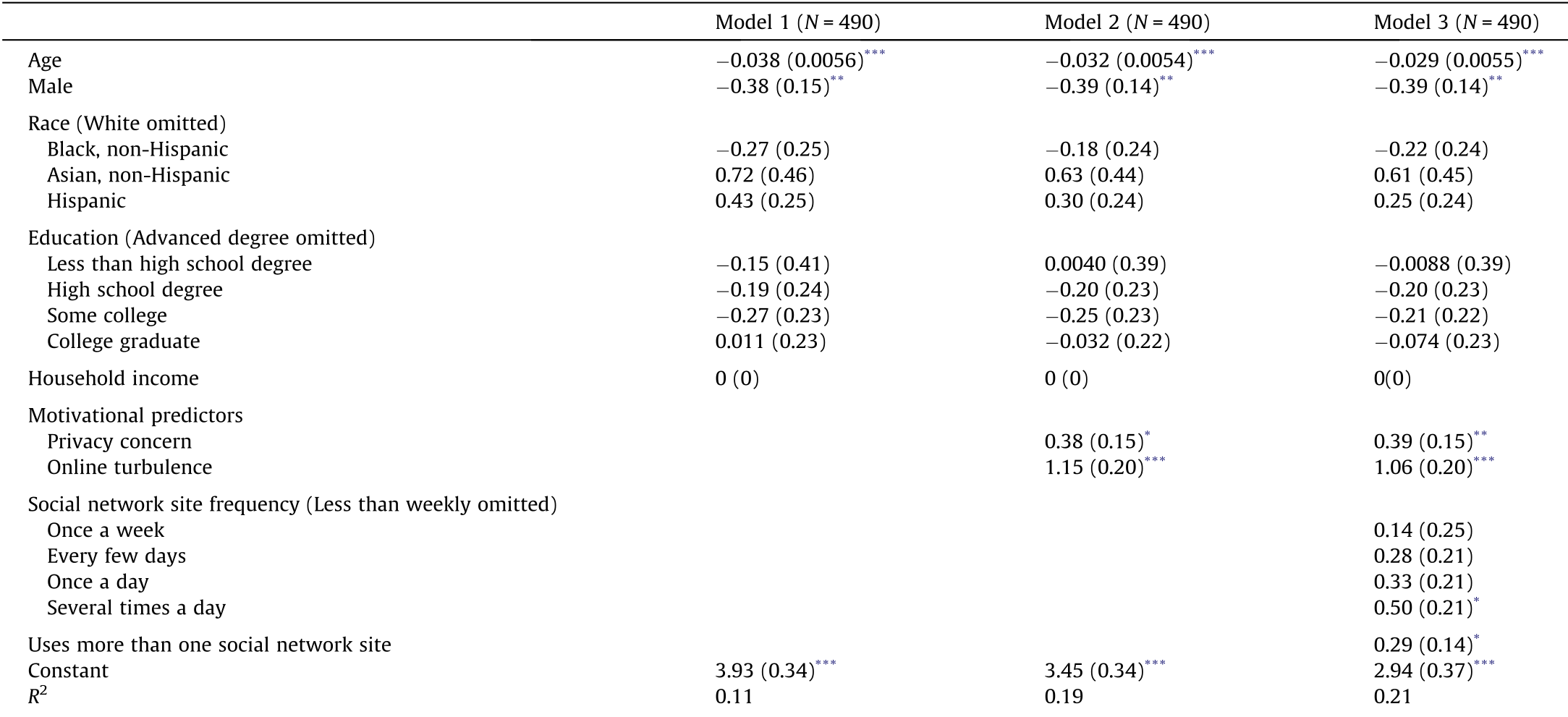 Model 3 shows that online turbulence and frequency of use ("Several times a day") are major drivers of tool diversity.
Critical Insight: Technical Skill as a Human Right
The most profound takeaway here is that privacy is a form of digital literacy. If a user doesn't know how to untag a photo or that they can delete a comment, their reputation is effectively at the mercy of others.
Limitations
The study relies on self-reported data, which can be subject to social desirability bias (people claim they are more "private" than they actually are). Furthermore, the data represents a snapshot of the MySpace/Facebook transition era; today's algorithmic environments (TikTok/Instagram) may require even more complex strategies.
Conclusion
We must move away from the idea that privacy is purely a personal choice. It is a technical capability. To prevent a future where digital reputations are only protected for the tech-savvy elite, platform designers and policymakers must simplify these "markers" and prioritize privacy education. Users shouldn't have to experience "turbulence" to learn how to protect themselves.
Takeaway: In the age of permanent digital footprints, the "delete" and "untag" buttons are not just features—they are essential tools for social survival.