
Beyond the Echo Chamber: How Social Network Sites Breach Our Political Bubbles
The contribution of social network sites to exposure to political difference: The relationships among SNSs, online political messaging, and exposure to cross-cutting perspectives
This study investigates the impact of Social Network Sites (SNSs) on exposure to political difference using 2008 US Election data. It demonstrates that SNS use and online political messaging significantly increase exposure to cross-cutting viewpoints, countering the "echo chamber" or fragmentation thesis.
TL;DR
Contrary to the popular belief that social media isolates us in ideological "filter bubbles," this seminal study by Yonghwan Kim argues that Social Network Sites (SNSs) actually increase our exposure to political difference. By analyzing the 2008 electoral landscape, the research finds that the interactive and "inadvertent" nature of SNSs forces users to encounter cross-cutting perspectives, largely through the mechanism of online political messaging.
Background: The Fragmentation Debate
In the mid-2000s, scholars like Cass Sunstein warned of a fragmented society where the Internet allowed users to perfectly "filter" their environment. This "CyberGhetto" hypothesis suggested that digital choice would lead to extreme polarization. Kim’s work positions itself as a crucial counter-argument, aligning with the "Inadvertency Thesis"—the idea that because SNSs blur the lines between private, public, and apolitical spaces, users stumble upon dissenting views they wouldn't normally seek out.
Why SNSs Break the Filter
The study identifies two primary drivers for diversity exposure:
- Structural Inadvertency: Features like hyperlinks, diverse friend networks, and interactive apps make it difficult to avoid dissimilar views.
- Integrated Spaces: Unlike political chat rooms (where people go to argue), SNSs are hybrid environments where politics and social life coexist, leading to "accidental" democratic deliberation.
Methodology & The Mediation Model
Kim utilized survey data from the Pew Internet & American Life Project, focusing on the 2008 US Presidential Election. The core of the analysis is a mediation model:
- Independent Variable: SNS Use (Facebook/MySpace activity).
- Mediator: Online Political Messaging (Posting comments, blogging).
- Dependent Variable: Exposure to cross-cutting (challenging) viewpoints.
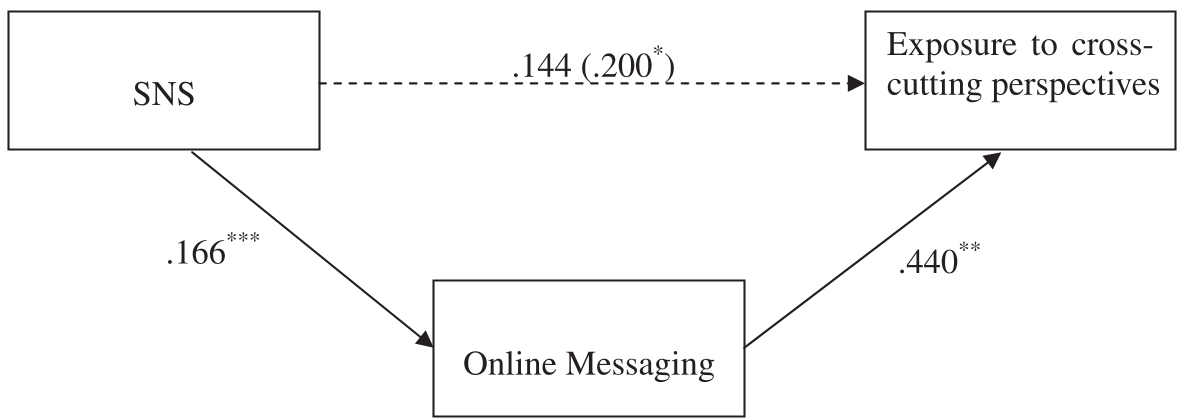
Figure 1: Path analysis showing how SNS use leads to diversity exposure via the mediating effect of political messaging.
Key Mathematical Insights:
The data confirms a total effect where SNS use significantly predicts exposure (B=.200). However, once "Online Political Messaging" is added to the model, the direct effect of SNS use vanishes. This indicates that it isn't just browsing Facebook that helps; it is the active act of engagement (messaging) that bridges the gap to dissimilar perspectives.
Unexpected Results: The Partisans vs. The Independents
A major contribution of this work is the analysis of Partisanship as a moderator.
- Hypothesis 5 Failed: Interestingly, SNS use promoted exposure to difference for everyone, regardless of whether they were staunch Democrats/Republicans or Independents.
- The Messaging Divergence: For online messaging, however, "Nonpartisans" saw a much higher boost in diversity exposure than "Partisans." This suggests that while partisans might use messaging to reinforce their views, independents use it as a tool to navigate the broader political landscape.
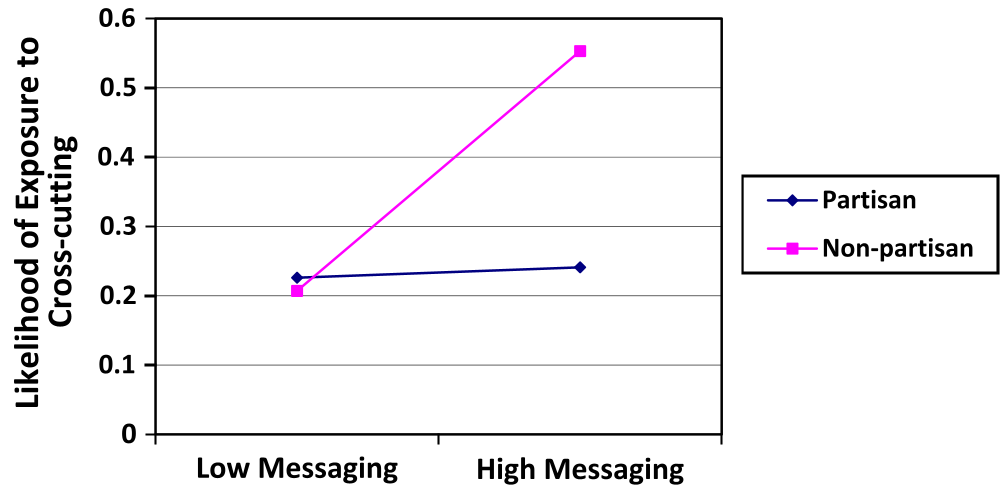
Figure 2: Interaction effect demonstrating that nonpartisans experience a steeper increase in political difference exposure through messaging compared to partisans.
Critical Insight & Contemporary Value
The study concludes that education is actually a negative predictor of diversity exposure—highly educated individuals are less likely to encounter disagreement, likely due to more sophisticated self-selection strategies.
Why does this matter in 2026? While this paper was written in the era of Facebook and MySpace, its findings on incidental exposure are more relevant than ever. As modern algorithms (like those on TikTok) prioritize engagement, they often mimic the "inadvertency" Kim described, though sometimes with more aggressive optimization.
Limitations
- Self-Reporting: The study relies on user perception of "challenging views" rather than objective content analysis.
- Chronological Gap: It does not account for the modern "algorithmic curation" era which has far more power to filter than the 2008-era SNSs.
Final Summary
Kim’s research provides a robust empirical defense of social media's role in a pluralistic democracy. By facilitating "weak ties" and incidental political encounters, SNSs act as a vital infrastructure for exposure to the "other side," provided that users remain active participants in the conversation.