
Social Network Topology: The Hidden Blueprint of Virtual Community Success
Social Network Structure as a Critical Success Condition for Virtual Communities
This paper investigates Open Source Software Project (OSSP) communities as a specific subset of virtual communities, proposing that social network structure is a critical determinant of community success. It introduces a needs-based typology of virtual communities and presents four specific hypotheses linking network metrics (density, bridging, and subgroup connectedness) to project outcomes like software releases and user activity.
TL;DR
Why do some Open Source Software Projects (OSSP) thrive while thousands of others die in infancy? This paper argues that the secret lies not in the code, but in the social network structure. By analyzing over 200 communities, the authors demonstrate that success requires a delicate balance: enough "bridging" to outside ideas, moderate internal "closeness" to prevent noise, and a decentralized "administrator" presence that empowers contributors.
The "Success" Gap in Virtual Communities
The digital landscape is a graveyard of abandoned projects. On platforms like SourceForge, only a fraction of initiatives ever reach a "mature" status. Existing literature often focuses on usability or individual motivation, but this paper shifts the lens to the macro-social structure.
The core insight is that virtual communities are essentially information-processing organisms. If the network structure is too sparse, resources aren't utilized; if it's too dense, the "cost-of-ties" (time spent reading emails/posts) outweighs the benefits of collaboration.
Methodology: Mapping the Social Connectome
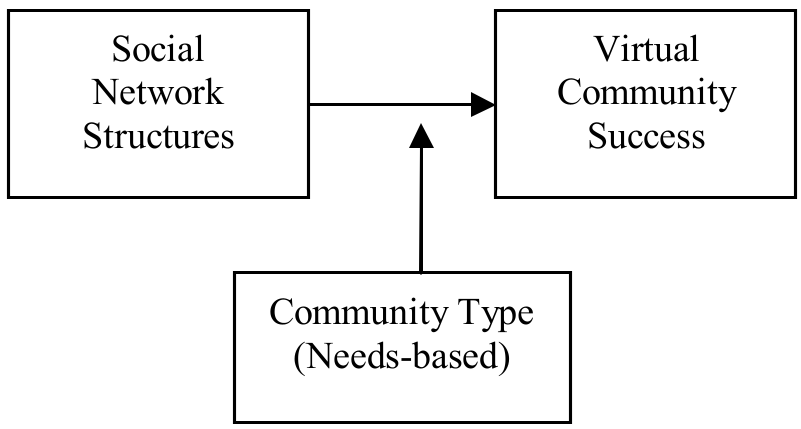
The authors propose a Needs-Based Typology, categorizing communities by the psychological and instrumental needs they satisfy (Socialization, Gaming, Content Sharing, etc.). OSSP communities fall under "Development Communities."
To measure success, the authors use a dual-network approach:
- Communication Network: Who talks to whom in public forums?
- Membership Network: How many other projects do core members belong to?
Core Conceptual Model
The model posits that social structure directly influences whether members feel their needs (challenge, identity, ownership) are met, which in turn drives community vitality.
Deep Dive: The Four Success Hypotheses
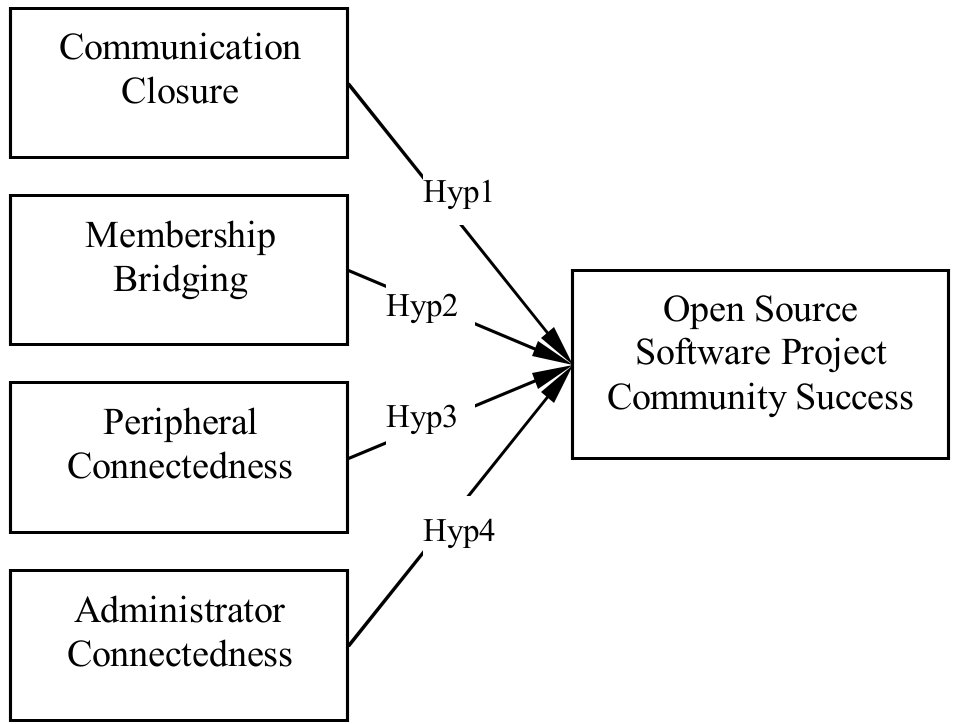
1. The Goldilocks Zone of Communication (Hypothesis 1)
The authors argue for an Inverted-U relationship between communication density and success. Total silence means no coordination; however, a "fully connected" graph where everyone talks to everyone leads to information overload. High density becomes a tax on the limited time of volunteers.
2. The Power of "Weak Ties" (Hypothesis 2)
Success increases as core members build more "bridging ties" to other communities. These bridges act as conduits for new design patterns, bug fixes, and potential new recruits. Unlike internal ties, these external connections provide non-redundant information.
3. Peripheral Engagement (Hypothesis 3)
OSSPs are like "onions" with a core and many outer layers (beta testers, bug reporters). The paper suggests that peripheral members must be connected to the core to feel a sense of legitimacy. If they are ignored, they stop contributing; if they are over-connected, they distract the core developers.
4. The Administrative Paradox (Hypothesis 4)
Perhaps the most counter-intuitive finding: Administrator connectedness should be low.
- Burn-out: Administrators who engage in every thread quickly exhaust themselves.
- Ownership: "Heavy-handed" or overly present leadership reduces the "feeling of ownership" among contributors. To thrive, a community needs a leader who delegates and remains neutral.
Experimental Framework
The researchers tested these hypotheses using a time-adjusted observation window, tracking 200+ projects for two years following their first release. This ensures that the data isn't skewed by comparing a 10-year-old giant like Linux to a month-old project.
Critical Insight: Implications for Community Builders
This research moves community management from an "art" to a "science."
- For Administrators: Your job is to facilitate, not to dominate. If you are the most central node in every conversation, you are likely a bottleneck and a deterrent to organic growth.
- For Designers: Platforms should provide tools that visualize these network densities, allowing managers to diagnose "structural health" in real-time.
Limitations & Future Work
While the OSSP model is robust, the "needs" of a socialization community (like Facebook) might actually favor higher density than a development community. Future research must determine the "optimal density" for different genres of virtual interaction.
Conclusion
The success of a virtual community is emergent; it is "baked into" the geometry of its social ties. By mastering the balance between closure and bridging, OSSP leaders can transform a stagnant repository into a thriving ecosystem.