
Detection vs. Tolerance: Navigating the Design Space of Social Sybil Defenses
Exploring the design space of social network-based Sybil defenses
This paper explores the design space of social network-based Sybil defenses, categorizing them into Sybil Detection (e.g., SybilLimit) and Sybil Tolerance (e.g., Ostra). It provides a comparative analysis of their underlying assumptions, structural requirements, and practical deployment challenges.
TL;DR
Sybil attacks—where one malicious actor creates infinite fake identities—undermine the integrity of distributed systems. This paper provides a seminal taxonomy of defenses: Sybil Detection, which attempts to identify fake accounts based on graph structure, and Sybil Tolerance, which uses credit-based mechanisms to limit the damage an attacker can do. While Detection is easier to integrate, Tolerance is more robust to the messy, non-uniform structures of real-world social networks.
Contextual Positioning
Within the academic landscape, this work moves beyond the "first-generation" Sybil papers (like SybilGuard) by providing a critical meta-analysis. It transition the field from asking "Is this node a Sybil?" to "How much leverage does this Sybil have?", marking a shift toward more resilient, transaction-aware security models.
Problem & Motivation: The "Fast-Mixing" Fallacy
Most Sybil Detection schemes rely on a specific graph-theoretic assumption: the honest region of a social network is "fast-mixing" (densely connected), while the Sybil region is connected only by a few "attack edges."
The authors argue this is often false in reality. Real social networks are fragmented into small, tightly-knit communities with sparse internal cuts.
- The Failure Mode: If an honest user is in a "fringe" community, Detection schemes will misclassify them as a Sybil (False Positive).
- The Vulnerability: If an attacker disguises their nodes as a legitimate-looking community, they can infiltrate the system undetected (False Negative).
Methodology: Two Divergent Paths
1. Sybil Detection (Binary Classification)
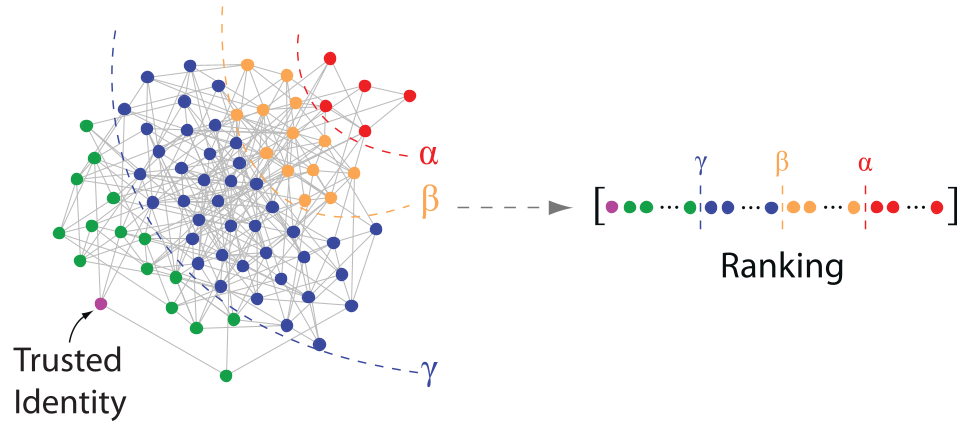
Detection schemes (SybilLimit, SybilInfer) essentially rank nodes based on their proximity to a "known-good" seed node. A cutoff is applied; nodes "too far" are banned.
2. Sybil Tolerance (Impact Bounding)
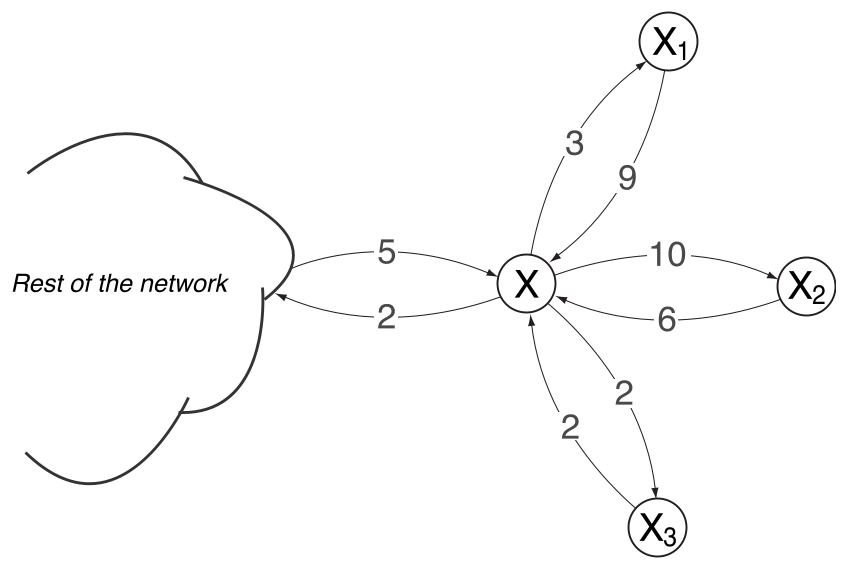
Instead of banning nodes, Tolerance systems (SumUp, Ostra, Bazaar) treat the social graph as a Credit Network.
- Mechanism: Every link between friends has a "credit limit." To send a message or cast a vote, you must find a path from yourself to the recipient/collector with available credit.
- Intuition: An attacker can create 1,000,000 identities, but the sum of credit they have with the honest world is constant. They can’t "manufacture" trust.
Experiments & Results: The Cost of Tolerance
The paper highlights a crucial trade-off: Scalability. While Tolerance is structurally superior, it relies on calculating Max-Flow, a computationally expensive task.
- Latency: In 3.3M-4M link networks, Bazaar and Ostra require 3.7 to 6.0 seconds per transaction. This is unacceptable for high-throughput systems like real-time bidding or instant messaging without optimization.
- Graceful Degradation: Unlike Detection (where a False Positive = account deletion), a False Positive in a Tolerance system simply limits the rate of interaction, allowing the user to recover credit over time.
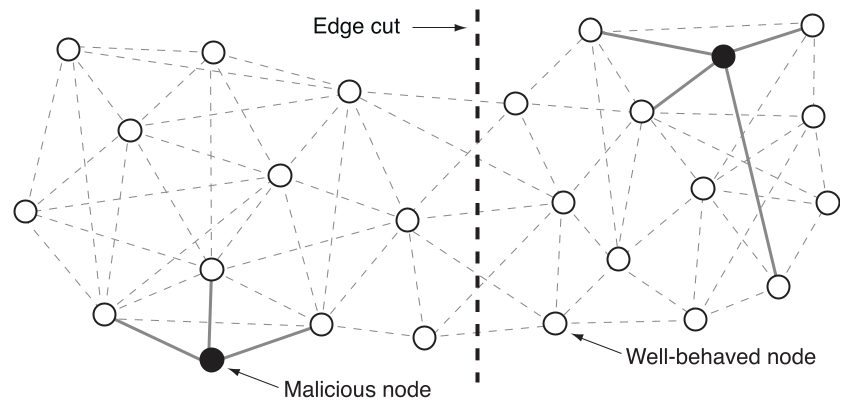 Figure: Even if malicious nodes (filled) exist, they cannot exhaust credit between well-behaved nodes because the bottleneck is at the attackers' entry point.
Critical Analysis & Conclusion
Takeaway
If you are building an application where identity is binary (e.g., node admission in a DHT), Detection is your only choice, but it is risky. For applications involving resources (voting, spam filtering, marketplaces), Sybil Tolerance is strictly better because it aligns the security mechanism with the actual "currency" of the attack.
Limitations
- Liquidity Issues: In Credit Networks, if two honest groups don't interact often, they might "starve" of credit even without an attack.
- Computational Complexity: Max-flow must be approximated or parallelized to work at Global-scale (billions of edges).
Future Outlook
The authors suggest that the marriage of graph structure and transaction history is the future. We should expect future Sybil defenses to leverage machine learning to dynamically adjust credit weights, moving beyond static graph topology to behavioral analysis.