
Sybils in the Mist: Why Social Network Defenses Are Actually Community Detectors
An analysis of social network-based Sybil defenses
This paper presents a unified analysis of various social network-based Sybil defense schemes (SybilGuard, SybilLimit, SybilInfer, and SumUp), revealing that they fundamentally function as community detection algorithms. By reducing these disparate methods to a core node-ranking mechanism based on local connectivity, the authors demonstrate that all such defenses work by identifying clusters (communities) around a trusted node.
TL;DR
Is your Sybil defense actually just finding your friends? This seminal paper by Viswanath et al. (SIGCOMM '10) reveals that despite their mathematical variety, popular Sybil defenses like SybilGuard and SybilInfer are essentially local community detection algorithms. The bad news? If your network has a strong community structure (like most real-world social graphs), these defenses are remarkably easy to bypass or break.
Background: The Social Trust Assumption
Sybil attacks—where one person creates thousands of fake identities—are the bane of decentralized systems. Traditional defenses relied on Central Authorities (CAs), which kill the "open" nature of the internet. The "Social Defense" wave proposed a sexier idea: use the structure of human trust. The core assumption was that an attacker can create infinite fake nodes but only a finite number of real "friendships" with non-Sybil users. This creates a "bottleneck" in the graph that defenses try to find.
The "Grand Unified Theory" of Sybil Defense
The authors performed a brilliant architectural reduction. They took four major schemes and realized they all follow a two-step pipeline:
- Ranking: An algorithm ranks nodes based on how "close" or "well-connected" they are to a trusted seed.
- Cutoff: A parameter (like walk length or probability threshold) decides where to draw the line between "Friend" and "Sybil."
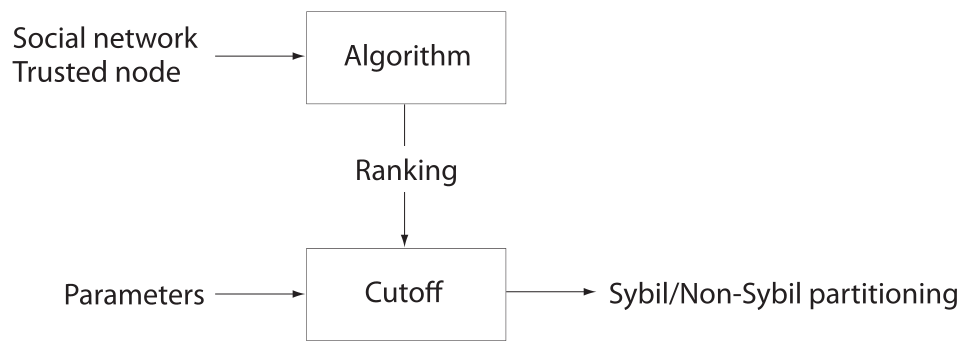
By analyzing these rankings using Mutual Information and Conductance, the authors found that these schemes weren't just "finding Sybils"—they were finding the local community of the trusted node.
Why This Is a Problem: The Modularity Trap
The paper's most stinging critique is directed at the Fast-Mixing Assumption. Most early defenses assumed the "honest" part of the network was a giant, well-connected blob. In reality, humans form many small, sparsely connected groups.
1. The Structure Sensitivity
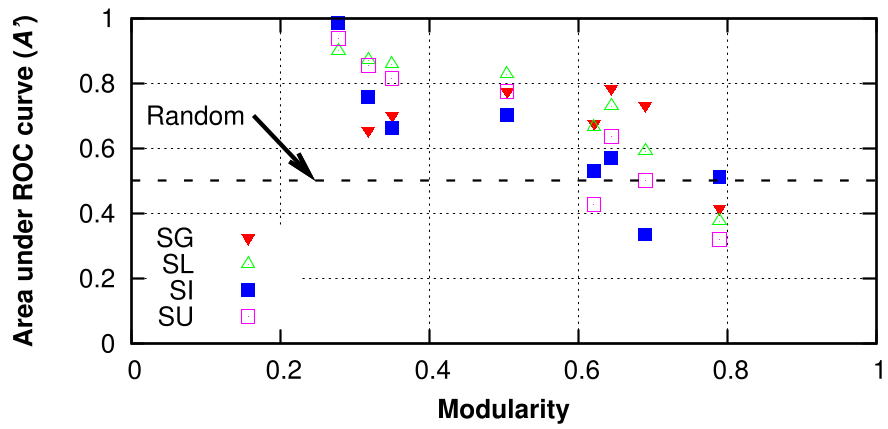
The authors showed that as a network's Modularity (a measure of how "clumpy" it is) increases, the defense accuracy plummets. In a highly clumpy network, a non-Sybil in a different department looks just as "disconnected" as a malicious Sybil.
2. Targeted Sybil Attacks
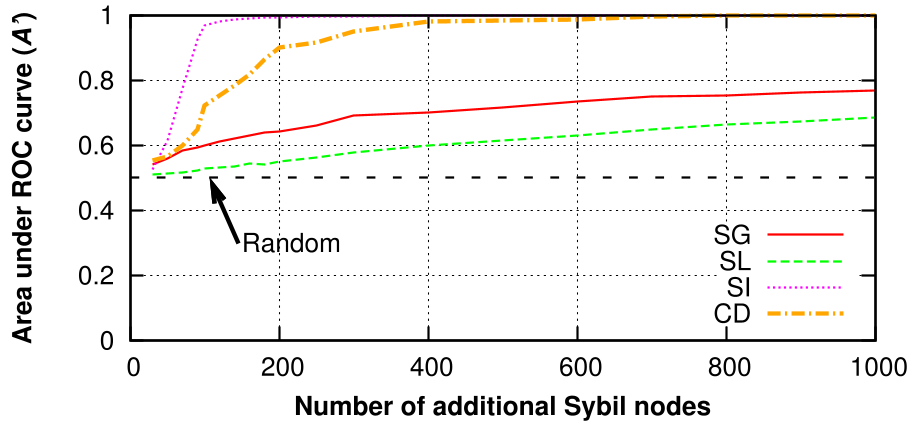
If an attacker knows the community structure, they can launch a "Targeted Attack." By befriending just a few influential users within the trusted node's local cluster, the Sybils become "local" and get ranked higher than real users from other parts of the network. The result? The defense admits the attackers and blocks the honest users.
Methodology: Community Detection as Defense
To prove their point, the authors used a standard community detection algorithm (Mislove's algorithm) and compared it to the specialized Sybil defenses.
- Result: The generic community detection performed just as well (and sometimes better) than the specialized tools.
- Insight: We can stop reinventing the wheel and start using the rich, 30-year-old literature on graph clustering to build better security.
Deep Insight & Conclusion
This paper serves as a vital reality check. It teaches us that security is only as good as our model of human behavior. If we model human networks as random graphs, our security fails when humans behave like "cliques."
Key Takeaways:
- Community = Vulnerability: High modularity in social networks is a feature for users but a bug for Sybil security.
- Beyond Topology: To truly fix the Sybil problem, we can't just look at who is "friends" with whom. We need interaction data (who actually talks to whom) and multiple trust anchors.
The future of Sybil defense isn't about finding the perfect graph partitioning algorithm; it's about making identities "expensive" to maintain through activity-based trust.