
Agentic Social Networks: Elevating Semantic Search via Hidden Markov Models
Calculating the strength of ties of a social network in a semantic search system using hidden Markov models
This paper introduces a Multi-Agent System (MAS) for semantic search where software agents form a social network. It utilizes Hidden Markov Models (HMM) to dynamically calculate "tie strengths" between agents to optimize query routing and result ranking.
TL;DR
This research bridges the gap between Social Network Theory and Semantic Search by treating software agents as social actors. By employing Hidden Markov Models (HMM) to quantify the "Strength of Ties," the system intelligently routes search queries to the most relevant peers, effectively overcoming the hurdles of decentralized and inconsistent data repositories.
Background: The Decentralization Dilemma
The modern Web is a vast, decentralized expanse. While this ensures scalability and resilience, it creates a "Tower of Babel" problem: different repositories use different Ontologies (internal vocabularies). Traditional search engines often struggle with context, leading to irrelevant results and the need for exhaustive manual filtering.
The authors argue that search is essentially a Knowledge Management (KM) problem. Their solution? A Multi-Agent System (MAS) where agents don't just search—they learn, negotiate, and form social bonds.
The Core Intuition: Not All Ties are Equal
In social science, the "Strength of Weak Ties" is a famous concept. However, in technical search, Strong Ties—built on high intimacy, reciprocity, and frequent communication—are usually better indicators of knowledge alignment.
The researchers identified three pillars of tie strength:
- Closeness: Based on the Degree of Understanding (du) between two different ontologies.
- Time-Related Variables: Duration, frequency, and recency of interaction.
- Mutual Confidence: Neighborhood overlap (common friends) and overall network structure.
Methodology: Putting the 'Hidden' in Tie Strength
The "Strength of Ties" is not something you can measure directly into a single number; it is an intrinsic, evolving property. Thus, the authors use Hidden Markov Models (HMM).
- The Hidden State: The actual strength of the tie (, the transition matrix).
- The Observations: The measurable factors like ontology similarity and communication logs (, the observation matrix).
- The Goal: Optimize the system parameters so the model best describes how these interactions translate into a reliable relationship.
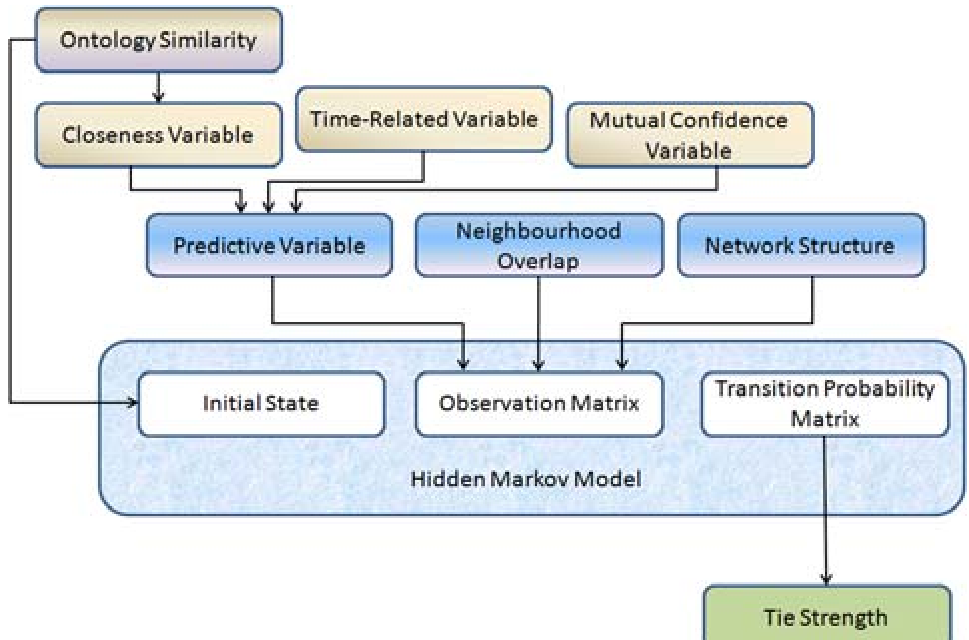 Figure 1: The multi-agent architecture where agents act as users, teachers, and searchers.
The Mathematics of Bond
The predictive variable is calculated via a linear combination: Where is closeness, is time, and is mutual confidence. The final Tie Strength (TS) is a weighted probability sum generated by the HMM.
Experimental Insight: The 'U-Shaped' Relationship
One of the most fascinating findings in the paper is the relationship between Closeness (Ontology Similarity) and Tie Strength.
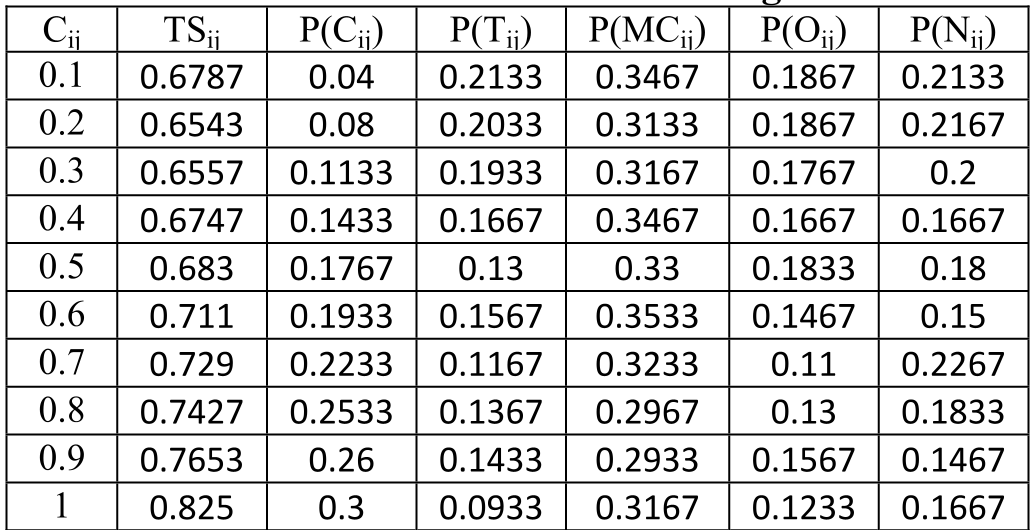
As seen in the data, tie strength doesn't always increase linearly. Initially, when closeness is very low, other factors (like network structure) keep the tie strength moderately high. However, as the agents begin to align their ontologies (), the Closeness factor becomes the dominant driver, pushing the Tie Strength toward .
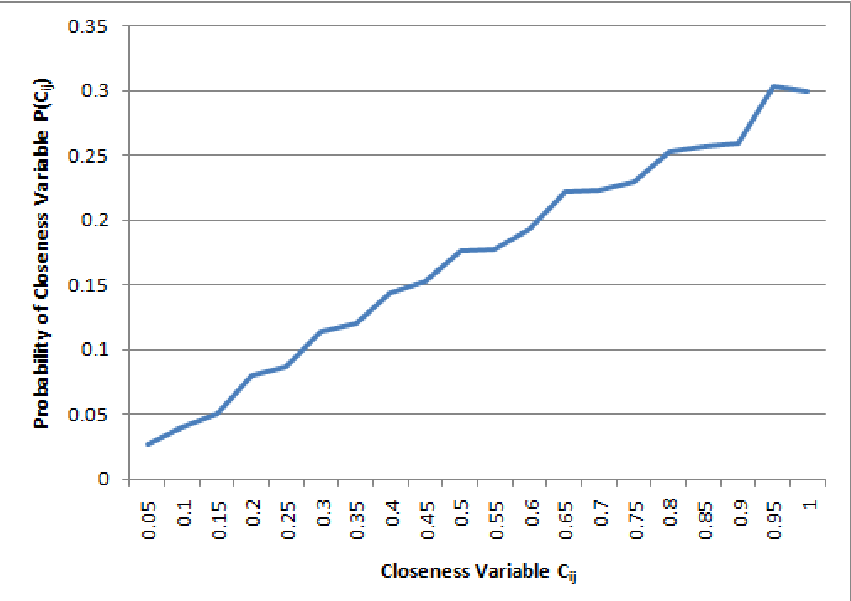 Figure 2: Visualizing how increasing ontology similarity boosts the probability of a strong tie.
Conclusion & Future Look
By quantifying the "social" relationship between agents, this framework allows for:
- Intelligent Query Routing: Only asking agents that "speak your language."
- Conflict Resolution: Trusting "teachers" with stronger ties during the learning process.
- Ranked Results: Prioritizing data from reliable, high-strength peers.
Limitations: The paper assumes a linear combination for some variables, which might oversimplify complex social dynamics. Future iterations might benefit from Deep Learning to model non-linear interactions between variables.
Takeaway: This work proves that for AI agents to be truly effective in a decentralized world, they must not only be "smart" but also "socially aware."