
The Economics of Honesty: Leveraging Social Influence to Secure E-Marketplaces
Leveraging a Social Network of Trust for Promoting Honesty in E-Marketplaces
This paper introduces a trust-based incentive framework for e-marketplaces that leverages social networks of buyers to promote honesty. It employs a mechanism where sellers reward buyers based on their social reputation (influence), while buyers use selective tendering to filter out untrustworthy sellers, achieving a Nash equilibrium where honesty is the most profitable strategy for all rational agents.
TL;DR
In a world of "fake reviews" and "shoddy goods," how do we force honesty in a digital market? This paper proposes a mechanism where social reputation equals cash rewards. By treating a buyer's influence as a valuable asset, sellers are incentivized to offer discounts to "reputable" buyers, who in turn stay honest to maintain their status. The result? A self-policing ecosystem where being a "good actor" is the most profitable business decision.
Problem & Motivation: The Reputation Dilemma
In online auctions, we face a two-sided trust deficit:
- Sellers may promise high quality but deliver junk (Opportunism).
- Buyers may provide fake reviews to sabotage competitors or boost friends (Unfair Ratings).
Most existing solutions use "side payments" (paying users to review), but these require a central "bank" and are prone to collusion. The authors' insight is to shift the focus from monetary bribes to market positioning. If a buyer is highly respected by other buyers, their "opinion" is worth more to a seller's future growth. Therefore, why not reward that influence directly?
Methodology: The "Social Capital" Bidding Engine
1. Modeling Buyer Reputation
The core innovation is calculating a buyer 's global reputation using a recursive formula: This ensures that reputation isn't just about the number of followers, but the quality and influence of those followers.
2. The Seller's Equilibrium Strategy
Sellers don't just bid based on immediate profit. They factor in the Expected Future Gain (). A satisfied reputable buyer will spread the word through the social network, increasing the seller's probability of being invited to future auctions.
The paper proves that the optimal bid (price) is a monotonically decreasing function of the buyer's reputation.
- High Reputation Buyer Lower Price (Reward).
- Low Reputation Buyer Standard Price.
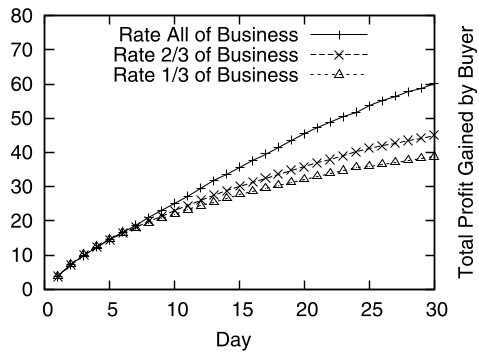 Figure: The impact of limiting bidders. Note how limiting sellers to 6 (Graph C) aligns profit with honesty, whereas 30 sellers (Graph B) rewards dishonesty.
Experiments: Why "Lower Competition" Can Sometimes Be Better
Counter-intuitively, the study finds that limitless competition is bad for honesty.
In the "Public Tendering" simulation (30+ sellers), prices are driven so low that honest sellers can no longer cover their costs. This forces sellers to lie about quality just to survive. By using Selective Tendering (limiting the auction to the top 6 most trusted sellers), the buyer ensures that the winning seller makes enough profit to value their reputation, thus "buying" their honesty.
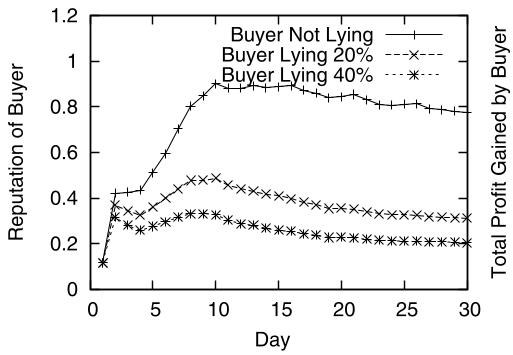 Figure: Buyers who provide more unfair ratings (red/yellow lines) see their reputation collapse over time compared to honest buyers (blue).
Critical Analysis & Conclusion
Takeaway
The paper successfully demonstrates that honesty is not just a moral choice but a rational economic one when social networks are integrated into the auction mechanism. It effectively bridges the gap between Social Network Analysis (SNA) and Game Theory.
Limitations
- Initial Trust: The model assumes a "seed" of honest agents. If a marketplace is 90% bots/colluders from day one, the neighborhood exclusion might fail.
- Computational Overhead: Fixed-point eigenvector calculations for every buyer in a massive marketplace (like Amazon) could be computationally expensive.
Future Outlook
This framework is a precursor to modern "Social Commerce" strategies. Integrating this with Blockchain-based Verifiable Credentials could allow for a truly decentralized, trustless marketplace where your "on-chain reputation" automatically triggers smart-contract-based discounts.