
Beyond Interest: Driving Social Interaction via Community-Aware Tweet Recommendations
Encouraging User Interaction of Social Network through Tweet Recommendation Using Community Structure
This paper introduces a tweet recommendation framework designed to stimulate social interaction (replies) on Twitter by utilizing Latent Dirichlet Allocation (LDA). The method uniquely combines semantic "Word Topics" with relational "Human Topics" extracted from community structures to predict user engagement.
TL;DR
Most recommendation engines aim to find content you like, but this paper aims to find content you will reply to. By combining Latent Dirichlet Allocation (LDA) for text analysis with a novel "Human Topic" model based on community relations (follows/mentions), the researchers from Ritsumeikan University have built a system that prioritizes social conversation over passive scrolling.
The Motivation: Why Relevance Isn't Enough
On Twitter, a tweet might be "interesting" (e.g., a news update from a celebrity), but it rarely triggers a conversation. The authors observe a fundamental social truth: Interaction follows familiarity. You are far more likely to reply to a friend using community-specific slang than to a viral tweet from a stranger.
Previous SOTA methods focused on "Collaborative Ranking" or "Reciprocal Recommendation," but they often missed the specific "community niche" that drives the urge to reply.
Methodology: The Fusion of Words and Humans
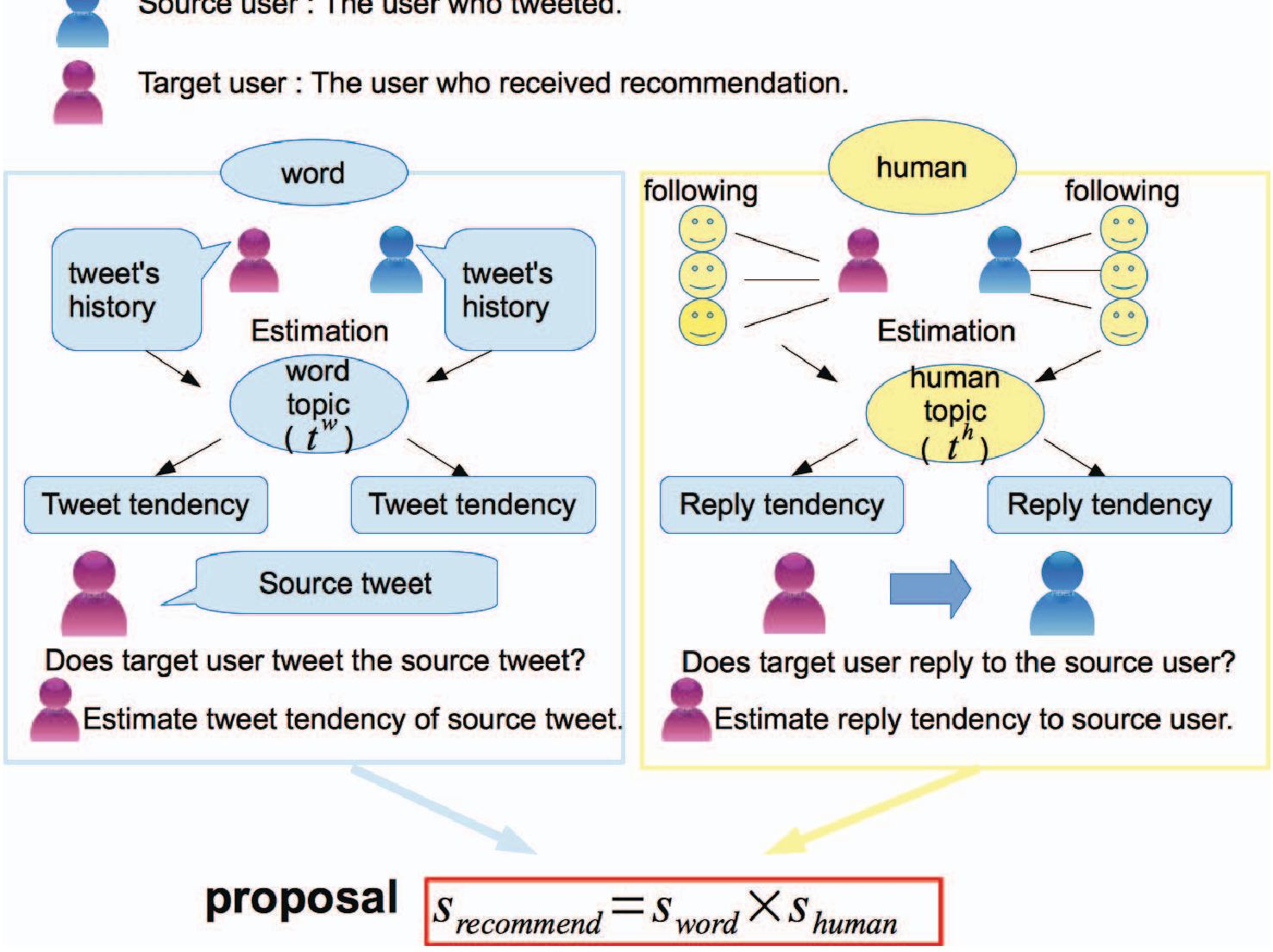
The core innovation lies in the dual-topic modeling approach. The authors use LDA to estimate two distinct distributions:
- Word Topics (): Instead of just counting keywords, this identifies the latent theme (e.g., "baseball") from nouns in a user's history.
- Human Topics (): This treats user IDs in a community (followers, followings, mentions) as tokens in a document. It estimates the likelihood that a "Target User" belongs to the same social circle as the "Source User."
The final recommendation score is the joint probability:
Experimental Insights
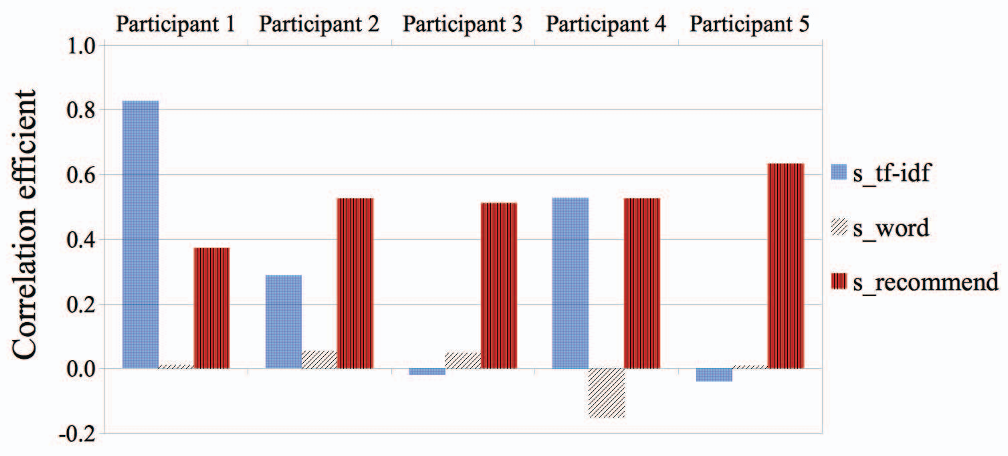
The researchers tested their model against five participants and compared it to standard TF-IDF and word-only LDA models.
Key Findings:
- The "In-Joke" Effect: One highly-rated tweet contained the word "西ノ島" (Nishinoshima), a coined term understood only by a specific community. The metric successfully captured this community bond.
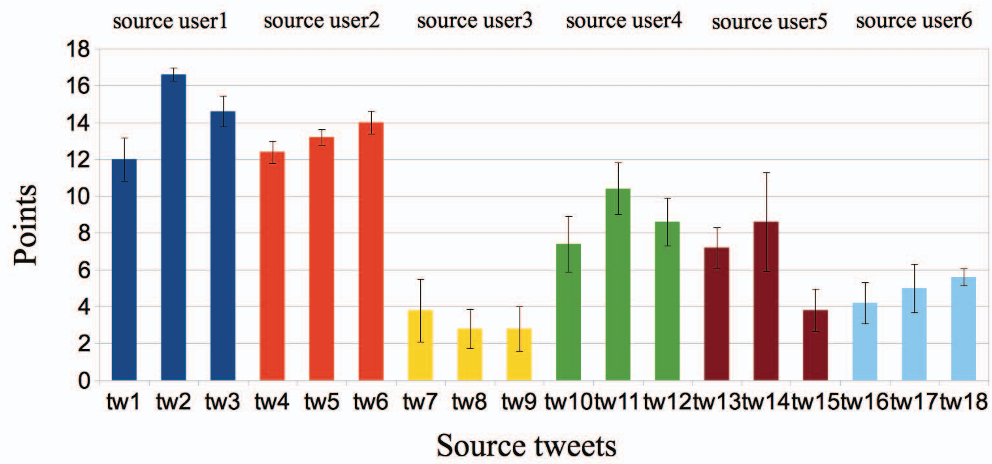
- Familiarity Wins: As shown in the graph below, users consistently gave higher "reply intention" scores to tweets from users they were already following (Source Users 1 & 2) compared to celebrities (Source Users 3 & 4) or strangers.
- Statistical Superiority: The proposed method achieved a higher Spearman rank correlation coefficient than word-based models, proving that human relations are a stronger predictor of interaction than text alone.
Critical Analysis & Takeaways
This work highlights a critical shift in recommendation philosophy: Social networks are not just content silos; they are digital neighborhoods.
Limitations:
- The study used a relatively small sample size (five participants).
- The LDA model relies on static snapshots of data, whereas Twitter's community structure is highly dynamic.
Future Outlook: The logic here can be extended to modern AI-driven platforms. By moving from simple "Content-based Filtering" to "Community-Latent Modeling," platforms can foster more genuine human connection rather than just maximizing "watch time" or "clicks." The next step for this research is the automation of source user selection to scale the system for millions of users.