
Beyond Self-Reports: How Our Personality Truly Shapes Our Digital Identity on Facebook
Social network use and personality
This study investigates the relationship between the Five-Factor Model (FFM) of personality and Facebook behavior using objective profile data rather than self-reports. The researchers found significant correlations between personality traits (Extroversion, Neuroticism, Openness, Agreeableness, and Conscientiousness) and specific online behaviors, such as the number of friends, photo uploads, and information sharing.
TL;DR
Is your Facebook profile a mirror of your soul or a carefully crafted mask? While previous studies suggested only a faint link between personality and social media use, this research by Amichai-Hamburger and Vinitzky proves that the connection is profound. By shifting the methodology from "asking users what they do" to "observing what they actually post," the authors demonstrate that our Big Five traits—Extroversion, Neuroticism, Openness, Agreeableness, and Conscientiousness—predict everything from our friend count to the types of photos we upload.
The "Self-Report" Trap: Why Previous Research Missed the Mark
For years, psychological research on the Internet relied on surveys. However, humans are notoriously bad at describing their own behavior, often tilting their answers to appear more "socially desirable." Earlier work by Ross et al. (2009) found only weak correlations between personality and Facebook use.
The authors of this study posited a sharp Insight: The problem wasn't that personality didn't matter; it was that the measurement was flawed. By analyzing the objective content of Facebook profiles (the number of friends, the specific info fields filled out, and the number of pictures), they aimed to uncover the true "digital body" of the user.
Methodology: From Traits to Information Upload
The researchers recruited 237 students, administering the gold-standard NEO-PI-R personality test. They then coded the participants' Facebook profiles across three main dimensions:
- Basic Information: Gender, relationship status, political views.
- Personal Information: Interests, favorite books, and "About Me" sections.
- Experimental Features: Friend counts, photo albums, and group memberships.

Key Findings: The Digital Signature of Personality
1. The Extrovert vs. Introvert Paradox
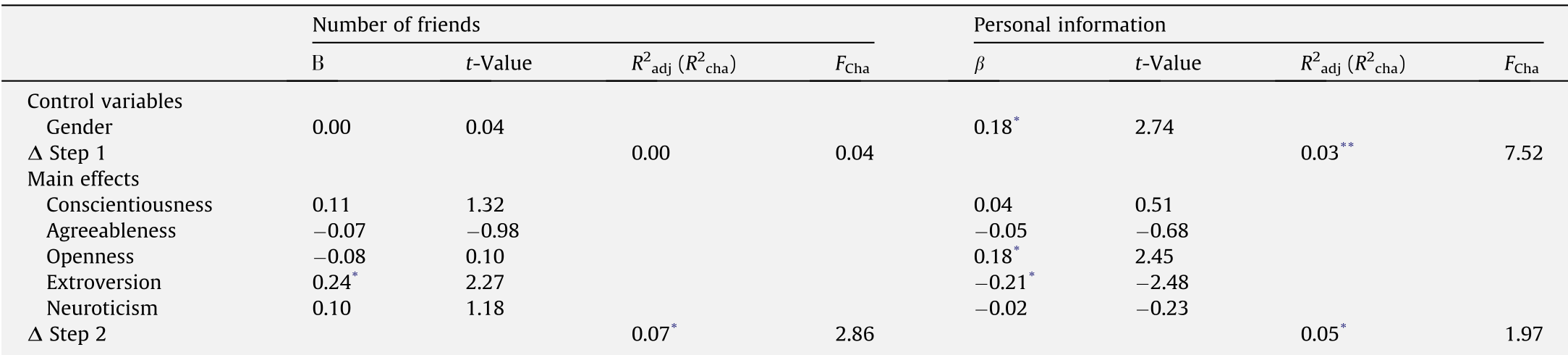
As expected, Extroverts have significantly more friends (Mean = 150.9) than introverts (Mean = 103.1). However, a fascinating reversal was discovered: Introverts actually upload more personal information.
- The Logic: Extroverts rely on their natural social dominance and feel less need to "promote" themselves through text. Introverts may use the "safe" distance of the screen to express their identity more deeply.
2. Neuroticism and the "Selfie" Shield
High Neuroticism (emotional instability) was positively correlated with posting self-photos but negatively correlated with posting "other" photos (like landscapes or group shots).
- The Logic: Users high in neuroticism likely use their profile picture as a tool for Impression Management, seeking social validation and self-assurance through controlled self-imagery.
3. Conscientiousness: The Goal-Oriented Socialite
Unlike previous theories suggesting conscientious people avoid the "distraction" of social media, this study found they actually have more friends.
- The Logic: Conscientious individuals are target-oriented. In the context of Facebook, they view "building a network" as a task to be executed efficiently.
Deep Insight: The U-Shaped Phenomenon
One of the most sophisticated findings in the paper is the U-shaped correlation regarding Agreeableness and Neuroticism. For instance, both very low and very high scorers in Agreeableness upload more pictures than moderate scorers. This suggests that the same behavior (uploading many photos) can stem from completely different motivations:
- High Agreeableness: Uploading to share memories and cooperate with friends.
- Low Agreeableness: Uploading perhaps for self-centered display or competition.
Critical Analysis & Implications
Limitations
The study focused on a cohesive group of Israeli university students. Social norms change across cultures; what is "standard" Facebook behavior in Israel might differ in East Asia or the US. Furthermore, as a "snapshot" study, it doesn't capture how profiles evolve over years.
The Marketing Future
The implications for Marketing Practitioners are massive. By analyzing a potential customer’s profile attributes, companies can estimate personality traits. For example, "Early Adopters" are often high in Openness. Marketers can identify these individuals not by asking them if they like new things, but by observing the complexity and "Personal Information" density of their profiles.
Conclusion
This paper serves as a methodological lighthouse. It proves that our behavior in the digital "stage"—as Goffman would call it—is a nuanced performance dictated by our underlying psychological traits. As we move further into an era of AI-driven social analytics, understanding the "Why" behind the "Point and Click" has never been more vital.