
Cityware: Bridging the Chasm Between Online Profiles and Physical Encounters
Social networking 2.0
Cityware is a pioneering pervasive computing platform that bridges the gap between digital social networks and physical mobility. By integrating Facebook profile data with real-world Bluetooth discovery traces, it creates a "Social Networking 2.0" ecosystem for studying human encounters in urban environments.
TL;DR
In the mid-2000s, while social networks were confined to browser windows, the Cityware project proposed a radical expansion: Social Networking 2.0. By linking Facebook's qualitative social graphs with Bluetooth-based physical proximity sensing, Cityware created a platform that tracks not just who you are friends with online, but who you actually spend time with in the real world.
The Missing Link in Social Research
Researchers studying human interaction have long faced a trade-off. You can have scale (online data like Facebook) or context (intensive real-world observation), but rarely both.
The authors observed that while we have rich qualitative data about our "friends, colleagues, and family" on Facebook, we lack quantitative data on how these ties manifest in physical space. Their insight? Bluetooth is the perfect proxy for human mobility. It has a short range (10-100m) and is almost always attached to a person via their mobile phone.
Methodology: A Massively Distributed Social Sensor
Cityware operates through a multi-tier architecture that turns the city into a living laboratory.
1. The Sensing Layer
Unlike previous systems that required users to install complex tracking software, Cityware relies on simple Bluetooth "discoverability." Volunteers run node software on their computers or phones, constantly scanning for nearby MAC addresses.
2. The Relationship Engine
The raw data flows to a server where it is processed into:
- Sessions: Determining the duration of a device's stay near a node.
- Encounters: Identifying when two devices are at the same place at the same time.
3. The Social Bridge
Users "opt-in" via a Facebook app, register their Bluetooth ID, and "tag" their friends' devices. This turns an anonymous MAC address into a rich profile containing age, interests, and relationship types.
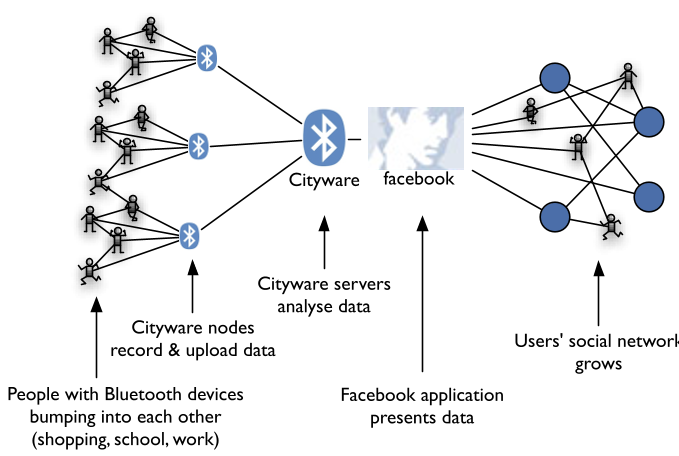 Figure 1: The Cityware Platform Architecture, spanning from physical Bluetooth devices to the Facebook UI.
Real-World Feedback & Community
The project gained significant traction after a BBC report, leading to a worldwide network of 450 nodes. The user feedback highlighted several fascinating socio-technical phenomena:
- Node Pride: Users formed a "self-helping community," proudly announcing new nodes in their towns as if they were digitizing their local community.
- The Privacy Paradox: While some decried the potential for "stalking," others noted that users were already sharing far more sensitive information on Facebook, and one could simply "go invisible" by turning off Bluetooth.
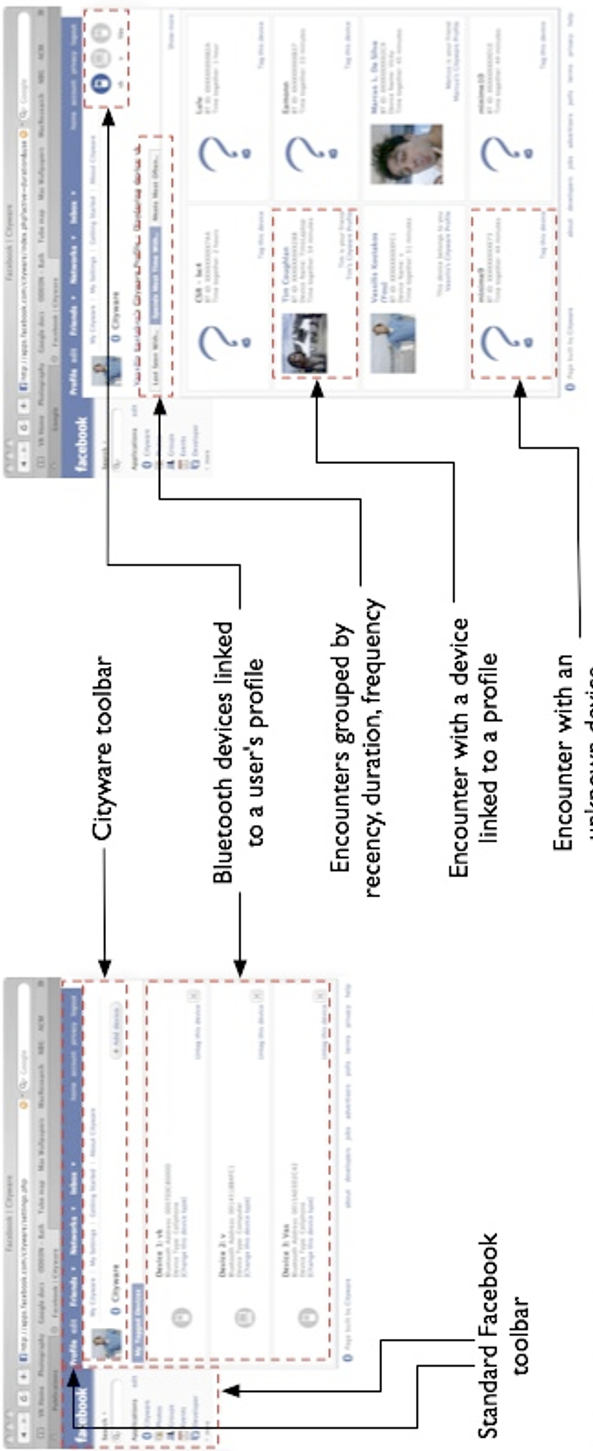 Figure 2: The Cityware Interface on Facebook, allowing users to see their real-world "encounters" and stats.
Research Potential: Beyond Socializing
The true value of Cityware lies in its potential as a research tool. By crossing physical data with social data, we can answer questions like:
- Social Metrics: Do "house-mates" show different Bluetooth encounter patterns than "colleagues"?
- Adaptive Systems: Can a phone predict your next move and change its settings (e.g., going silent in a meeting room you frequently visit)?
- Epidemiology: How would a digital or biological virus spread through this specific network of encounters?
Critical Insight & Conclusion
Cityware was ahead of its time. It anticipated the "Check-in" culture of Foursquare and the "Find My" mesh networks of today. Its core contribution is the realization that identity is verified online, but sociality is lived offline.
However, the reliance on "discoverable" Bluetooth was a significant technical hurdle—even in 2008, only ~7.5% of people had it enabled. Furthermore, the centralized nature of the "tagging" system raised early red flags about the ethics of ambient surveillance that still haunt the industry today.
Takeaway: Cityware proved that urban design and digital systems are inseparable. For future developers, the lesson is clear: provide enough social value (seeing your "encounters"), and users will willingly build your infrastructure for you.