
The Facebook Dilemma: Unpacking the Hidden Link Between Social Networking and Academic Success
Social networking and academic performance: A review
This systematic review synthesizes 23 peer-reviewed empirical studies to investigate the impact of Social Networking Sites (SNS), specifically Facebook, on students' academic performance (GPA). The review categorizes findings into negative, positive, and non-significant associations, highlighting that while a negative trend exists, the relationship remains empirically contested.
TL;DR
Is social media ruining our students' grades? This systematic review of 23 empirical studies reveals a complex, "unstable" relationship. While there is a prevailing negative correlation between heavy SNS use and GPA—largely driven by the "multitasking tax"—the evidence is far from unanimous. The impact depends more on how students use these platforms rather than just how long they stay logged in.
Motivation: Beyond the Media Sensation
For years, headlines have oscillate between "Social Media is Making Students Smarter" and "Facebook is the Death of the GPA." Academically, this is known as the SNS-Academic Performance Nexus. The authors, Doleck and Lajoie, recognized that as SNS becomes ubiquitous, the scholarship has remained fragmented. Their goal was to move past the anecdotes and provide a rigorous synthesis of what the data actually tells us about computer-mediated communication in education.
Methodology: Mapping the Intellectual Landscape
The researchers didn't just read papers; they treated the literature as a dataset. By leveraging Latent Dirichlet Allocation (LDA), they performed automated topic modeling to identify the "DNA" of this research field.
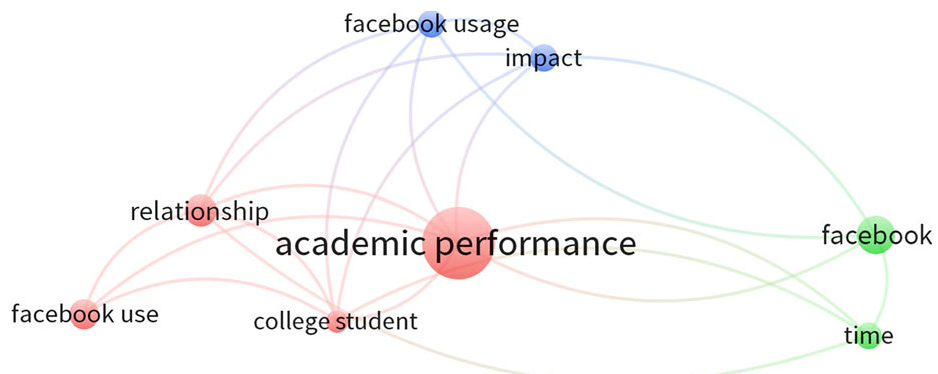 Figure 1: VOSviewer visualization showing the thematic clusters of current scholarship, dominated by "Academic Performance" and "Facebook."
The study filtered hundreds of articles down to 23 core peer-reviewed papers, focusing on general SNS use rather than intentional "educational" use to prevent confounding variables.
Core Findings: The "Multitasking Tax"
The review categorized the findings into three silos:
- The Negative Trend: A majority of studies (e.g., Junco, Kirschner) suggest that as time on SNS increases, GPA tends to decrease. The primary culprit? Task-switching. Attempting to study while social notifications chime creates a "cognitive load" that precludes deeper learning.
- The Non-Significance: Surprisingly, several high-profile studies (e.g., Pasek et al.) found absolutely no statistical link between Facebook use and grades, suggesting that students might be better at managing their time than we give them credit for.
- The Positive Outlier: Some research (Ainin et al.) found that Facebook can actually improve academic performance by aiding socialization and acculturation, which in turn reduces stress and enhances the learning environment.
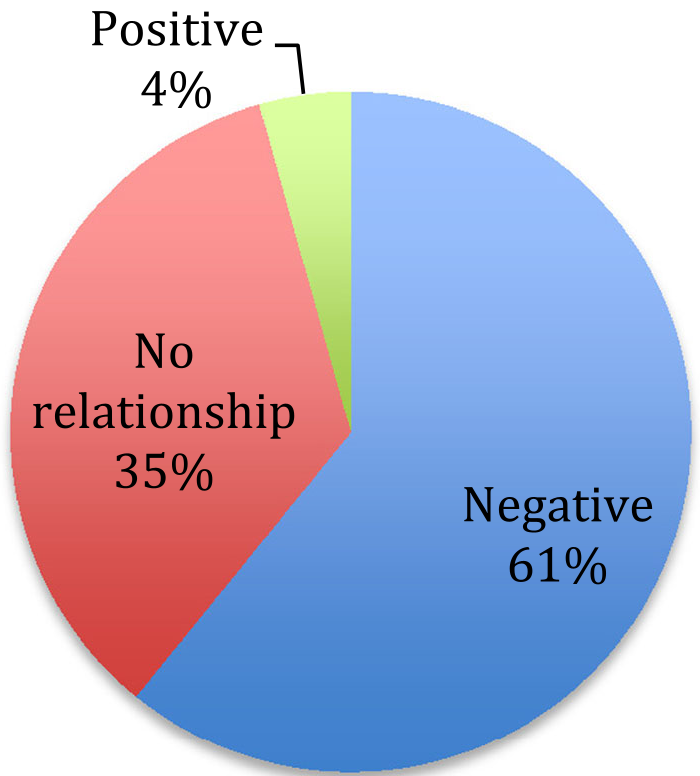 Figure 2: The distribution of findings highlights that while "Negative" results are frequent, they do not constitute a consensus.
Critical Analysis: Why the Data is "Muddied"
As a Senior Tech Editor, I find the most interesting part of this review to be the Methodological Gap. The authors point out a "US-centric" bias (nearly 65% of studies) and a heavy reliance on self-reported GPAs, which can be notoriously inaccurate.
Furthermore, current research assumes a Linear and Unidirectional relationship (SNS leads to lower GPA). But what if it's the opposite? Michikyan et al. (2015) "flipped the script," suggesting that poor academic performance might actually drive students to seek refuge and social validation on SNS.
Conclusion & Future Outlook
The "Death of the GPA" via Facebook is an oversimplification. This review proves that the impact of social networking is moderated by:
- Class Standing: Freshmen are more vulnerable to SNS-induced performance drops than seniors.
- Multitasking Efficacy: Some students manage task-switching better than others.
- Function of Use: Checking friends' status vs. active socialization yields different results.
Final takeaway: We need to move from Cross-Sectional "snapshots" to Longitudinal designs. Only by tracking students over months or years can we determine if social media is the cause of academic decline or merely a symptom of it.