
Harvesting the Social Mind: How Tag!t Extracts Deep Video Semantics
Using Social Networking and Collections to Enable Video Semantics Acquisition
This paper introduces "Tag!t," a social-networking application designed to acquire rich video semantics by leveraging collaborative tagging and user behavioral data. By integrating with public APIs like Facebook and YouTube, the system extracts temporal, collection-based, and linked-content metadata to overcome the limitations of static, author-defined video tags.
TL;DR
The "Tag!t" system bridges the gap between raw video files and human understanding by leveraging the "wisdom of the crowd" within social networks. Instead of relying on static descriptions, it captures how users interact with videos—where they laugh (temporal tags), what they skip (behavioral semantics), and how they categorize content (collection semantics). This social-centric approach transforms isolated media into a web of interlinked semantic events.
Perspective: Moving Beyond Static Metadata
The fundamental crisis in video retrieval is the semantic gap. Most video platforms treat a 10-minute clip as a single opaque object described by 3-5 tags provided by the uploader. However, a video is a temporal journey; a tag relevant at minute 1:00 might be useless at 5:00.
The authors argue that the "Social Web" (Web 2.0) offers a goldmine of implicit data. When Bob shares a video and Alice comments "boring" while skipping the middle three minutes, they are unknowingly training a semantic engine.
Methodology: The Four Pillars of Social Semantics
The Tag!t architecture (deployed as a Facebook application) extracts intelligence through four distinct channels:
- Temporal Tagging: Users apply "emotitags" (one-click emotion markers) at specific timestamps. This creates a "heat map" of sentiment across the video’s timeline.
- User Behavioral Semantics: By monitoring
play,pause,seek, andstopevents, the system infers content quality. If everyone skips the same 30 seconds, that segment is semantically "noise" for that group. - Collection Semantics: The way users group videos into playlists (e.g., "Epic Fails" vs. "Educational") provides high-level classification that uploader tags often miss.
- Linked Content: When users associate a video with a Flickr photo or another YouTube clip, they create a relational graph, expanding the semantic reach of the original media.
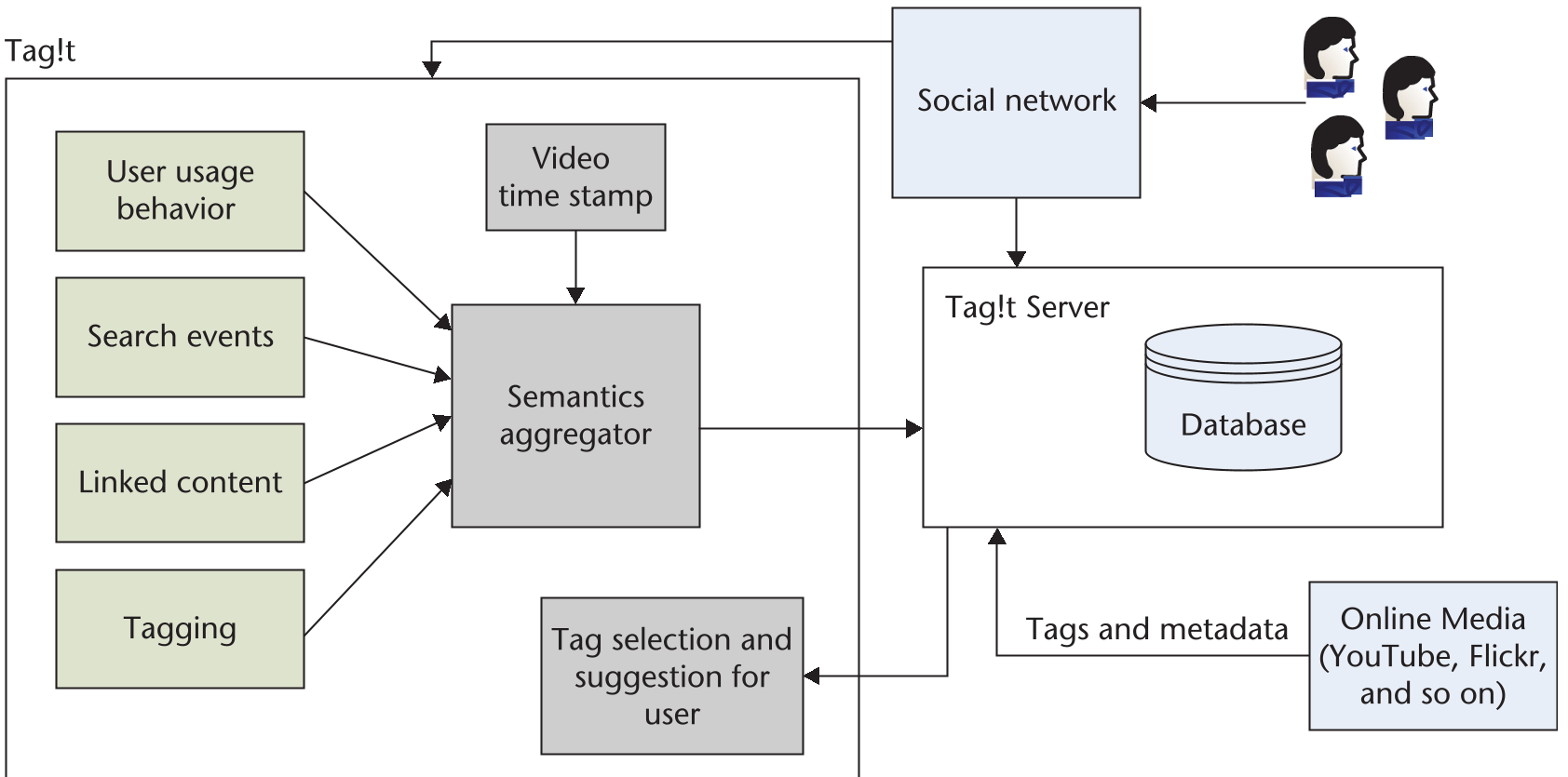 Figure 1: The Tag!t framework integrates client-side interaction with server-side semantic aggregation.
The "Group Consensus" Effect
A key insight of this research is that Social Groups = Semantic Consistency. While one user might find a clip "sad" and another "funny," users within the same social cluster (e.g., "Technical Users") tend to reach a consensus.
The experiment involving a comedy clip about physicists proved this. Technical users tagged scientific nuances that non-technical users ignored. By filtering tags through the lens of a user's social graph, search engines can provide results that are contextually relevant to that specific community’s "language."
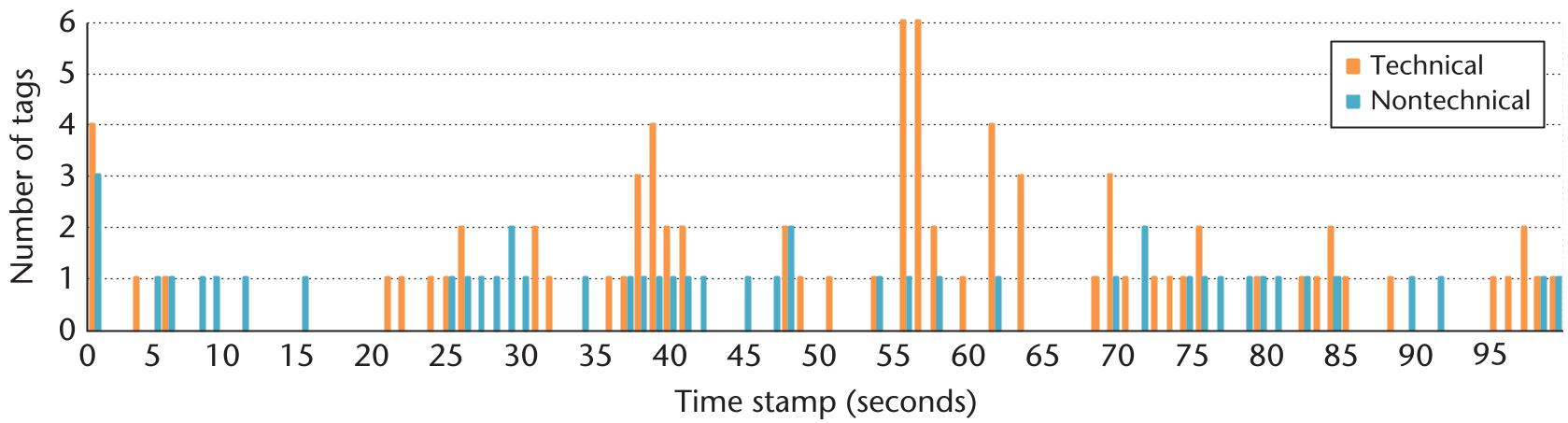 Figure 2: Analysis showing how technical and non-technical groups cluster their reactions around specific video events.
Gamification: Solving the Incentive Problem
Manually tagging video is a chore. The authors introduced a "Competition Mode" to solve this. Users earn points by matching the timing and sentiment of their friends' tags. This transforms metadata generation from "work" into a social game, significantly increasing the volume of available data.
Critical Insight & Future Outlook
While Tag!t successfully demonstrates how to gather semantics, the real challenge lies in standardization. The use of Continuous Media Markup Language (CMML) is a step in the right direction, allowing for dynamic, time-synced metadata.
Limitations: The study relies on a relatively small user group (22 participants). In a real-world "viral" scenario, the noise level from "tag spam" would require more robust filtering algorithms.
The Future: As we move into an era of AI-driven content, the data gathered by systems like Tag!t will be essential for training multi-modal LLMs to understand the "emotional arc" of videos rather than just identifying objects in frames.
Conclusion
Tag!t shifts the paradigm from Content Analysis (pixels) to Context Analysis (people). By treating a video as a living document within a social ecosystem, the researchers have paved the way for search engines that don't just find videos, but understand why we watch them.