
Habbo Hotel: When Social Networking Meets Digital Gaming - An Ethical Collision
Social networking and digital gaming media convergence: Classification and its consequences for appropriation
This paper presents a field study of Habbo Hotel, an online play space that exemplifies the convergence of social networking and digital gaming. By applying the Social Shaping of Technology (SST) framework, the authors classify user behaviors, specifically "scamming," and analyze how the blurring of online and offline moral boundaries affects player appropriation.
TL;DR
This research dives into the "grey zones" of media convergence by studying Habbo Hotel. It reveals how the blend of social networking (perceived as reality) and digital gaming (perceived as fantasy) leads to complex ethical dilemmas, specifically in the form of virtual scamming. While developers build spaces for play, users "innofuse" them with predatory economies, justifying theft of virtual goods that have real-world monetary value.
The Problem: The Classification Crisis
Traditional Information Systems research often stops at the office door. However, the convergence of media—like the Sony PlayStation 3 or platforms like Habbo Hotel—combines disparate functions (gaming, socializing, commerce) into a single "box."
The core problem is classification. If we classify a space as a "game," we might view asocial behavior as "part of the fun." If we classify it as a "social network," those same behaviors are viewed as moral wrongs. In converged spaces, these definitions bleed into each other, creating a vacuum where "scammers" thrive by exploiting the ambiguity of whether online actions are "real."
Methodology: Beyond the Designer's Intent
The authors reject technological determinism. Instead of assuming users follow the "rules" of the system, they use the Social Shaping of Technology (SST) framework to see Habbo as a configurational technology.
Key concepts used:
- Inscripiton: The preferred reading/use intended by the developers (Sulake).
- Innofusion: Innovation that occurs during local diffusion—in this case, the creation of "scamming games" by the community.
The Habbo Interface
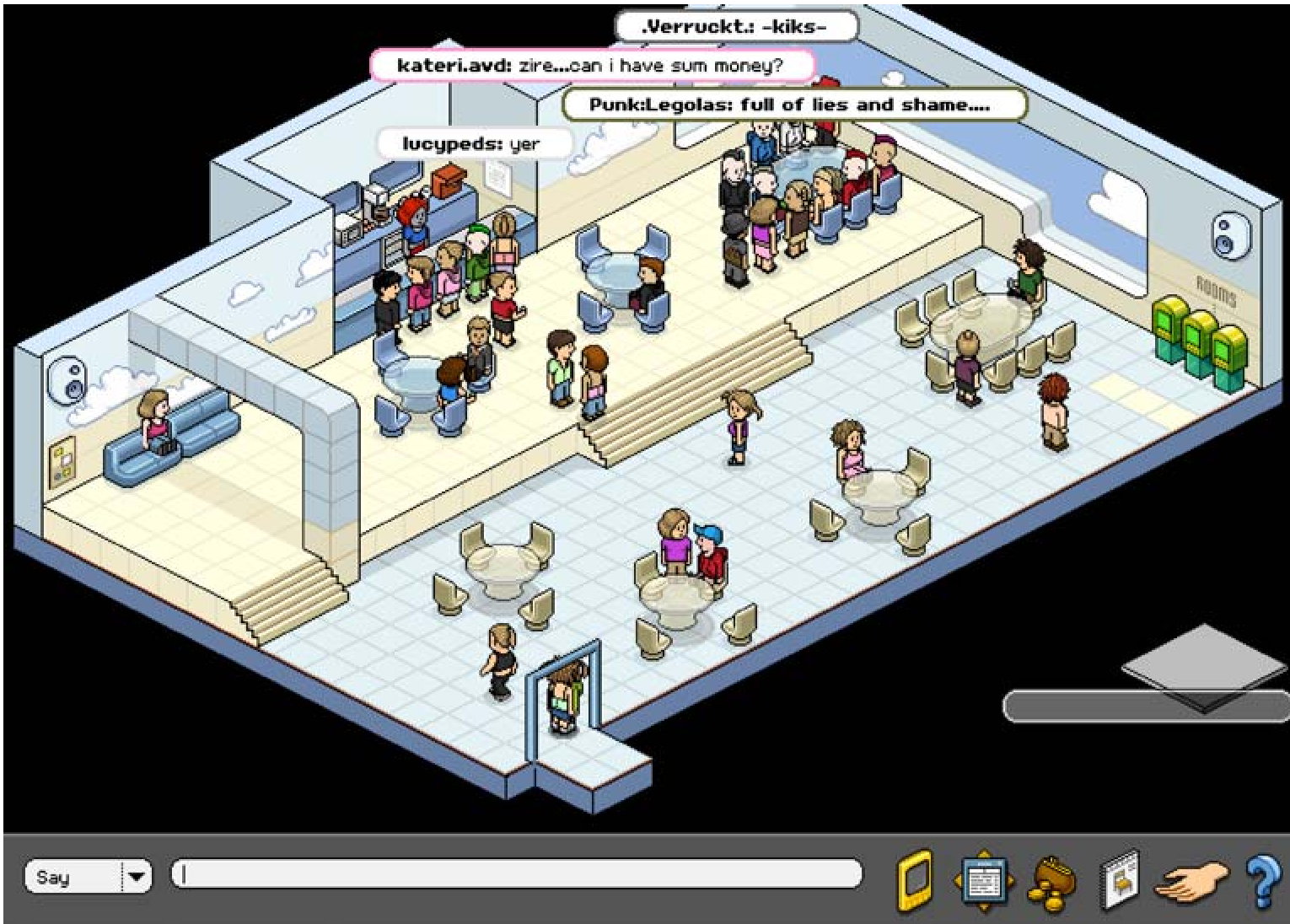 The isometric tile-based environment facilitates distance-based chat, making it a "social grooming" space where trust is easily built and subsequently exploited.
The "Art" of the Scam: Methodology of Deception
The paper uncovers a fascinating taxonomy of "anti-social" networking. Scammers don't just hack; they perform.
- The Art Money Scam: A "Gullible Guy" is lured into a room where an invisible audience (using teleporters or hiding behind furniture) watches the theft.
- Gold Digging: Using the in-game "marriage" mechanic to gain access to a partner's "Furni" (virtual furniture).
- Virtual Prostitution: Trading social/sexual performance for rare digital items.
Economics of "Furni"
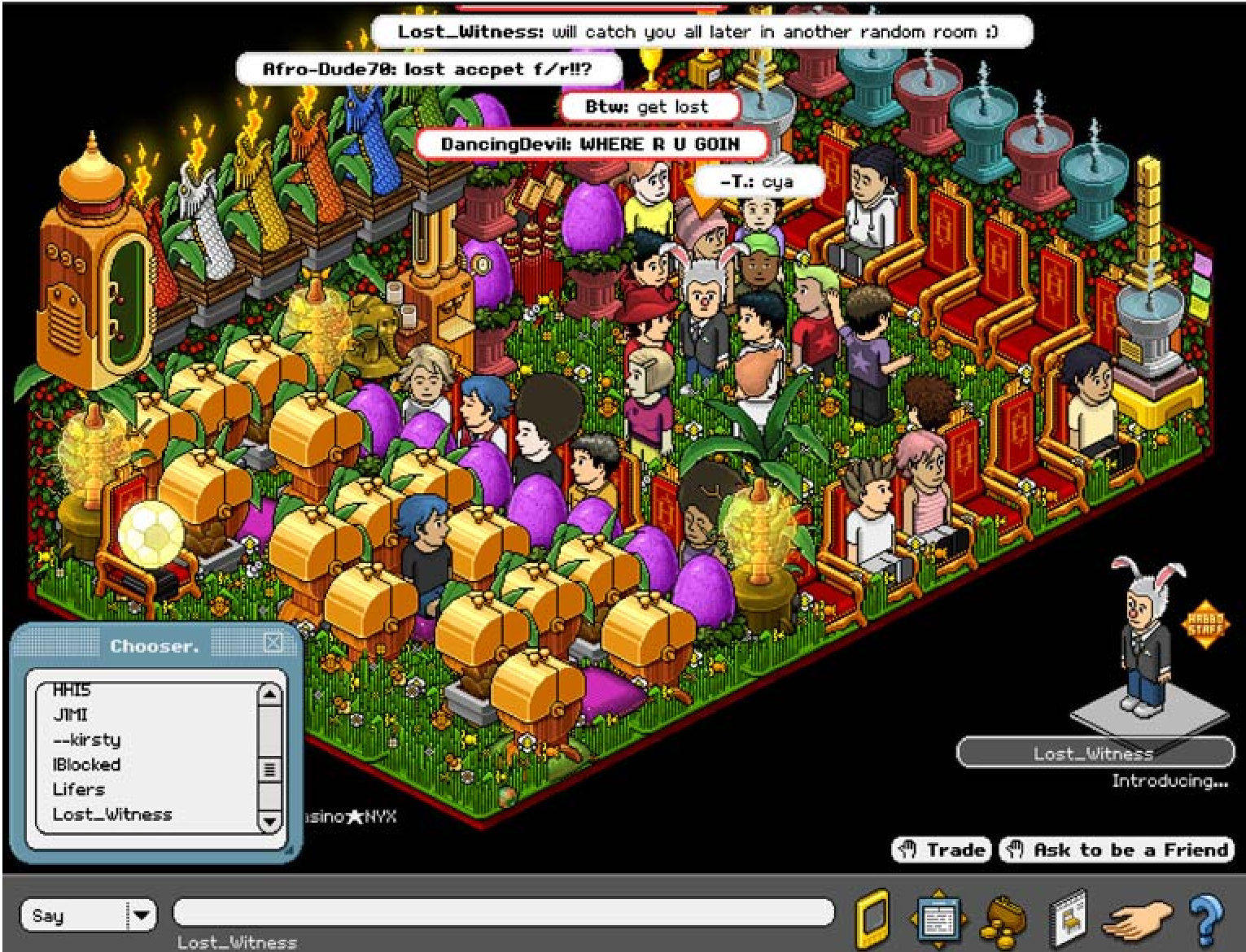 A room packed with "Furni." While developers intended these for decoration, they function as a hard currency. Rare items like "Thrones" (pictured) have been found on eBay for £19.99, grounding the "fantasy" in a tangible economy.
Critical Insight: The "Real Life" vs. "Game" Paradox
The most striking finding is the moral bracketing used by scammers. In interviews, scammers admitted they wouldn't "rob old ladies in real life," yet they felt zero remorse for emptying a child's Habbo account. They view their targets as "Gullible Guys" and justify their actions as "beating the system" or "ripping off the developers."
This creates a dangerous disconnect:
- Developers release "Rare Furni" to drive revenue, inadvertently fueling a competitive "secondary market."
- Scammers view the environment as a "game" where the goal is to accumulate assets by any means.
- Victims (often children) experience the loss as a "real" social betrayal, as their online ties are part of their actual social system.
Conclusion: Educating for a Converged World
The paper concludes that we cannot rely on "Design" alone to fix ethical issues (the Design Fallacy). Instead, as media continues to converge, we must:
- Recognize that online activities are not "bracketed off" from reality.
- Educate users on the shifting nature of "rights and wrongs" in play spaces.
- Acknowledge that developers share the responsibility for the social structures they incentivize (like rarity and competition).
Final Takeaway: As "virtual" and "real" continue to merge, the way we classify our digital spaces will determine our moral obligations within them.