
Bridging Social Silos: A FOAF-based Semantic Interoperability Framework
9742_Social networking interoperability through extended FOAF vocabulary and service.
This paper proposes an interoperable framework for Social Network Services (SNS) by extending the Friend of a Friend (FOAF) vocabulary. It introduces a FOAF-based ontology and a dedicated "FOAF Web Service" to unify disparate user profiles and social graphs across multiple Web 2.0 platforms.
TL;DR
Social networking today is a fragmented landscape of "Walled Gardens." This paper presents a solution to unify these silos by extending the FOAF (Friend of a Friend) vocabulary into a comprehensive ontology and deploying a FOAF Web Service. This allows developers to create "Social Mashups" that interact with multiple platforms like LinkedIn and Twitter using a single, semantic interface.
The Problem: The "Walled Garden" Effect
Despite the maturity of Web 2.0, social data remains trapped. The authors identify four critical inhibitors to a seamless social experience:
- Identity Fragmentation: Users must maintain separate accounts and IDs for every service.
- Data Redundancy: Updating contact information requires manual entry across multiple platforms.
- Information Incompleteness: Partial data (e.g., a photo on Flickr, a resume on LinkedIn) is rarely synced.
- Lack of Control: Data is owned by operators, making it hard for users to "move" their social graph to new services.
While industry attempts like OpenSocial (by Google) and the Facebook Platform exist, they are either widget-centric or platform-locked. They lack a true semantic layer that understands the meaning of a social connection regardless of the platform.
Methodology: The FOAF Extension
The core innovation lies in bridging the gap between the decentralized FOAF project and the functional requirements of modern SNS APIs.
1. Enhancing the Ontology
The researchers extended the standard FOAF vocabulary (which handles names and "knows" relationships) with a new namespace to handle service-specific metadata. Key additions include:
profile: Represents the user's specific account on an SNS.rs/ws: Definitions for REST/Web Services provided by that specific SNS.op_name/op_url: Mapping of API operations (e.g., "Send Message").priority: A mechanism to resolve which SNS should be the "primary" source for specific data.
2. The FOAF Web Service Architecture
The proposed system acts as a semantic middleware. When a client requests a social profile, the service:
- Queries the corresponding SNS via its native API.
- Authenticates using OAuth.
- Transforms the proprietary response into a unified RDF/FOAF document.
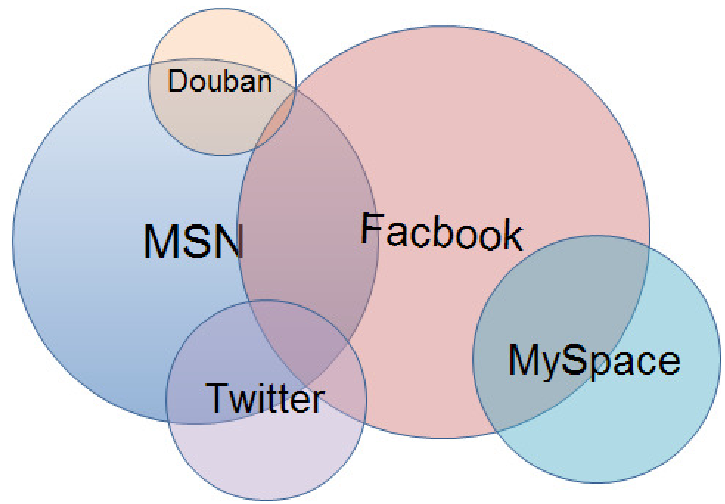 Figure 1: The vision of a user interacting with multiple online social networks through a unified semantic layer.
Case Study: LinkedIn2Twitter
To prove the design, the authors developed LinkedIn2Twitter. This application allows a user to:
- Log in once.
- View their LinkedIn professional network.
- Directly send a Twitter message to those contacts without leaving the interface.
The technical heavy lifting is done via the FOAF Web Service, which maps a "LinkedIn Contact" and a "Twitter Direct Message" into a single semantic flow.
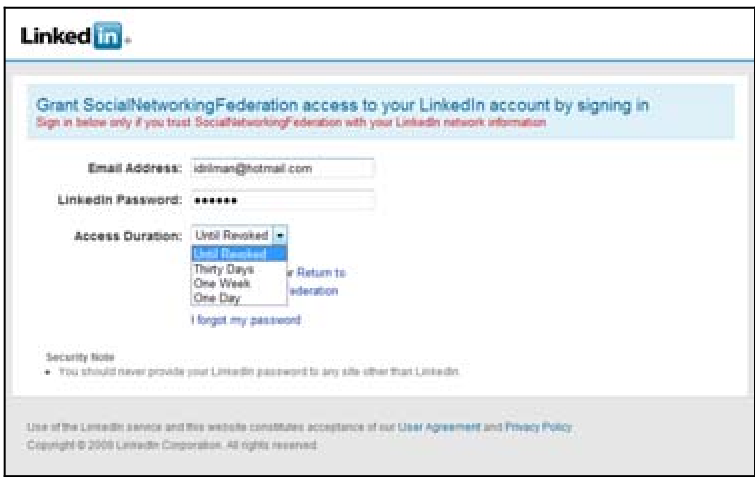 Figure 2: Prototype implementation showing OAuth authentication through the LinkedIn portal facilitated by the FOAF service.
Experimental Logic
The researchers provided XML/RDF snippets (Table 1 & 2 in the paper) showing how a generic person object is now decorated with service and openid properties, allowing a machine to understand that "User X on Site A" is identical to "User X on Site B."
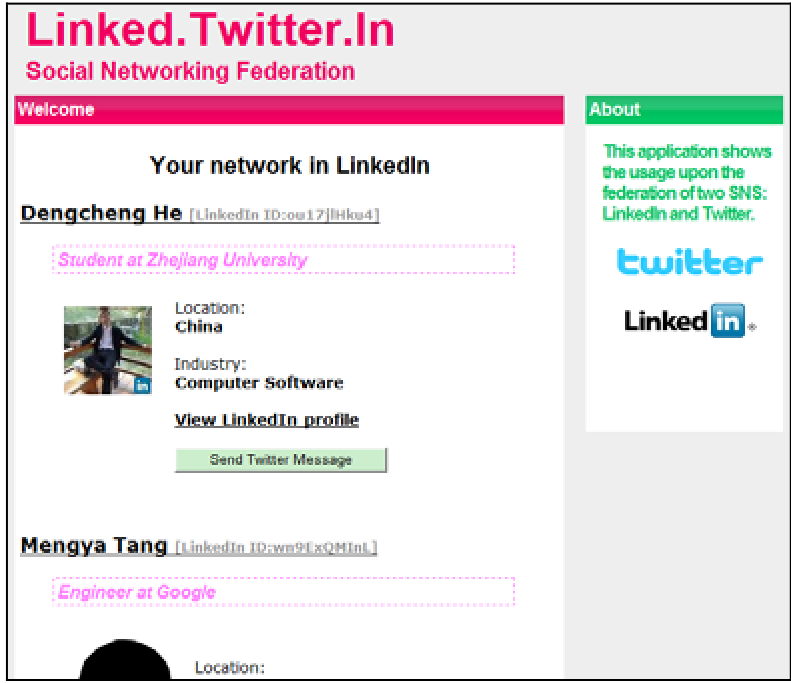 Figure 3: A unified contact list aggregated from different social services using the semantic mapping.
Critical Analysis & Future Outlook
The paper successfully demonstrates that Semantic Web technologies are not just for academic metadata but can solve real-world API fragmentation.
Strengths:
- Decentralization: By using FOAF, the user theoretically retains ownership of their social descriptor.
- Developer Efficiency: One "Semantic API" replaces N proprietary ones.
Limitations & Future Work:
- Scalability: Converting real-time API calls into RDF on the fly introduces latency. The authors acknowledge the need for a higher-performance design.
- Operator Support: The success of this framework relies on SNS operators maintaining open APIs, which is a significant business hurdle (e.g., "API limits" and data gatekeeping).
Conclusion
This research provides a foundational roadmap for a Unified Social Web. By treating social networks as interoperable services rather than isolated destinations, we move closer to a web where users, not platforms, own their social connections.