
The Digital Soapbox: Mapping the Social Network of Greek Political Blogging
A Social Networking Exploration of Political Blogging in Greece
This paper investigates the topological characteristics of the Greek political blogosphere during the 2007 PASOK leadership election. By applying Social Network Analysis (SNA) and statistical metrics, it identifies "focal point" blogs and measures connectivity patterns among 142 active blogs.
TL;DR
In the wake of the 2007 Greek leadership crisis, a new political battlefield emerged: the blogosphere. This paper analyzes how a few "Elite" blogs managed to hijack the political conversation, creating dense hubs of influence that functioned as "focal points" for both citizens and mainstream media. Using Social Network Theory, the authors prove that in the digital world, connectivity is the ultimate currency of power.
Background: The Crisis of PASOK
After a stinging defeat in the 2007 Greek national elections, the Pan-Hellenic Socialist Movement (PASOK) faced a leadership showdown between George Papandreou and Evangelos Venizelos. This period marked a turning point for the Greek internet, as political blogging transitioned from a hobby to a "social-transformative" tool. The researchers set out to map this transition using quantitative metrics to see if the Greek digital landscape obeyed the same "power laws" observed in the US.
The "Power Law" of Influence
The core problem the authors address is the Skewedness of digital attention. In a network of 142 blogs, most are "shouting into the void" with zero to one incoming links.
The study confirms that the distribution of hyperlinks follows a lognormal pattern. A tiny fraction of blogs—the "A-list"—receives the lion's share of attention. These blogs act as Aggregators, filtering complex political debates into "summary statistics" that journalists then use to gauge public opinion.
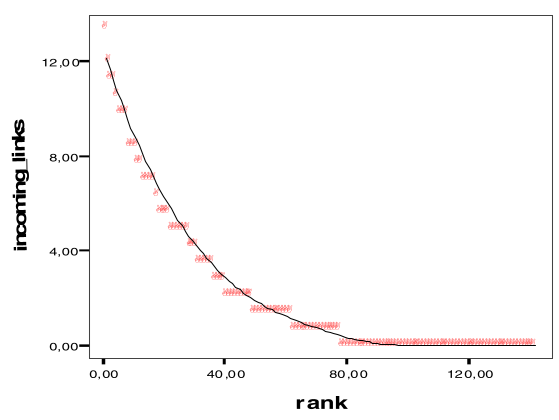 Figure: The long-tail distribution showing that the vast majority of blogs have minimal connectivity, while a few "focal points" dominate.
Methodology: Beyond Mentions
The authors didn't just count posts; they mapped the Interactivity Architecture.
- Connectivity: Who links to whom?
- Closeness: How insular are the political factions?
- Temporal Variation: How did the "buzz" change as the election approached?
They discovered that posts linking to Venizelos (the challenger) were highly concentrated at the start of the campaign, reflecting a burst of critical scrutiny, whereas links to the incumbent Papandreou were more uniform.
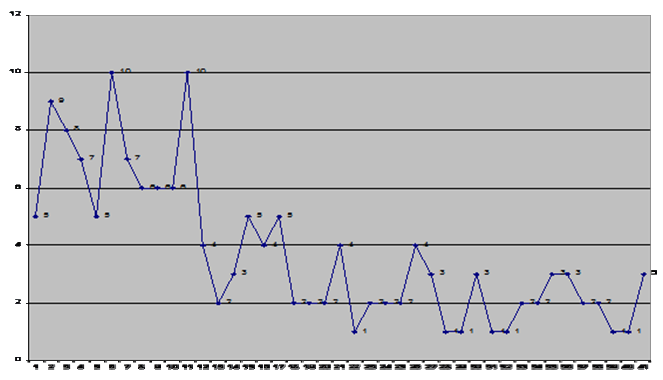 Fig. 1: Contrasting the distribution of attention between the two main candidates over the campaign period.
The Core Groups: Digital Echo Chambers?
Using Multidimensional Scaling (MDS), the researchers identified three distinct clusters:
- Group 1 (The Loyalists): Strictly pro-incumbent, highly interconnected (55.6% intra-linking).
- Group 2 (The Critics/Neutrals): A mix of critical political blogs and non-aligned observers with lower internal cohesion.
- Group 3 (The Long Tail): 119 blogs with almost no links, representing the "amateur" or ad-hoc campaign blogs.
The "Closeness" metric revealed a fascinating insight: The pro-Papandreou group functioned as a tight-knit community, effectively creating a "digital fortress" of support, while the opposition was more fragmented.
Critical Analysis: Why This Matters
The value of this paper lies in its application of Social Networking Theory to a specific political crisis. It highlights two critical roles of smaller blogs:
- Fire Alarms: Small blogs find niche information and "signal" it to focal point blogs.
- Information Aggregators: Elite blogs filter these signals, providing a manageable "executive summary" for the mainstream press.
Limitations: Since the data is from 2007, it lacks the algorithmic complexity of modern social media (Shadowbanning, Echo Chamber algorithms). However, the fundamental physical intuition—that network topology dictates political influence—remains a cornerstone of digital sociology.
Conclusion
The 2007 PASOK election wasn't just decided in town halls; it was framed in the "core groups" of the Greek blogosphere. As we move into an era of AI-driven discourse, understanding these "focal points" is more critical than ever for identifying the true gatekeepers of public opinion.