
Social Grid: Leveraging Social Networks to Flatten the Smart Grid Peak
Social Networking Reduces Peak Power Consumption in Smart Grid
The paper introduces a "family plan" approach for smart grids, utilizing social network topologies and distributed clustering to group users. By combining minimum-variance grouping with an Earliest Deadline First (EDF) scheduling algorithm, the system collaboratively shifts deferrable appliance loads to minimize peak power consumption.
TL;DR
Researchers have proposed a "family plan" for electricity. By grouping socially-connected users into clusters using a distributed minimum-variance algorithm, the system can "cancel out" coinciding power peaks. Combined with an Earliest Deadline First (EDF) scheduler, this approach reduces peak power consumption by nearly 48% and slashes fuel costs for utility companies.
Background: The Cost of the Peak
In the world of the Smart Grid, "the peak" is the enemy. High Peak-to-Average Ratio (PAR) forces utility companies to keep inefficient "peaker plants" on standby, leading to massive fuel waste and carbon emissions. While individual scheduling helps, the true potential for smoothing the load lies in collective action. However, scheduling millions of users centrally is a computational and privacy nightmare.
The Insight: Socially-Aware Load Leveling
The core innovation of this paper is the Family Plan approach. The authors realized that users are only willing to cooperate and share data if they already trust each other. By using social network graphs (like Facebook subsets), the system can form small, manageable "families" or groups.
The mathematical intuition is brilliant: if User A usually cooks at 5 PM and User B usually cooks at 8 PM, their power consumption patterns have a negative covariance. Grouping them together allows their combined load to remain steady.
Methodology: Clustering and Scheduling
The system operates in two distinct phases:
1. Distributed Minimum-Variance Clustering
Standard clustering (like K-means) is often centralized. This paper proposes a distributed algorithm where nodes only exchange state vectors with immediate social neighbors.
- Goal: Partition the graph into groups of size such that the aggregated variance of power consumption in each group is minimized.
- Efficiency: The authors achieve a linear complexity of , making it scalable to massive networks.
2. The EDF Scheduler
Once groups are formed, the "Family Plan" uses an Earliest Deadline First (EDF) scheduling policy.
- Long Jobs: Started at their earliest possible time.
- Short Jobs: Sorted by their "latest starting time" (urgency). The most urgent and power-hungry jobs are scheduled first into the available "valleys" of the load profile.
Experimental Results: A Win-Win for All
The team developed a trace-driven simulator using the ARMA model to generate realistic household data synchronized with the Reference Energy Disaggregation Data (REDD).
Key Findings:
- Peak Reduction: The proposed scheme reduced the PAR by 47.7% compared to no scheduling.
- Economic Impact: User payments (under quadratic pricing) dropped by 44.7%.
- Utility Side: Fuel costs for generators were slashed by 47.22%, as the grid could rely on fewer, more efficient base-load generators instead of expensive peaker units.
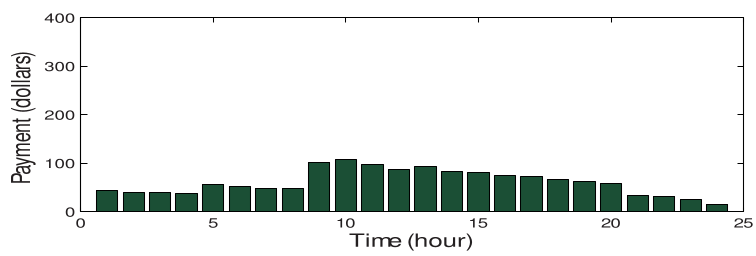 Fig: Energy consumption and payment under the family plan (Nc = 5) shows a significantly flatter profile compared to individual usage.
Critical Insight: Why Minimum-Variance beats Random?
The study proves that random grouping is insufficient. Randomly grouping two households that both peak at 6 PM provides no "room" for the scheduler to shift jobs. Minimum-variance clustering specifically hunts for complementary users, ensuring that one person's "peak" falls into another's "valley."
Conclusion and Future Outlook
The "Social Networking" approach to the Smart Grid addresses the two biggest hurdles in demand-response: trust and complexity. By offloading the coordination to small social circles, we achieve the efficiency of a centralized system with the privacy and speed of a distributed one.
Future Directions: The authors suggest incorporating interruptible jobs (e.g., an EV charger that can pause and resume), which would provide even more granular control and potentially push peak reduction past the 50% mark.