
Building the Academic Backbone: A Dedicated Social Network for Global Collaboration
Social Networking System for Academic Collaboration
The paper presents a dedicated Social Networking System designed for international academic collaboration, move beyond generic platforms like LinkedIn. Built using Java Server Pages (JSP), the system integrates automated network formation based on research interests and expertise to facilitate partnership finding and knowledge sharing.
TL;DR
This research addresses the inefficiency of mainstream social media for scholarly work by developing a custom Social Networking System (SNS) tailored for academia. By leveraging Java Server Pages (JSP) and a specialized "weblog-inspired" interaction model, the authors created a platform where researchers can find partners, manage international projects, and showcase expertise without the noise of generic professional networks.
Problem & Motivation: Why LinkedIn Isn't Enough for Labs
While platforms like LinkedIn excel at business networking, the authors argue they fall short in the academic sphere. Educational professionals face a specific set of hurdles:
- Information Fragmentation: Research projects and institutional news are often siloed.
- The Connectivity Paradox: High-density social networks often discourage active contribution because users feel their input is lost in the crowd.
- Search Ambiguity: Finding a "Java expert" for a quick query is easy; finding a collaborator for a "JSP-based pedagogical tool in high-pressure environments" requires more granular metadata.
The authors' insight was to move toward a disassortative pattern—mimicking the structure of weblogs rather than just "friends lists"—to foster sustainable cooperation and knowledge exchange.
Methodology: The Core Architecture
The system was designed using UML (StarUML) and implemented on a classic enterprise stack (Apache Tomcat, MySQL, and NetBeans).
1. Automated Network Recognition
Instead of forcing users to manually find every group, the system uses the user's registered data—Country, Institution, Area, and Interests—to automatically suggest and populate "Networks." These networks function as topic-oriented weblogs where visibility is high but contribution is focused.
2. The Hybrid Interaction Model
The system balances three distinct interaction layers:
- Profiles: The "Resume" layer with granular privacy controls.
- Networks: The "Community" layer, automatically generated by the system.
- Groups: The "Project" layer, giving users granular control over visibility (Open vs. Closed) and membership.
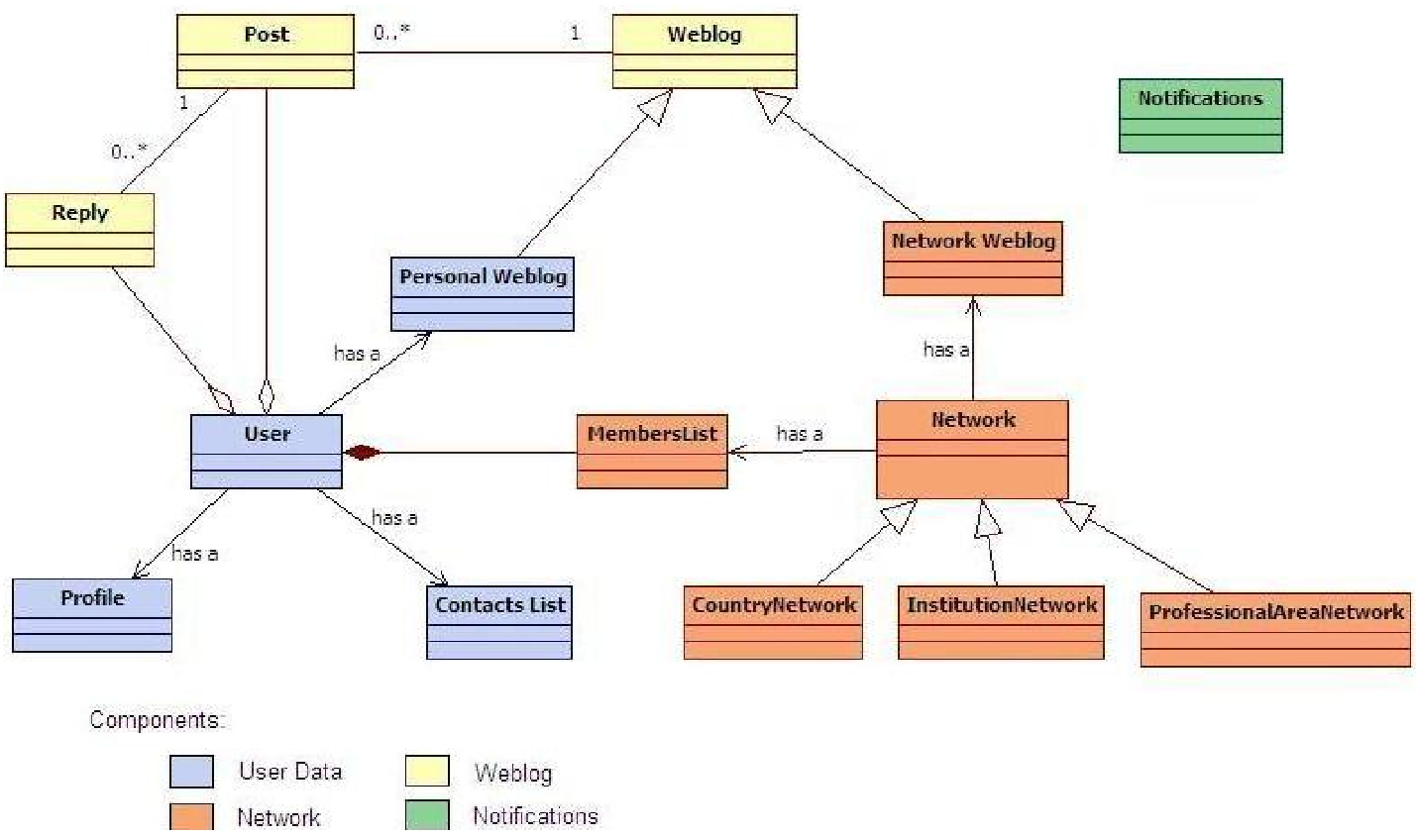 Fig 1. The Class Diagram illustrating the relationship between Users, Networks, and Profiles.
Experiments & Results
The implementation proved that a specialized academic portal could be built effectively using JSP. Key functionalities validated during the study include:
- Expert Tagging: Successfully categorizing users by "Skills" or "Projects" to minimize search friction.
- Privacy Enforcement: Implementing levels of data access where only verified contacts can view detailed personal weblogs.
- Sustainability: The inclusion of weblog-style "posts and replies" within networks was found to facilitate a more academic discourse than simple social "likes."
Critical Analysis & Conclusion
Takeaway
The core value of this work lies in recognizing that academic collaboration is metadata-heavy. By linking users through shared institutional and research traits rather than just social links, the system creates a more relevant "Search and Discover" experience for researchers.
Limitations & Future Work
The authors acknowledge that the system, as a monolithic JSP application, faces scalability and complexity challenges. They suggest moving toward Java Server Faces (JSF) and AJAX to create a more responsive, component-based architecture. Additionally, the "News and Events" module remained a placeholder in the initial prototype, representing a critical area for future development in academic event coordination.
Ultimately, this research serves as an early blueprint for what we now see in sophisticated academic ecosystems—proving that for researchers, the "who you know" is only valuable when paired with "what they know."