
Beyond the LMS: Decoding the Educational Affordances of Social Networking
Using Social Networking Tools for Teaching and Learning: A Perspective of University Lecturers and Students
This paper explores the integration of Social Networking Tools (SNTs) in higher education by proposing a new typology of educational affordances. Drawing on survey data from 38 participants across universities in Uganda and the UK, the study identifies Facebook as the dominant platform and examines how pedagogical, social, and technological affordances shape digital learning.
TL;DR
As students increasingly move away from traditional Learning Management Systems (LMS) like Blackboard, this paper investigates the "why" and "how" of Social Networking Tools (SNTs) in academia. The researchers propose a typology to categorize the pedagogical, social, and technological affordances of tools like Facebook. The findings highlight a significant perception gap: while students are ready to embrace "Social Collaborative E-learning," lecturers remain largely hesitant or uncertain.
The "Affordance" Problem: Why LMS is Falling Short
The primary motivation for this study is the inherent limitation of traditional LMS platforms. While efficient for administrative tasks, LMS platforms often lack the dynamic, multi-way interaction students crave.
The authors leverage Gibson's Affordance Theory, which suggests that we perceive objects not just by their shapes, but by their possibilities for action. In an educational context, SNTs are the "objects" and student-teacher interactions are the "actions." The challenge is that these actions are often confined to social browsing rather than structured learning.
Methodology: A New Typology of SNS Usage
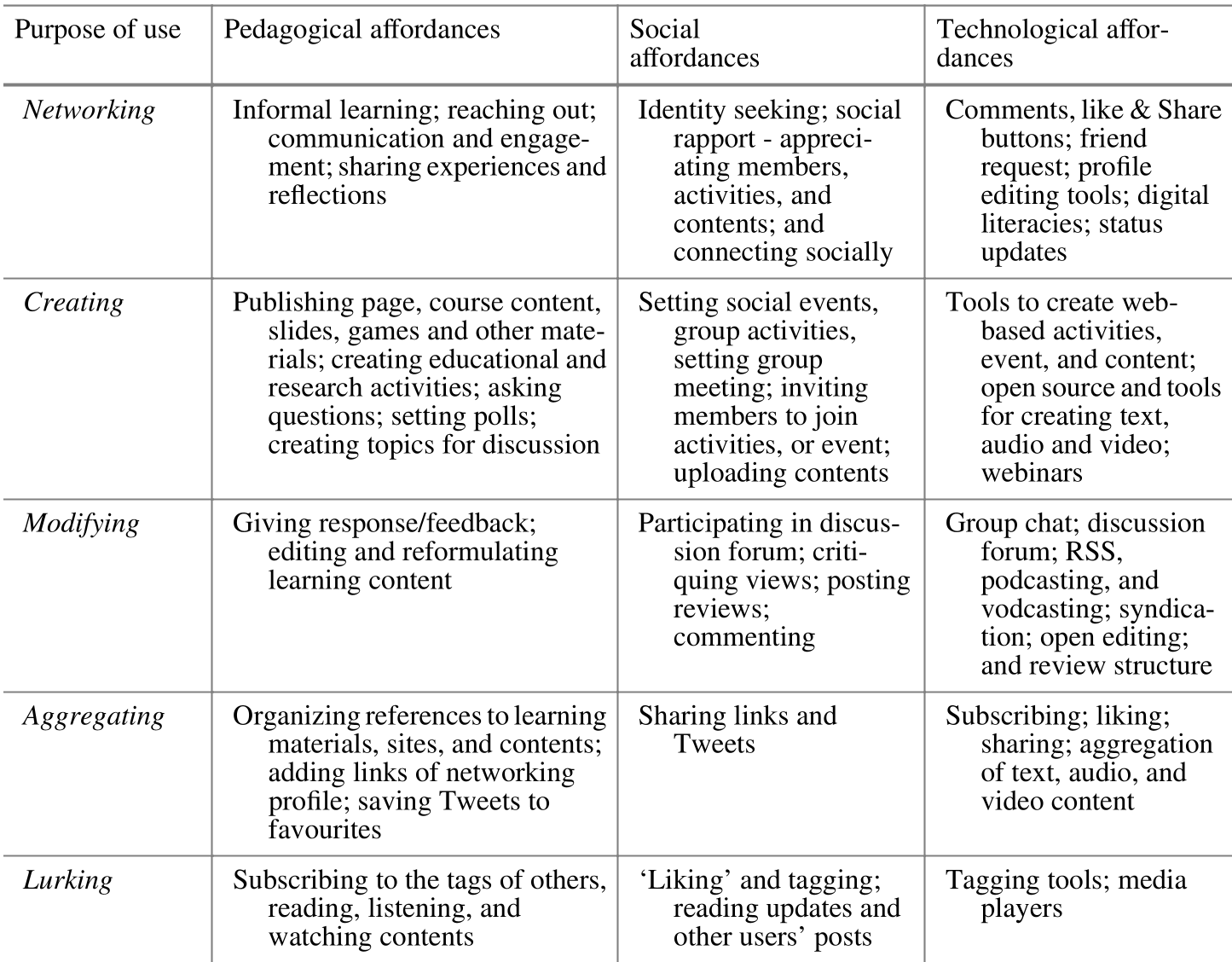
The core contribution of this work is a matrix that reconciles "Purpose of Use" with "Educational Affordances."
1. The Three Perspectives of Affordance
- Pedagogical: Innovative learning approaches, multimedia presentation, and student reflection.
- Social: Peer-to-peer interaction, social rapport, and synchronous communication.
- Technological: Open, customizable environments and digital literacy development.
2. The Interaction Matrix
The authors categorize user behavior into five levels: Networking, Creating, Modifying, Aggregating, and Lurking.
Key Findings: The Lecturer-Student Gap
The study conducted a cross-continental survey involving the University of Reading (UK), Uganda Christian University, and Makerere University.
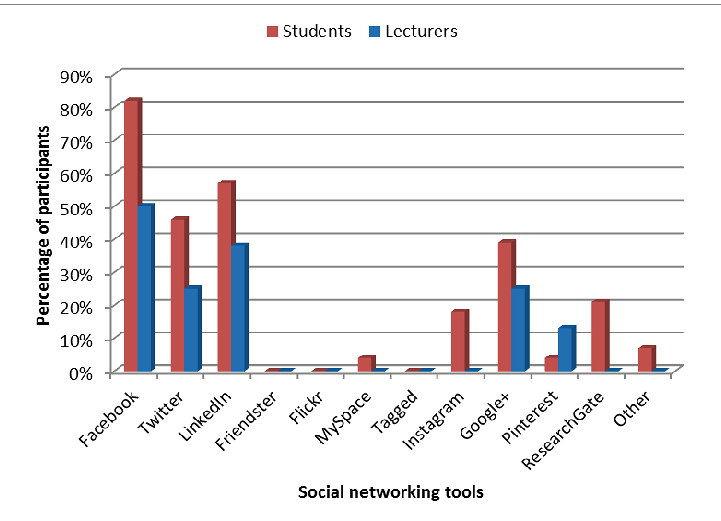
- Facebook Supremacy: 75% of participants used Facebook, citing its "ease of use" for class announcements and group coordination.
- Usage Intensity: Participants spend an average of 21 hours per week on social networks, indicating that these tools are already deeply embedded in their daily lives.
- The Perception Gap: 61% of students find SNTs "useful" for education, compared to a significantly lower percentage of lecturers. A staggering 49% of lecturers provided "No Response" regarding the usefulness of these tools, suggesting a lack of engagement or awareness of how to pivot these tools for teaching.
Critical Insight: Social vs. Pedagogical
Despite the high usage, the data reveals that Social Affordances (making friends, chatting) are far more pronounced than Pedagogical Affordances (learning, brainstorming).
The researchers argue that for SNTs to truly transform education, the environment must shift. It is not enough to simply "be on Facebook"; the technological affordances (like group chats and polls) must be intentionally mapped to pedagogical outcomes (like peer review and content creation).
Conclusion and Future Outlook
This paper serves as an early-stage roadmap for "Social Collaborative E-learning." While the study is limited by its sample size, it identifies a critical trajectory: the shift from centralized LMS to decentralized, social-first learning environments.
Future Work must address the "Lecturer Uncertainty." If 49% of lecturers are non-responsive to the educational potential of these tools, the barrier to Web 2.0 education is not technological—it is cultural and professional. Integrating social tools into formal curricula will require training that shifts the focus from "socializing" to "collaborating."
Takeaway for Educators: Start by identifying which "Purpose of Use" (e.g., Aggregating or Creating) aligns with your learning objectives before choosing a tool. The affordance follows the intent.