
Bridging the Gap: Transforming Facebook into a Polar Research Science Gateway
Utilizing a social networking site as a web portal to process CReSIS radar data
The paper presents a novel approach to building a science gateway for polar research by integrating CReSIS radar data processing and visualization into a social networking site (Facebook). The method utilizes Web 2.0 technologies (PHP, JavaScript, Google Maps API) to provide an interactive portal for examining Greenland ice sheet data, achieving a cross-institutional cyberinfrastructure link between ECSU and IU.
TL;DR
Researchers from ECSU and Indiana University have pioneered a way to bring complex climate data—specifically ice-sheet radar data from Greenland—into the social networking sphere. By utilizing Facebook as a "Web Portal," they have lowered the technical barrier for students and researchers to process and visualize data that is critical to understanding global sea-level rise.
Context & Motivation: Why a Social Network?
The study of climate change, particularly the decline of ice sheets in Greenland and Antarctica, generates massive volumes of radar data. Traditionally, accessing this data required specialized knowledge of Grid portals and command-line interfaces—tools that are often intimidating for undergraduate students or K-12 educators.
The authors argue that the "previous generation" of component-based portals (like Java portlets) is too heavy and difficult to maintain for smaller institutions. Their insight? Meet the researchers where they already are. By embedding scientific tools into a social networking environment like Facebook, they leverage familiar interfaces and existing identity management to simplify the research experience.
Methodology: The "Gadget" Approach
Instead of building a monolithic portal, the team used a shared services approach.
1. The Tech Stack
The application resides on an ECSU server but is "wrapped" within a Facebook iFrame. This allows the use of standard web technologies:
- Frontend: HTML, CSS, and JavaScript.
- Backend: PHP for logic and storage.
- Mapping: Google Maps API for latitude/longitude clustering of the Helheim Glacier flight paths.
2. Remote Processing via SOAP
The heavy lifting doesn't happen on the social network. Instead, the application communicates with Indiana University’s high-performance computing clusters using SOAP (Simple Object Access Protocol).
- Filters: Users can select Median, Wiener, or FIR1 filters.
- Execution: MATLAB digital processing filters are wrapped as web services using the Generic Factory tool (GFAC).
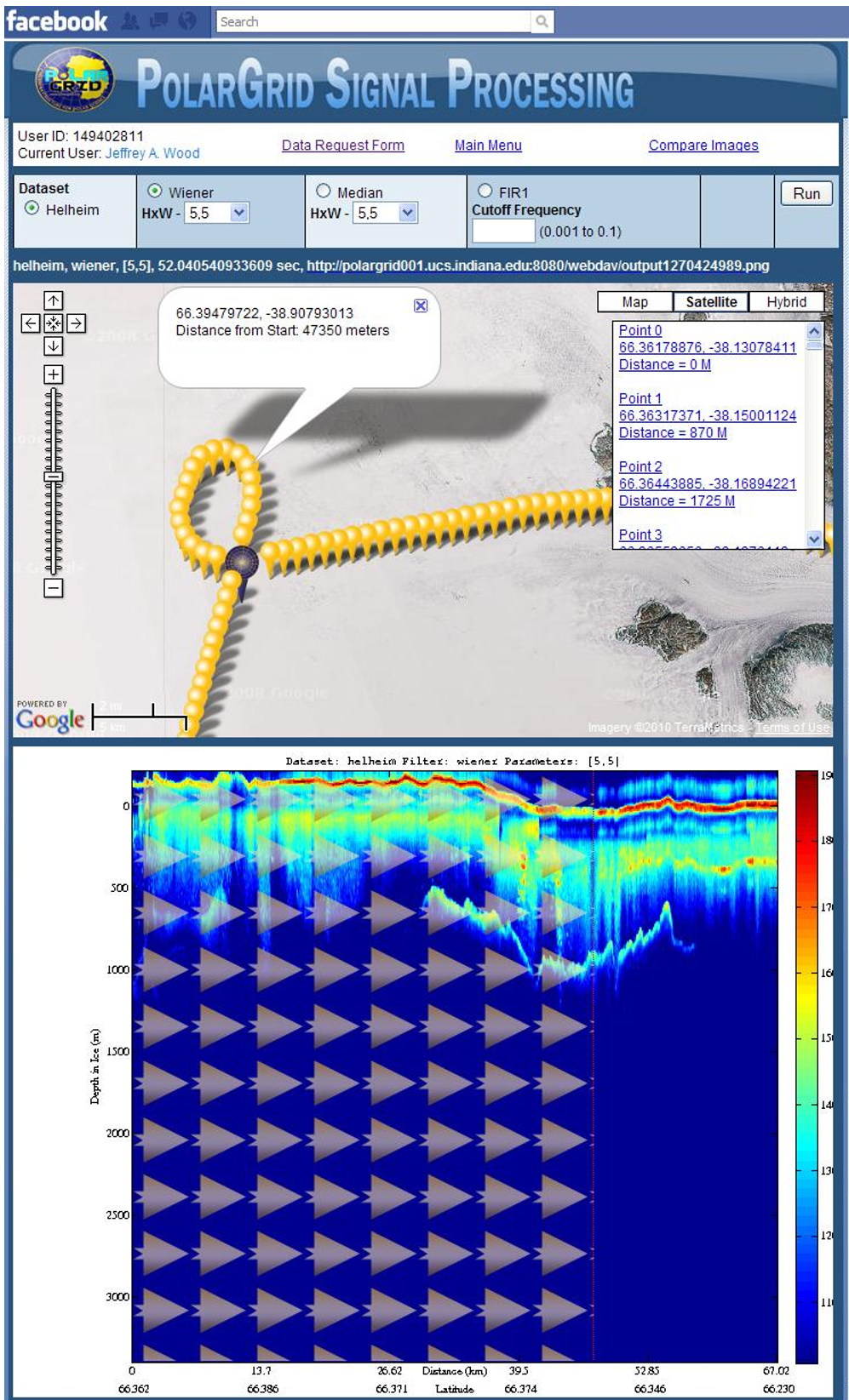 Figure 1: The Facebook Implementation showing the integration of social identity with scientific visualization tools.
Key Results and Interactive Features
The project delivered several high-value tools for researchers:
- Image Comparison Tool: A unique JavaScript-based overlay system where users can hover their cursor to fade between two different filtered images, allowing for immediate visual analysis of noise reduction techniques.
- Map-to-Image Correlation: By clicking a point on the Google Map (the flight path), the system translates the GPS coordinate to a horizontal pixel position on the radar image, providing a "3D reference" for the user.
- Performance Tracking: The team discovered that image processing via SOAP could take anywhere from 30 to 160 seconds. This led to the conclusion that "in-progress" indicators are vital for user experience in science gateways.
Critical Insights: A Path for Smaller Institutions
One of the paper's most significant contributions is the proof of concept for Small-Scale Cyberinfrastructure.
- Lowering the Learning Curve: The developer was new to PHP and APIs but was able to construct a functional gateway by drawing on the advanced skills of a larger partnering institution (IU).
- Sustainability: Using Web 2.0 technologies (Web Services, JavaScript) extends the life of applications compared to local, proprietary systems that fail when funding or personnel change.
Conclusion and Future Outlook
While this specific implementation used 2010-era Facebook iFrames, the underlying principle remains highly relevant: democratizing science through accessible UI.
The project demonstrates that gateways don't need to be massive, centralized architectures to be effective. Lightweight, modular, and socially-integrated tools can provide the necessary visualization and processing power to inspire the next generation of polar researchers.
Takeaway for Today
The shift toward "science gadgets" and integrating research into the digital life of the user is a precursor to modern notebook-based research (like Jupyter) and cloud-native collaborative platforms. For small institutions, the key to success is leveraging the "Grand Convergence" of shared digital resources.