
Beyond Graphs: Semantic Social Network Analysis for Targeted Marketing
Social networks analysis based on topic modeling
The paper presents a content-based social network analysis system centered on the Author-Recipient-Topic (ART) model and automated topic labeling. Applied to the Enron email corpus, the system extracts 50 latent topics and maps them to specific user communities to facilitate targeted product marketing.
TL;DR
Social Network Analysis (SNA) often misses the "what" in favor of the "who." This paper bridge that gap by implementing a content-based analysis pipeline using the Author-Recipient-Topic (ART) model. By applying this to the famous Enron corpus, the authors not only uncover latent discussion themes but also introduce an automated labeling system that turns abstract probability distributions into meaningful labels like "Market Research" or "Contract Reviews."
The Problem: The "Black Box" of Message Content
Most SNA frameworks treat the relationships between actors as simple edges in a graph. While this reveals centrality and closeness, it ignores the semantic nuances of the interactions. Why are these people talking?
Previous attempts using Latent Dirichlet Allocation (LDA) failed to account for the directed nature of communication—specifically, that the topic of a message is often dependent on both the sender and the receiver. While the ART model solved the "who-to-whom" topic distribution problem, it left researchers with a "labeling headache": identifying what a topic actually represents without manual expert intervention.
Methodology: The ART of Automated Discovery
The researchers built a three-stage system to move from raw text to labeled intent:
1. The ART Model Architecture
Unlike standard LDA, the ART model functions as a Bayesian network that conditions the topic distribution on the author-recipient pair. To generate a word, the model chooses a recipient, then a topic based on that specific relationship, and finally a word from that topic's distribution.
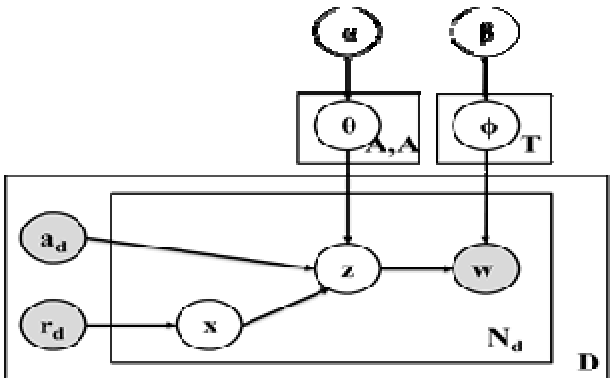 Fig 1. The Bayesian structure of the Author-Recipient-Topic model.
2. Automatic Topic Labeling
This is where the paper adds significant practical value. Instead of human experts, the system uses a similarity-based approach. It compares the word distributions of "discovered" topics against a "training" set of pre-labeled topics using several metrics:
- Cosine Similarity: Measures the angle between word vectors.
- Tanimoto & Jaccard Coefficients: Effective for set-based overlap of keywords.
- Dice Similarity: Evaluates the association strength between detected terms.
Experimental Insights: The Enron Case Study
The system was tested on the Enron email corpus (11,945 emails). By setting the model to find 50 topics, the system was able to map the complex corporate communication of Enron.
Performance Evidence
The system successfully differentiated between formal business processes and informal social coordination. For instance, "Topic 1" was tagged as "Dinner" with high statistical confidence across all similarity metrics, while "Topic 2" was accurately mapped to "Review Documents."
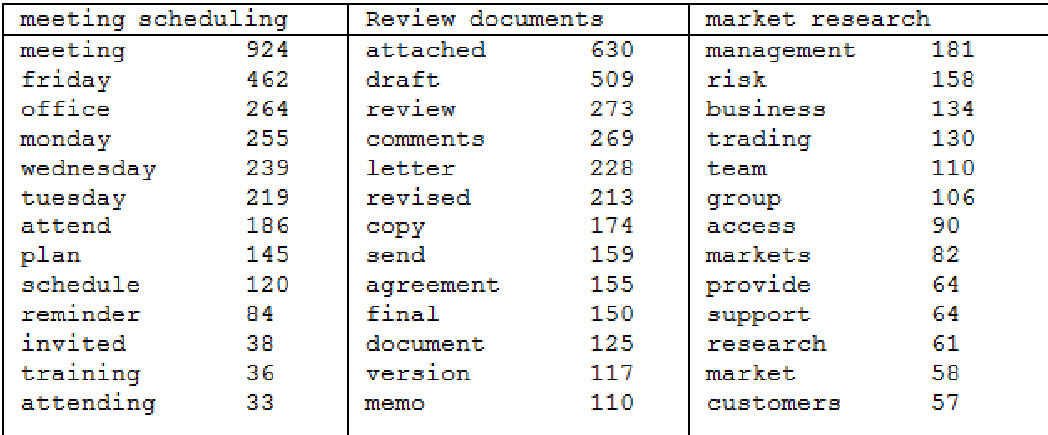 Table: Example of extracted keywords for Meeting Scheduling and Document Review.
The model provides three critical outputs:
- Vocabulary-Topic Matrix: What words define each theme.
- Author-Topic Matrix: Which users are the primary sources of specific topics.
- Recipient-Topic Matrix: Who is consuming or reacting to specific information.
Critical Analysis & Future Outlook
Strengths: The integration of the ART model with an automated labeling pipeline is a major step toward usable SNA tools in marketing and security. It moves the field from "statistical description" to "semantic understanding."
Limitations: The labeling accuracy depends heavily on the quality and breadth of the pre-labeled training dataset. If the training data doesn't cover the specific domain of the social network (e.g., using a general news dataset to label a specialized medical forum), the labeling may fail.
Future Work: The authors propose the RART (Role-Author-Recipient-Topic) model. This would add a "Role" variable, allowing the system to understand not just what is being said, but the hierarchical influence of the speaker—for instance, distinguishing between a CEO’s directive and a junior employee’s suggestion on the same topic.
Conclusion
This research provides a robust blueprint for organizations looking to mine social data for trends. By understanding the intersection of "who is talking to whom" and "what they are talking about," marketers can identify niche communities with surgical precision.