
Leveraging Social Graphs for Trust: Secure Certification in Vehicular DTNs
Social networks for certification in Vehicular Disruption Tolerant Networks
The paper proposes a decentralized certification mechanism for Vehicular Disruption Tolerant Networks (vDTNs) by modeling the network as a social graph. It leverages "friendship" and direct contacts to establish trust through self-signed certificates and a PGP-like reputation system, achieving over 85% reliable message delivery in sparse scenarios.
TL;DR
Vehicular Disruption Tolerant Networks (vDTNs) often operate in "offline" environments where central authority is unreachable. This paper introduces a Decentralized Certification Mechanism that transforms car drivers into a social network. By using direct physical encounters to sign certificates and a "friends-of-friends" validation logic, the system ensures that 85% of received messages are authenticated without ever needing a central server.
Problem & Motivation: The Connectivity Gap
In a typical Vehicular Ad Hoc Network (VANET), cars need to trust the traffic data they receive. Is that "accident ahead" alert real, or is it a gas station owner trying to divert traffic toward their business?
Traditional security relies on a Certificate Authority (CA). However, in vDTNs:
- Intermittent Links: Cars move too fast or lack 4G/5G coverage to ping a central server.
- High Latency: Waiting for a CA validation in a "store-carry-forward" environment could make the security check take longer than the message's utility.
- Identity Vulnerability: Without a way to verify public keys offline, the system is ripe for Sybil attacks and misinformation.
The authors' insight is simple: We trust people we know. By translating human social structures into cryptographic chains, vehicles can verify each other based on mutual acquaintances.
Methodology: The Social-Cryptographic Graph
1. Direct Social Pairing
The system starts with a Self-Signed Certificate. When two drivers who know each other meet (e.g., in a parking lot or at a stoplight), they pair their devices via Bluetooth. They sign each other's certificates, essentially saying, "I vouch for this user's identity."
2. Transitive Validation (Friends of Friends)
Validation isn't limited to direct friends. The network is modeled as a graph . If Node A trusts Node B, and Node B trusts Node C, Node A can validate Node C’s signature using Node B’s public key as a bridge.
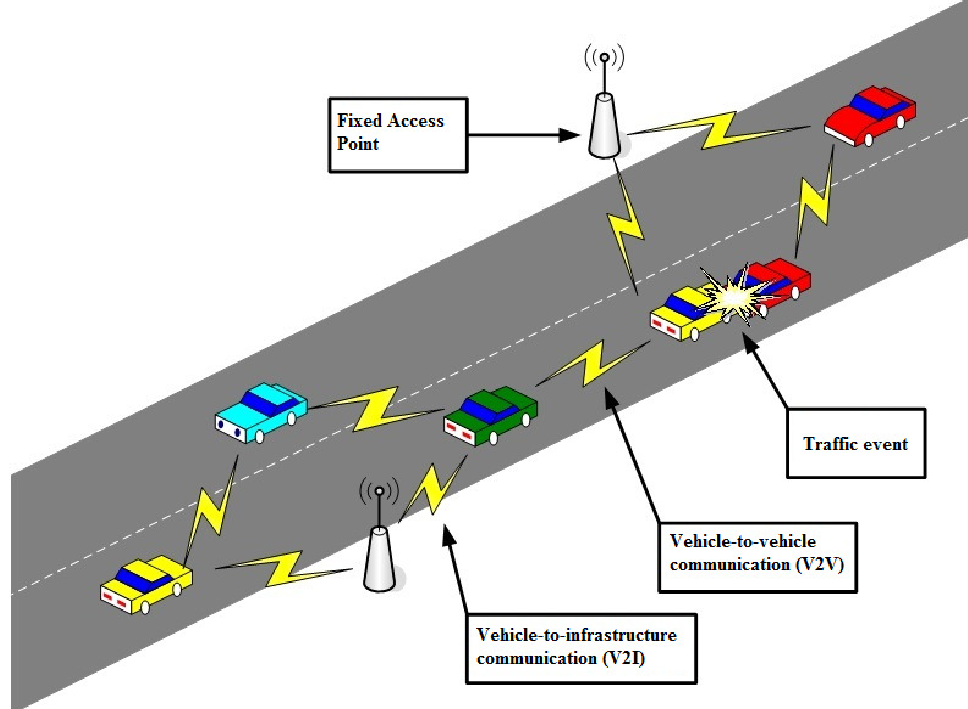 Figure 1: Hybrid V2V and V2I communication where social trust bridges the infrastructure gaps.
3. Certified Reputation Bonus
To discourage "free-riding" or bad behavior, the paper introduces Certified Reputation. When a vehicle provides useful traffic data, the recipient issues a "bonus" signature on the sender's certificate. If a vehicle has more positive bonuses than negative signs from your social circle, it is deemed reliable.
Experiments & Evaluation
The researchers utilized The ONE (Opportunistic Networking Evaluator) to simulate an urban environment (4.5km x 3.4km) with 150 to 600 nodes.
Key Results:
- Reliability Breakthrough: Even in sparse networks (150 nodes), the social mechanism identified over 85% of messages as reliable when nodes had a 20% friendship density.
- The Power of Transitivity: Adding "friends-of-friends" to the validation set increased the reliable message count by 20% to 30% compared to a direct-friend-only model.
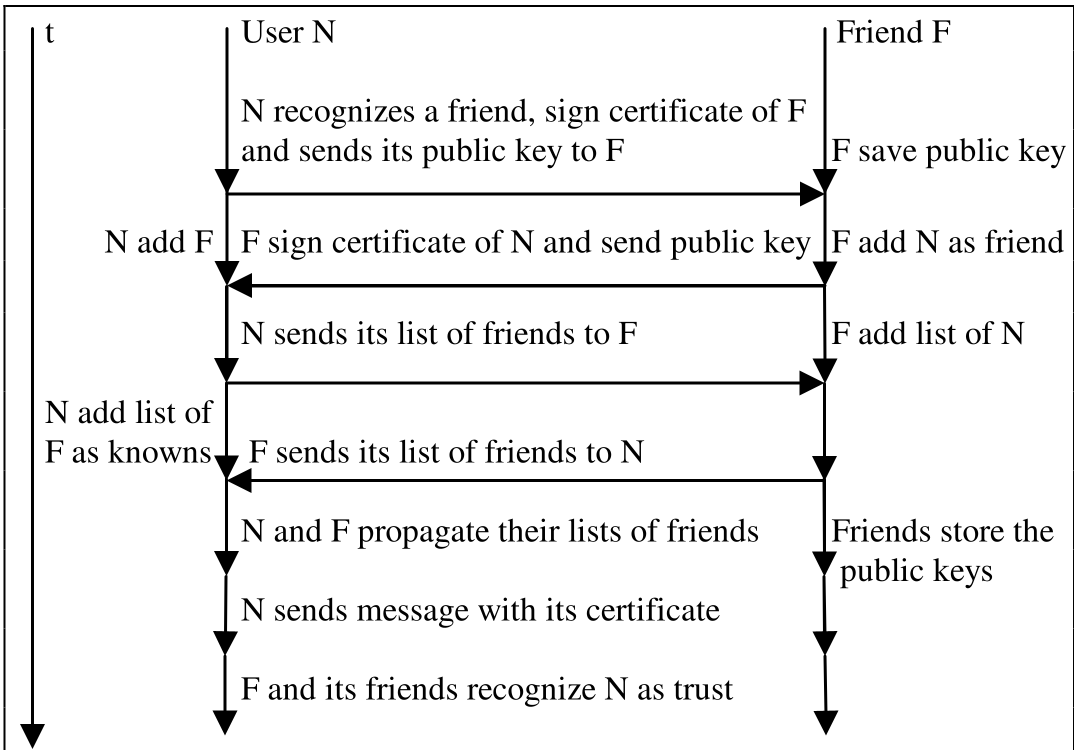 Figure 2: The sequence of reputation bonus issuance, preventing collusion by requiring social intersections.
Critical Analysis & Conclusion
Takeaway
This work successfully adapts the "Web of Trust" (PGP concept) to the high-mobility world of vDTNs. It moves away from the "all-or-nothing" security of centralized PKI toward a probabilistic, social-based trust model that is far more resilient to the "disruptions" inherent in vehicular travel.
Limitations & Future Work
- Bootstrap Problem: How does a new driver gain initial trust if they don't have existing "friends" in the network?
- Storage Overhead: While the paper suggests hashes can keep the footprint small, storing the public keys of "friends of friends" (potentially 10,000+ keys) might still challenge some low-end embedded vehicular units.
- Future Path: Integrating these local social certificates with global platforms like Facebook or LinkedIn could bridge the "initial trust" gap.
By grounding digital security in real-world human interactions, this methodology provides a robust blueprint for secure communication in the next generation of autonomous and connected vehicles.