
Screens, Scenes, and Social Links: How Cultural Tastes Shape the Networks of Young Users
Social networks and cultural practices: A case study of young avid screen users in France
This sociological study explores how young French "screen users" (aged 19-24) integrate information and communication technologies (ICT) into their cultural and relational lives. It identifies three distinct configurations—Specialization, Distribution, and Polarization—to explain how cultural practices like music, gaming, and social media shape social network structures.
TL;DR
Based on a qualitative study of French students, this research moves beyond seeing cultural consumption as a solo activity. Instead, it reveals that our use of screens—from diving into "hacking" forums to organizing "free parties"—is a tool for building specific types of social capital. The authors identify three ways we organize our lives: as Specialists in niches, Distributors of mainstream culture, or members of a dedicated Polarized clan.
Background: Beyond the Isolated Consumer
In the early 2000s, the "digital culture" was beginning to explode. While many viewed young people sitting in front of screens as isolated "couch potatoes," sociologists Cardon and Granjon saw something different: a complex reorganization of human relationships. The central insight of this paper is that tastes and technologies are social glue. Whether you are sharing an MP3 or a "private" website of party photos, you are not just consuming content; you are defining who belongs in your circle and who doesn't.
The Problem: The "Relational" Blind Spot
Most statistical studies on culture ask: "What do you watch?" or "What do you listen to?" The authors argue this is the wrong question. It ignores the Why and the With Whom. They argue that cultural practices have an "inductive bias" towards certain social structures. For example:
- Specialized tastes (like niche Manga or Hacking) often require "virtual" friends because local peers don't share the expertise.
- Mainstream tastes (like TV or Pop music) serve as "relational oil," allowing a person to converse with anyone from their mother to their classmates.
Methodology: The "Egocentric" Network Map
To capture this, the researchers used a rich, ethnographic toolkit. They didn't just give out surveys; they had 10 young subjects keep notebooks of every interaction and cultural act. They then mapped these into "relational matrices," visualizing how different groups of people (cliques) were connected—or intentionally kept apart.
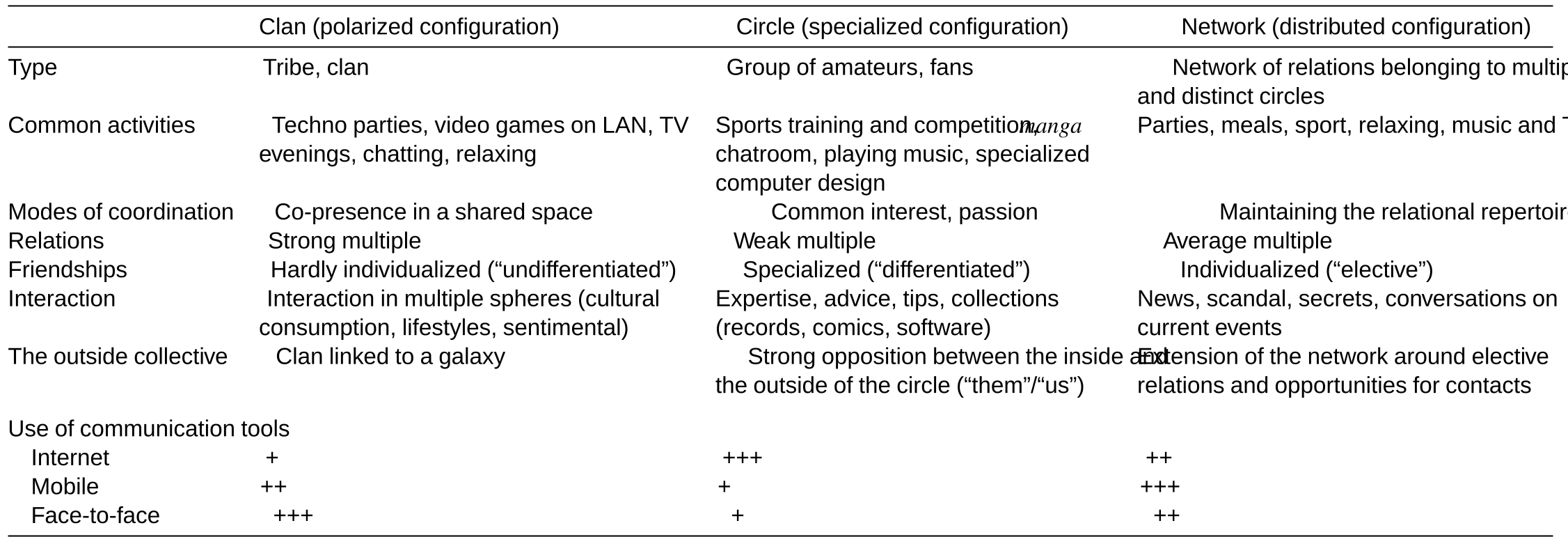 Table 1: Comparison of the three identified configurations: Clan (Polarized), Circle (Specialized), and Network (Distributed).
The Three Archetypes of Screen Culture
1. Nathan’s Specialized Niches (The Circle)
Nathan represents the "Specialist." He keeps his life in silos. He has his "Musician" friends, his "University" friends, and his "Virtual" friends in hacking and manga forums.
- The Insight: Cultural expertise allows for "differentiated friendships." You don't need to know everything about a forum member; you only need to share a passion for a specific genre.
- Technology: High reliance on the Internet and forums to find specialized peers.
2. Nina’s Social Web (The Distribution)
Nina represents "Distribution." She is socially fluid, moving between her family, her brothers' friends, and her university peers. She uses culture (like TV shows or photos of parties) to bridge these gaps.
- The Insight: Here, culture is a "repertoire." By sharing common tastes across all circles, she increases the density of her network.
- Technology: High reliance on the Mobile Phone and SMS to coordinate and "re-live" shared moments with friends and family.
3. Goulven’s Techno Tribe (The Polarization)
Goulven belongs to a "Clan." Everything he does—watching TV, playing video games, or attending "Free Parties"—is done with the same core group of people.
- The Insight: This is "gregarious doing." Tastes aren't individual; they belong to the tribe. If the tribe moves from Reggae to Techno, Goulven moves with them.
- Technology: High reliance on Face-to-Face interaction and shared physical spaces, using ICT merely to coordinate the next massive gathering.
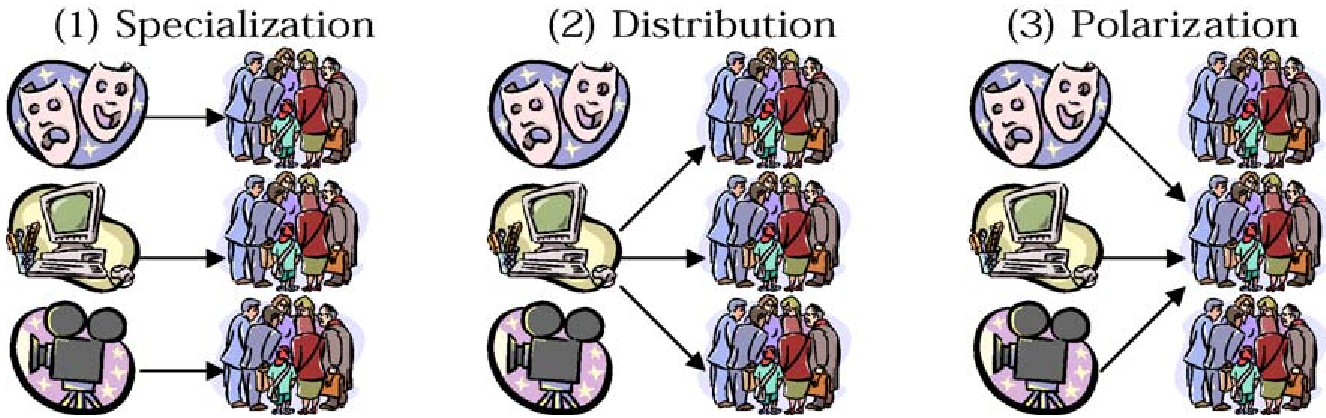 Example: A mapping of Nathan's social network, showing the separation of his specialized spheres.
Critical Analysis & Conclusion
Takeaway: This paper teaches us that our tech use reflects our "relational ethics." Some of us seek to broaden our horizons (Nina), while others seek to hide in "relational niches" (Nathan).
Limitations:
- The study is based on a very small sample (10 students).
- Written in 2004, it predates the era of algorithmic social media (TikTok/Instagram), which now "pushes" culture onto us, perhaps forcing more "Specialization" through algorithmic filter bubbles.
Future Outlook: As we move into an era of AI-curated culture, the "Polarization" (Clans) may shift toward "Virtual Tribes." Understanding whether we are using our screens to separate our lives or unite them remains the fundamental question of digital sociology.