
Beyond the Star Rating: Leveraging Social Networks for Objective Product Quality
Social Networks as Data Source for Recommendation Systems
The paper introduces a social-network-based recommendation system that bypasses unreliable product reviews by mining user-generated content from forums and blogs. It utilizes a taxonomy-driven approach to extract product features and sentiments, achieving significant correlation with the established J.D. Power Initial Quality Study (IQS).
TL;DR
Online reviews are often biased, manipulated, or extreme. This paper proposes a paradigm shift: instead of looking at "reviews," we should mine unstructured social network conversations (forums and blogs). By calculating dynamic Satisfaction and Relevance indices, the researchers built a system for the automotive domain that correlates significantly with professional J.D. Power quality rankings, offering a more honest view of product performance over time.
The "Helpfulness" Trap: Why Reviews are Broken
We’ve all seen it: a product has 4.5 stars, but the top review is a disgruntled 1-star rant, or a suspiciously glowing testimonial. Research cited in this paper confirms that online reviews are bimodal—people only post when they are ecstatic or furious. Worse, financial incentives lead to "baits" or manipulated comments.
The authors argue that true quality data lives in Internet forums. In a forum, users seek help or discuss technical details without the pressure of "rating" a product for a shop. This "unrequested feedback" is the key to objective recommendation.
Methodology: Turning Noise into Insights
The core challenge is that forum posts are messy. Unlike Amazon reviews, they don't have star ratings or "pros and cons" lists. The authors developed an NLP pipeline to impose structure:
- Pre-processing: Using N-gram classification and TreeTagger for multi-lingual POS tagging, followed by aggressive cleaning of "internet speak" and nicknames.
- Taxonomy-Based Topic Detection: Instead of fragile statistical co-occurrences, they use a massive automotive taxonomy (2,081 concepts) to map mentions of things like "clutch" or "infotainment" with high precision.
- Sentiment Mapping: Using context-aware sentiment lexicons to assign values between [-1, 1] to specific features.
Strategic Architecture
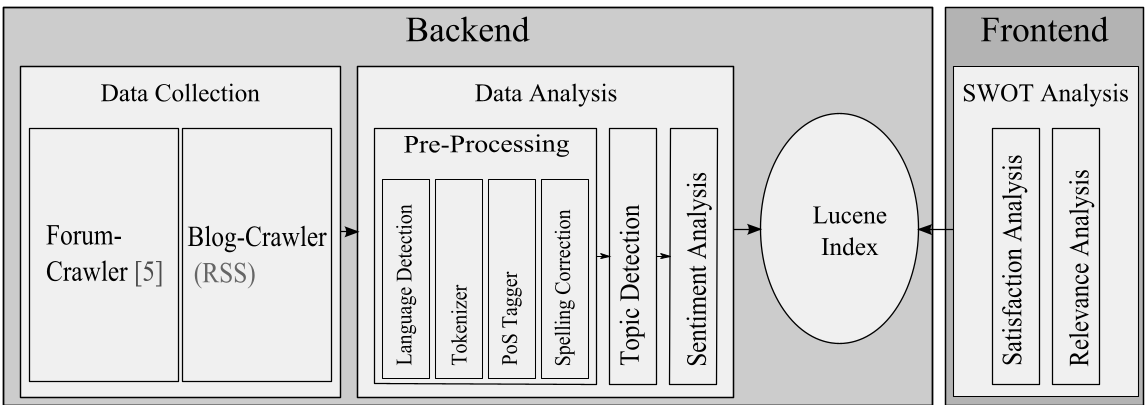
The system doesn't just count mentions; it calculates:
- Satisfaction Index (): Adjusted by the "global" baseline of how people usually talk about a feature, ensuring that a naturally "complained-about" part doesn't unfairly tank a car's score.
- Relevance Index (): A measure of how likely a user is to discuss a specific feature for a specific model, highlighting what actually matters to owners.
Experimental Results: The J.D. Power Benchmark
To prove this actually works, the team analyzed 13 million comments and compared their scores to the J.D. Power Initial Quality Study (IQS)—the gold standard in the car industry.
Performance Validation
The system achieved a 0.46 correlation with IQS. While not a 1:1 match (due to the presence of "soft facts" in social data like service quality), t-tests showed no systematic error.
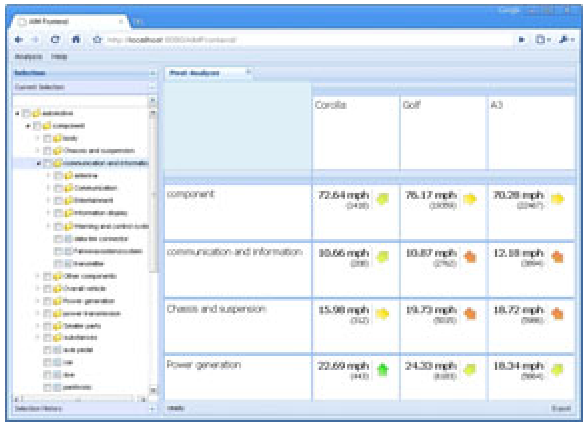
As seen in the data coverage chart, abstract features (like general components) have massive data points, while hyper-specific sales designations are harder to track. This highlights the precision vs. recall trade-off: the system favors precision to maintain user trust.
Deep Insight: Why This Matters for the Future
The brilliance of this work lies in its temporal awareness. Traditional reviews are static; they don't account for a car's quality degrading over five years or a hotel's service improving after a renovation. By slicing social data into time slots, this recommendation system can show a product’s quality trajectory.
Limitations & Outlook
- The Irony Gap: The system still struggles with sarcasm and irony, a common trait in forum discussions.
- Taxonomy Maintenance: Relying on fixed taxonomies requires constant human effort to update new tech terms (e.g., "EV Charging Curve").
Final Takeaway: As "Review Bombing" and AI-generated fake reviews become more common, the future of recommendation systems lies in the "peanut gallery" of organic social discourse, where users talk to each other rather than to a store.