
From Likes to Tables: Deciphering the Social Media Drivers of Restaurant Choice
Social Networks’ Factors Driving Consumer Restaurant Choice: An Exploratory Analysis
This study investigates the specific social media elements that influence restaurant selection among consumers in Tijuana, Mexico. Using Exploratory Factor Analysis (EFA), the researchers identified four distinctive pillars: organization-generated digital content, social network popularity, peer eWOM, and real-time customer participation.
TL;DR
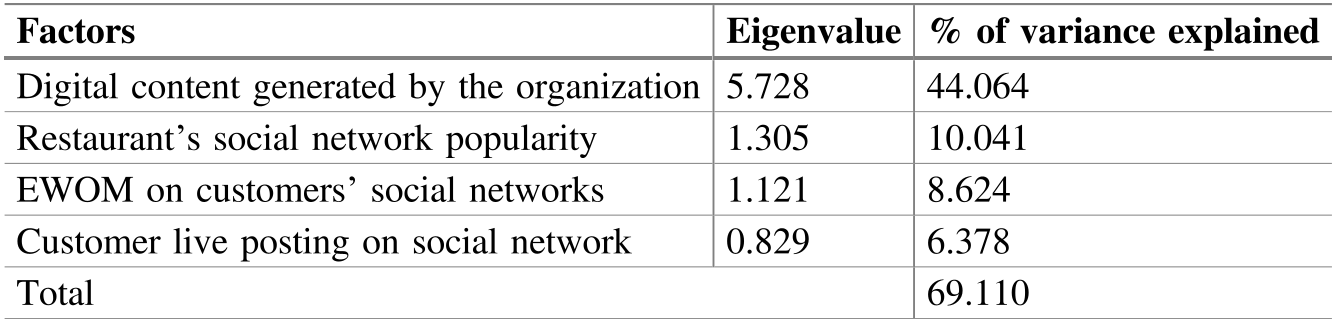
Social media is no longer just an "extra" marketing channel for restaurants; it is the primary lens through which consumers vet their dining options. This research identifies four key dimensions—Official Content, Social Popularity, Peer eWOM, and Live Interactions—that dictate restaurant choice. While official photos of food and menus still hold the most weight (44% of variance), the emergence of "Live Posting" is redefining real-time social proof.
Background: The eWOM Revolution
The shift from traditional Word of Mouth (WOM) to Electronic Word of Mouth (eWOM) has fundamentally changed the power dynamic in the food industry. Consumers now trust "anonymous peers" on discussion forums and "expert friends" on Facebook more than traditional advertising. However, restaurant managers often struggle with what to post or how to measure the effectiveness of their digital presence.
The Problem: The Granularity Gap
Most hospitality research acknowledges that social media is important, but few studies dissect the anatomy of that influence. Is it the number of "Likes" that matters? Or is it the high-resolution photo of the pasta? This study closes that gap by analyzing thirteen specific social media items to see how they cluster into decision-making drivers.
Methodology: The Factor Analysis Approach
The researchers conducted an online survey of 385 customers in the culinary hub of Tijuana, Mexico. To ensure rigorous findings, they used:
- Cronbach’s Alpha (0.892): Confirming the reliability of the survey.
- KMO and Bartlett’s Test: Ensuring the data was suitable for structure detection.
- Exploratory Factor Analysis (EFA): To group individual actions (like "check-ins" or "viewing a menu") into broader strategic pillars.

Core Findings: The Four Pillars of Dining Decisions
1. Digital Content Generated by the Organization (44.06% Variance)
This remains the heavyweight of social media marketing. Consumers look for:
- Visual Evidence: High-quality photographs of facilities and food.
- Information Utility: Clear pricing, menu variety, and active promotions. Insight: The restaurant’s own profile serves as the "Primary Truth" for factual info (prices/menu).
2. Social Network Popularity (10.04% Variance)
This acts as a "Social Heuristic" or mental shortcut. It includes:
- Overall ratings (e.g., Facebook star ratings).
- Total follower count and the volume of "Likes" on posts.
3. eWOM on Customer's Social Networks (8.62% Variance)
Peer experiences provide the "Social Proof" that high-quality official photos might lack:
- Comments and reviews shared by customers on their own profiles.
- Tagged photos of food shared by diners.
4. Customer Live Posting (6.38% Variance)
This is the "New Frontier." It involves:
- Check-ins: Signaling that people are physically present now.
- Stories & Live Broadcasts: Providing an unfiltered, authentic look at the atmosphere.
Deep Insight: Why "Live" Matters
The study highlights a critical psychological shift. The "nearness" of a post to the time of consumption significantly boosts its influence. A "Live Story" suggested by the algorithm feels more authentic and less "staged" than a professional photo. It reduces the perceived risk for the consumer by showing the current reality of the venue.
Critical Analysis & Conclusion
While official content (Factor 1) creates the initial interest, the peer-driven factors (Factors 3 and 4) provide the "validation" required to finalize a choice.
Limitations: The study focuses on Tijuana, a specific geographic context. Future research should examine if these factors hold the same weight in different cultures or for different restaurant tiers (e.g., Fast Food vs. Michelin Star).
Future Outlook: For restaurant owners, the takeaway is clear: Invest in the aesthetic (professional photos) but facilitate the authentic (encourage live check-ins and stories). As technology speeds up, the gap between a consumer seeing a post and making a reservation is closing, making real-time social proof the next great competitive advantage.