
Decoding the Digital Fabric: A Systematic Taxonomy of Social Networks on the Internet
Social Networks on the Internet
This paper provides a comprehensive survey and taxonomy of social networks on the Internet (OSNs). It defines a formal framework transitioning from Homogeneous Social Networks (HSN) to complex Internet Multisystem Social Networks (ISN), establishing a standardized vocabulary for digital identities and relationships.
TL;DR
Social networks are no longer just "sites" like Facebook; they are the sum of all digital interactions across the web. This seminal survey by Musiał and Kazienko deconstructs the Internet into a hierarchy of social layers—from simple Homogeneous Social Networks (HSN) to complex Internet Multisystem Social Networks (ISN). By defining the "Virtual Identity" and "Multi-layered Ties," the authors provide a roadmap for analyzing how we connect via emails, tags, auctions, and even hidden hyperlinks.
Background: Beyond the "Six Degrees"
The study of social networks began with Stanley Milgram’s "Small World" experiment, famously resulting in the "six degrees of separation." However, the Internet has collapsed this distance. As early as the 2010s, researchers suggested that the online world operates on fewer than three degrees of separation. The challenge is that these connections are often hidden behind different platforms and disparate "internet identities."
The Core Innovation: A Hierarchical Architecture
The authors argue that the current fragmented view of online communities fails to capture the true complexity of human interaction. They propose a three-tier model to unify our understanding:
- Homogeneous Social Network (HSN): The simplest form, existing within one system with one type of relation (e.g., a network of email senders).
- System-based Social Network (SSN): A multi-layered network within a single system. For instance, on Flickr, you have ties based on "contacts," "tags," and "comments" simultaneously.
- Internet Multisystem Social Network (ISN): The most complex tier, where virtual identities are merged across different systems (e.g., using a Google account to log into Blogger and YouTube).
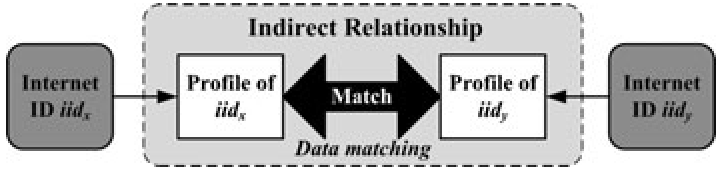 Figure: The concept of a "Tie" as an aggregation of multiple relationship layers (e.g., SMS, VoIP, and Email) between two identities.
Methodology: Redefining Identity and Relations
A key insight of this paper is the distinction between a Physical Social Entity (the person) and their Internet Identity (the digital representation).
1. The Virtual Identity
Since one person can have multiple identities (a professional email, a gaming nick, a social profile), the authors propose the Virtual Identity as an aggregator. This allows researchers to analyze the "whole" human behavior across the web rather than just their activity on a single site.
2. The Directness of Relationships
How do you define a "connection" online? The paper breaks it down by "grounds":
- Direct: Targeted communication (e.g., sending an IM).
- Quasi-direct: Meeting via an object. If two people comment on the same photo or use the same tag, they are in a quasi-direct relationship.
- Indirect: Invisible connections based on profile similarity (e.g., two people with the same interests who haven't met yet).
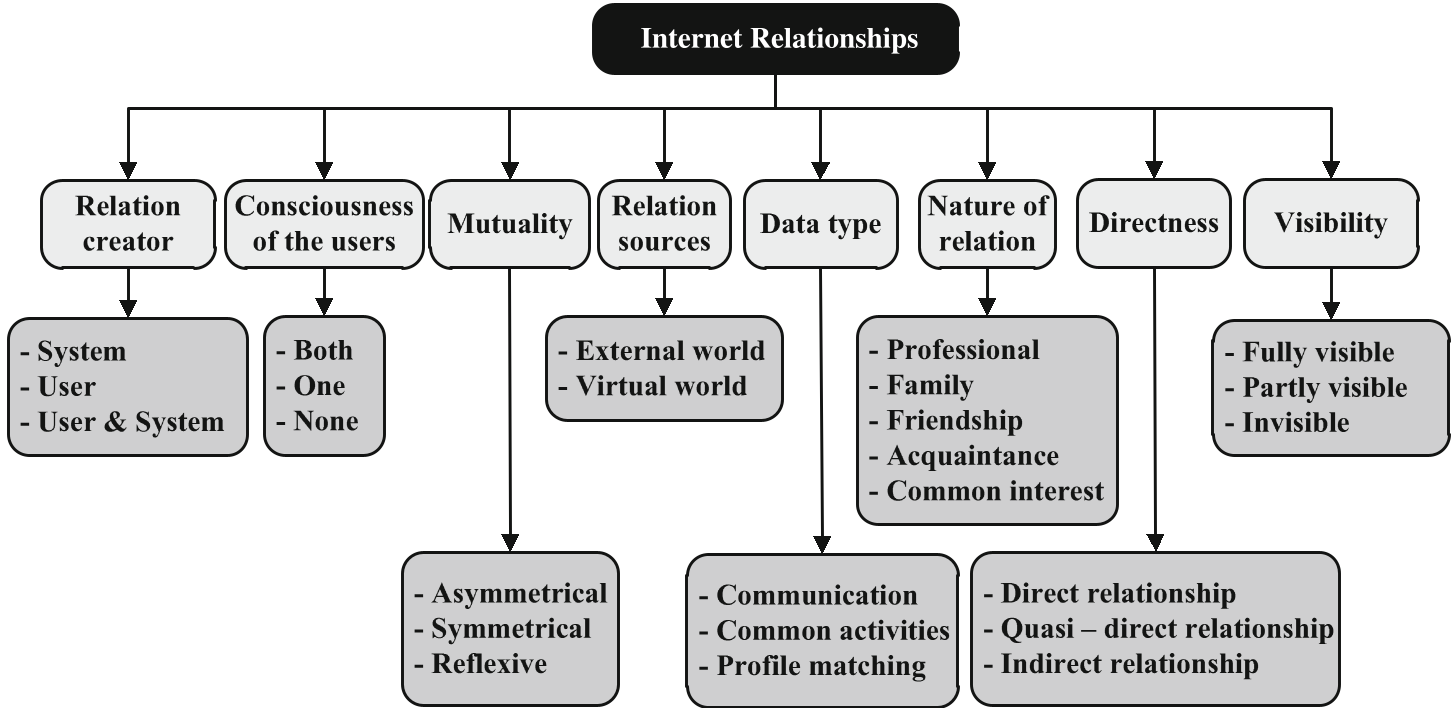 Figure: Taxonomy of Internet relationships, categorized by subject activity, awareness, and mutuality.
Experimental Analysis: Comparing Digital Ecosystems
The survey provides an exhaustive comparison of 14 categories including Email, Instant Messengers, Auction Systems, and Wikis.
Key Findings:
- Social Networking Sites (SNS) like Facebook or LinkedIn are unique because they make relationships "visible and browsable." In contrast, email networks are "hidden" and require server-side log analysis to uncover.
- Multimedia Sharing Systems (like Flickr) are actually "System-based Social Networks" with up to nine distinct layers of interaction (Tags, Faves, Authorship).
- Trust Management: Systems like eBay or Knowledge Markets rely on social network analysis to manage risk and verify users, proving that SNA has utility far beyond "socializing."
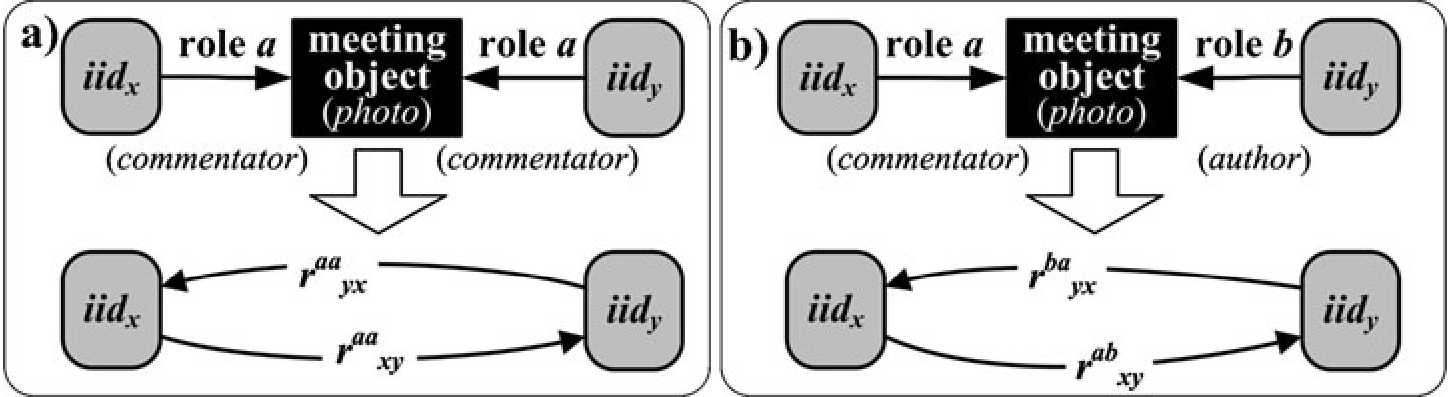 Figure: The multi-layered structure of a system like Flickr, showing how different activities create parallel social graphs.
Critical Insight & Conclusion
While this paper was written during the "Web 2.0" era, its logic remains strikingly relevant for the "Web3" and "Fediverse" age. The shift from siloed accounts to Interoperable Virtual Identities (like OpenID) is the trend predicted here.
Takeaway: The "social network" is not a destination; it is an infrastructure. For future research, the most valuable data won't come from a single platform's API, but from the integration of multi-system interactions into a coherent "Internet Multisystem Social Network."
Limitations
The primary challenge remains Privacy and Data Availability. While the model for merging identities (ISN) is theoretically sound, the "centralized silo" nature of modern tech giants makes cross-platform data gathering difficult for independent researchers without user-consented identity systems.