
Social Networks vs. Meritocracy: Why "Who You Know" Matters Less in Singapore
Social networks and labour market outcomes in a meritocracy
This sociological study investigates the efficacy of personal contacts in the Singaporean labor market, a world-leading meritocracy. Using data from the 2005 Project Network Survey, the author demonstrates that formal academic credentials act as the primary signaling mechanism for job matching, rendering social networking redundant in highly bureaucratized sectors.
TL;DR
In the world of job hunting, the mantra is often "it’s not what you know, but who you know." However, a seminal study by Vincent Chua challenges this universal assumption. Analyzing Singapore’s rigorous meritocracy, Chua finds that social networks are often a "substitute for the weak" rather than a "ladder for the elite." In sectors where academic credentials are the ultimate signal, personal contacts provide little to no advantage, and may even be associated with lower earnings.
The Institutional Paradox
Why does a strategy that works brilliantly in the Silicon Valley ecosystem fail in the Singaporean civil service? The answer lies in Institutional Context.
Most networking research is based on Liberal Market Economies (LMEs) like the United States, where the link between education and specific job roles is "loosely coupled." In these environments, employers use networks to reduce the uncertainty of a degree's value.
Singapore, conversely, represents a Coordinated Market Economy (CME). Here, the state acts as a "Republic of Valedictorians." The education system is a high-stakes sorting machine that provides a "tightly coupled" signal to employers. When the signal (the degree and its grade) is perfect, external noise (the personal recommendation) becomes irrelevant.
Methodology: Testing the Meritocratic Filter
Chua analyzed 656 Singaporean adults, distinguishing between three education levels and three work sectors: the State Sector (highly meritocratic), SMEs, and MNCs. He looked at both Contact Use (did you use a friend?) and Contact Status (was that friend high-status?).
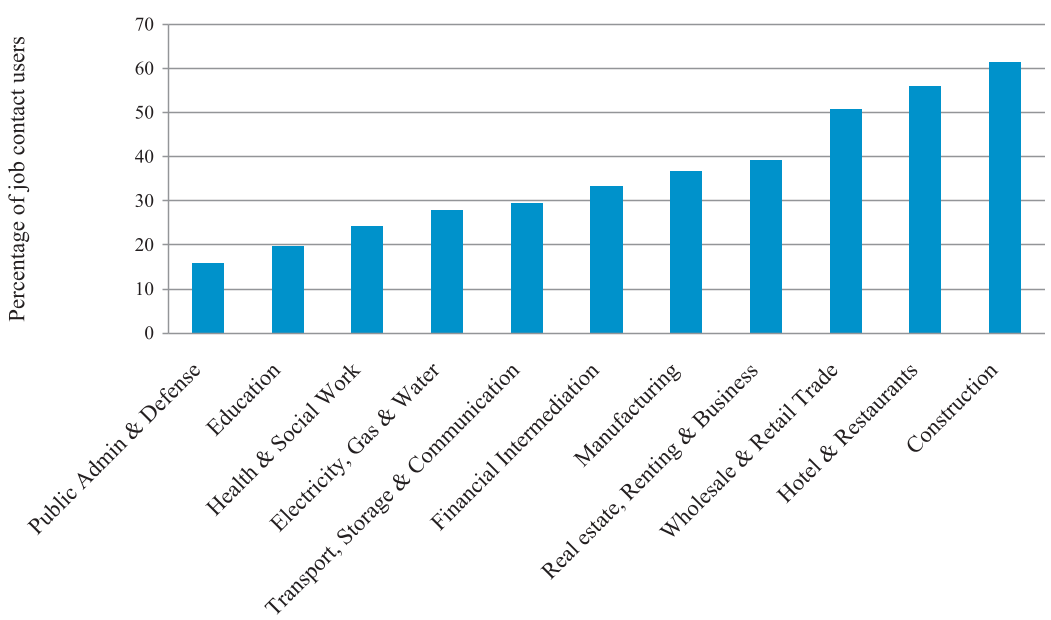 Fig 1: The stark contrast in networking frequency across industries. Sectors like Public Administration show the lowest reliance on contacts.
Key Findings: The Downward Mobility of Networking
The study reveals three provocative insights that flip traditional social capital theory on its head:
- The Substitution Effect: Personal contacts are primarily used by the less-educated. Among University graduates, the likelihood of using a contact is roughly four times lower than among those with primary education. Social capital is a safety net for those lacking human capital.
- The State Sector Barrier: In the public sector, jobs are allocated based on "exam meritocracy." Contacts are 24% less likely to be used for entry here compared to the private sector.
- Negative Returns for the Elite: For highly educated individuals, using a high-status contact actually correlates with lower earnings. In a pure meritocracy, the best candidates don't need "help"; seeking a job through a contact may signal to high-end employers that the candidate couldn't make it through the formal "front door."
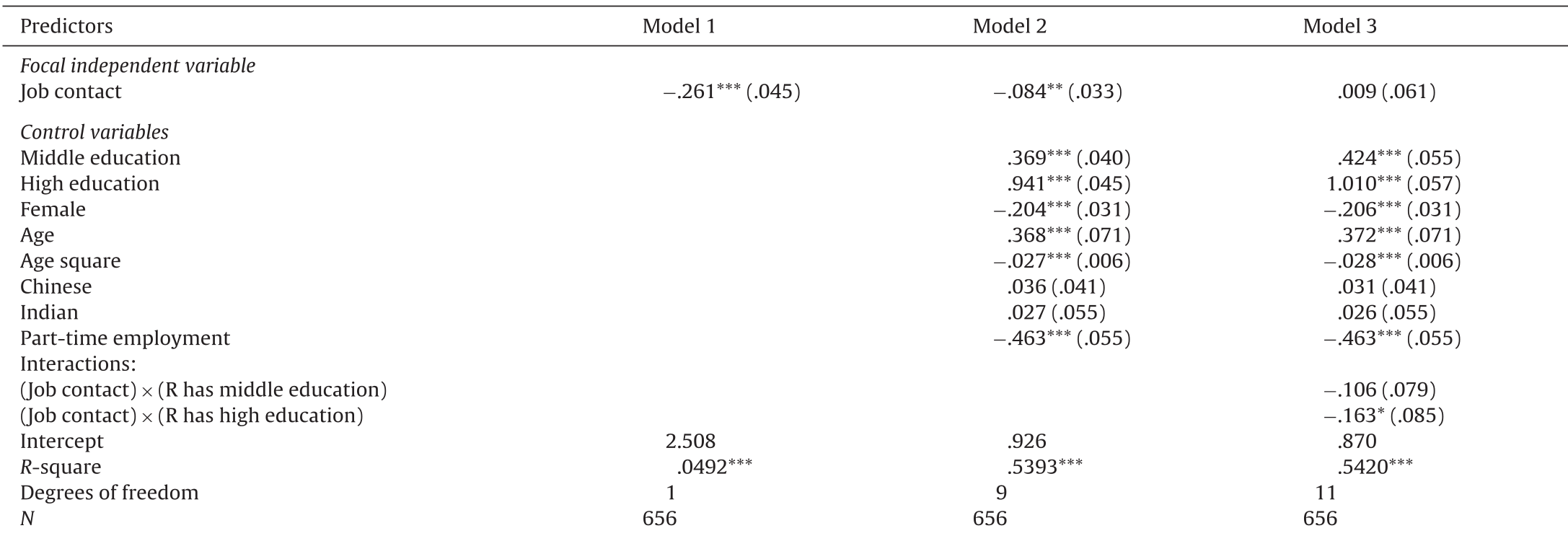 Table 3: Note the negative coefficient for Job Contacts on earnings (-.084*) when controls are applied, highlighting the "penalty" of informal searches in this context.*
Critical Insight: Cultural vs. Institutional Explanations
Many scholars argue that "Guanxi" (connections) is a cultural pillar of Chinese-majority societies like Singapore. Chua’s data shows that while Chinese citizens do use contacts more than other ethnic groups, this is largely explained by their concentration in the Private/SME sector, which is less bureaucratized.
When Chinese individuals enter the State Sector, their behavior mirrors the meritocratic norm. This suggests that Rules of the Game (Institutions) are more powerful than Routine Scripts (Culture) in shaping how we find work.
Conclusion: Lessons for the Future
The Singaporean model proves that systemic inequality caused by "old boy networks" can be mitigated through extreme credentialism. However, this comes with its own cost: the "Diploma Disease." As Singapore moves from an "exam meritocracy" to a "talent meritocracy" (valuing creativity over test scores), the role of social networks may return, as "talent" is harder to quantify than a GPA.
For practitioners and policymakers, the takeaway is clear: If you want to level the playing field, don't just teach people to network—formalize the rules of entry so that networking isn't necessary.