
GSG Algorithm: Harmonizing Speed and Accuracy in Social Network Node Mining
Social Networks Node Mining Algorithm of Based on Greedy Subgraph
This paper introduces the Greedy Subgraph (GSG) algorithm, a hybrid approach for influence maximization in social networks. It combines heuristic topological analysis with a localized greedy strategy to identify key influential nodes, significantly outperforming traditional methods like Degree or Closeness Centrality in accuracy while remaining computationally feasible for medium-to-large datasets.
TL;DR
The Greedy Subgraph (GSG) algorithm bridges the gap between fast but "dumb" heuristic methods and accurate but "slow" greedy algorithms. By leveraging a new metric called Influence Potential and a dynamic candidate selection strategy, it achieves high-precision influence maximization while being significantly faster than traditional Hill Climbing approaches.
Background & Positioning
In the study of social networks, identifying influential nodes is critical for applications ranging from viral marketing to curbing the spread of misinformation. Within the academic landscape, this work is a systematic optimization, refining the classical Linear Threshold (LT) model and greedy selection process to handle the scale of modern digital communication networks.
Problem & Motivation: The Heuristic-Greedy Paradox
Researchers have historically been stuck between two extremes:
- Heuristic Methods: Using Degree, Closeness, or Betweenness Centrality. These are very fast (linear time) but ignore the dynamic process of how information actually flows.
- Greedy Methods: Simulating thousands of cascades to find the best node. This provides a optimality guarantee but is computationally prohibited for large graphs.
The authors' insight is that the local topology (how tightly your friends are connected to each other) dictates influence potential more than just the raw number of connections.
Methodology: The Core Mechanism
1. Influence Potential ()
Instead of just counting neighbors, the authors factor in the Aggregation Coefficient (). If a neighbor's friends are all friends with each other (high ), that neighbor has less "potential" to spread information to new clusters.
The formula is defined as: Where is degree and is the clustering density.
2. The Hybrid Selection Strategy
The algorithm doesn't just look for "super-spreaders." it introduces a mix:
- Influence Potential Nodes: Top nodes based on .
- Zombie Nodes: Nodes with high activation thresholds () that are traditionally hard to influence. By specifically targeting these, the algorithm "breaks" resistant parts of the network.

Experiments & Results
The authors validated GSG against benchmarks like Degree Centrality (DC) and Semi-Local Centrality (SLC) using the SIR Epidemic Model across four real-world datasets, including the Enron email network.
Key Findings:
- Ranking Accuracy: In the Dolphin and Email datasets, the GSG algorithm's TOP-K results had the smallest positional deviation compared to the "ground truth" influence, meaning it consistently picked the most effective seeds.
- Efficiency: Standard Greedy algorithms take hours for large sets; GSG completed the Enron dataset task (36,692 nodes) in under 25 minutes.
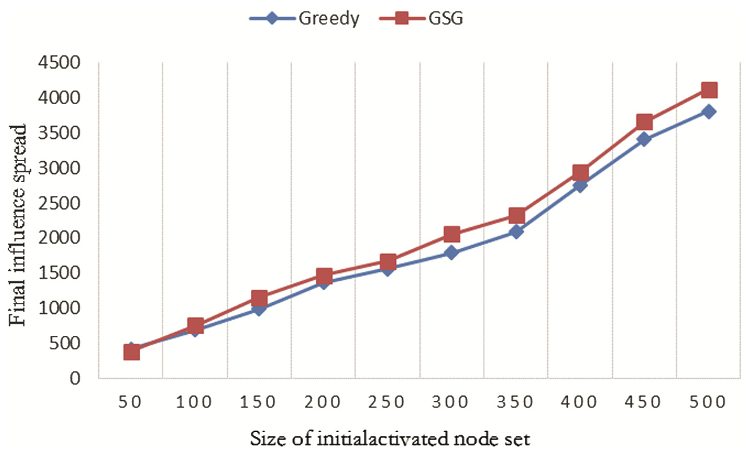 Figure: The diffusion effect shows GSG (labeled GSG) performing on par with the computationally expensive Greedy algorithm on the Wiki-Vote dataset.
Critical Analysis & Conclusion
Takeaway
The GSG algorithm provides a pragmatic path forward for social mining. By shifting the "Greedy" focus from the whole graph to a highly-potential subgraph, it maintains high influence spread without the quadratic cost of simulation.
Limitations
The algorithm relies on the potential factor , which is currently set empirically (finding as optimal). In highly heterogeneous networks (like financial transactions vs. social chats), this parameter might require automated tuning through reinforcement learning or adaptive methods.
Future Outlook
As social networks evolve into multi-layered platforms (sharing text, video, and transactions), extending GSG to multi-layer graphs where Influence Potential is calculated across different edge types would be a logical and valuable next step for the industry.